

Last Updated 01/09/2026
Executive Summary
- Strategic Overview: Comprehensive guidance on how much does sap business one cost in the uae? tailored for Middle East and GCC enterprises.
- Key Advantage: Eliminates departmental silos, standardizes reporting, and accelerates operational agility.
- Next Step: Consult with certified WMS Middle East SAP experts for tailored architecture sizing and cost estimation.
Imagine driving a car at 100 km/h while only looking in your rearview mirror. You can see exactly where you’ve been, every turn you made, and every pothole you hit, but you have no idea what obstacles are coming up on the road ahead. For many Enterprise Business Analysts and CFOs, this is exactly how they run their organizations-relying on dashboards that report history with precision while leaving the future completely blind.
This leads to the “Quarterly Fire Drill,” a scenario we see all too often. Every three months, high-paid analysts stop analyzing strategy and start doing manual data entry-pulling data from SAP, fixing broken Excel formulas, and arguing about whose version of the spreadsheet is correct. By the time the Board deck is ready, the data is two weeks old, and the meeting focuses entirely on explaining past variances rather than planning future moves.
For growing SMEs evaluating modern ERP options, explore our complete SAP Business One cost in the UAE guide to understand licensing and implementation requirements.
This is the “Intelligence Trap.” You have an abundance of data, but a scarcity of direction. In today’s volatile market, knowing “what happened” is merely table stakes; the winners are the organizations that can answer “what will happen” and “what should we do about it.” This is the critical shift from reactive Business Intelligence (BI) to proactive Advanced Analytics.
If you want to understand the analytics maturity gap specific to the Middle East market - including GCC use cases for cash flow prediction, retail margin optimization and oil & gas predictive maintenance - read our companion guide on how Middle East enterprises are moving beyond BI.
The High Cost of Reactive Decision Making
Why does this shift matter so much right now? Because the speed of business has accelerated beyond the capabilities of traditional reporting. A quarterly planning cycle is simply too slow for a world that changes weekly. When you rely solely on backward-looking BI, you are essentially making decisions based on a map that is three months out of date.
Research from McKinsey shows that analytics-driven organizations make decisions 5x faster than those relying on BI alone.
The cost of this latency is real. It manifests as stockouts because you didn’t predict a demand spike. It shows up as cash flow crunches because you didn’t foresee a delay in receivables. It results in missed market opportunities because your competitors identified a trend while you were still compiling the report on it. In short, reactive decision-making is a tax on your growth.
Defining the Shift: From Records to Roadmaps
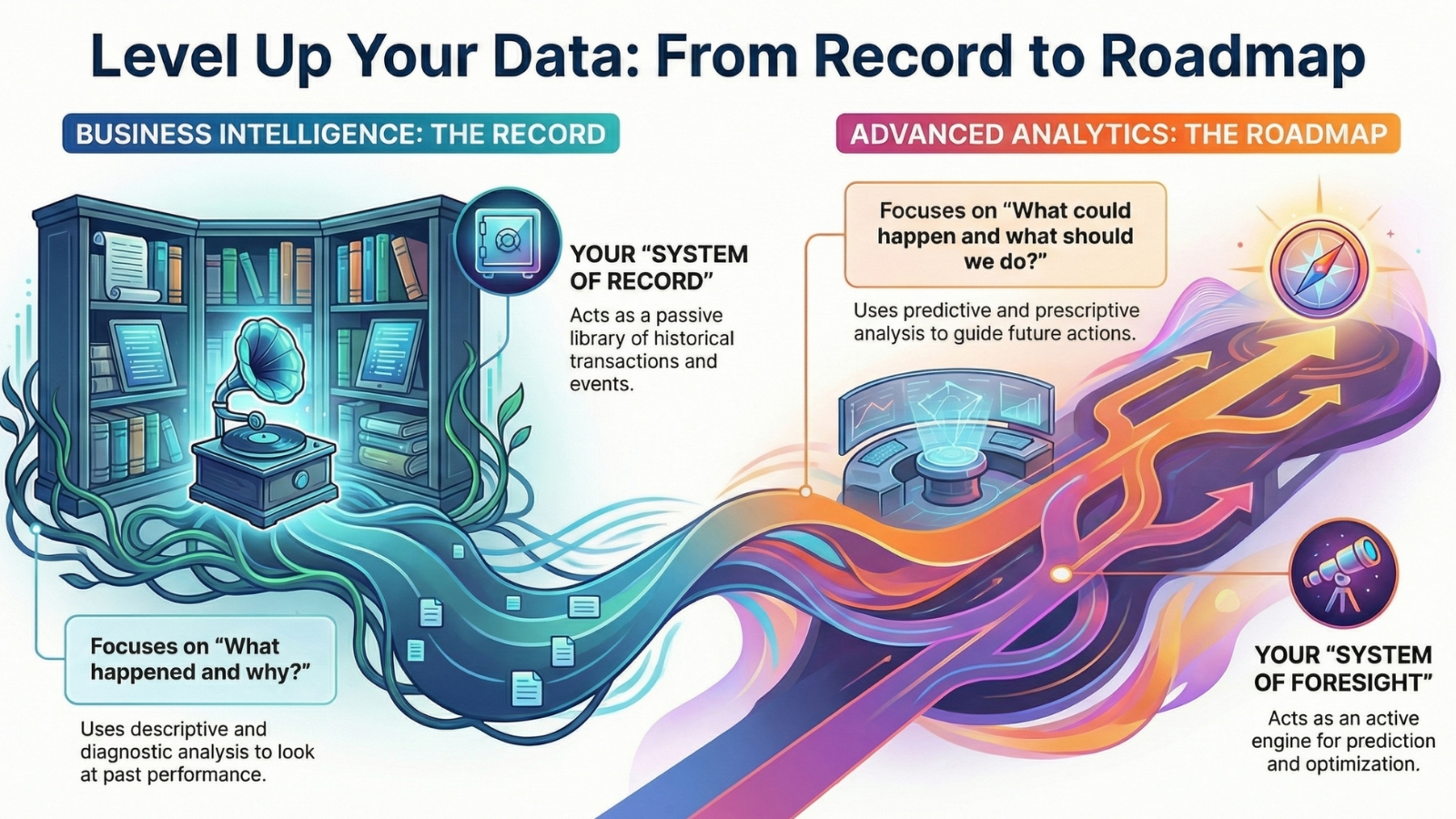
Before we look at the hurdles, we must clarify what we are aiming for. Advanced Analytics is not just “better reporting” or prettier charts; it is a fundamental change in the function of your data.
- Business Intelligence (The Record): Focuses on descriptive and diagnostic analysis. It asks, “What happened and why?” It is your system of record.
- Advanced Analytics (The Roadmap): Focuses on predictive and prescriptive analysis. It asks, “What could happen, and what is the best course of action?” It is your system of foresight.
At WMS, we help enterprises bridge this gap using tools like SAP Analytics Cloud. We turn your SAP environment from a passive library of transactions into an active engine of prediction. But getting there requires overcoming specific barriers.
Learn more about SAP Analytics Cloud - WMS’s primary tool for building this predictive analytics layer on top of SAP S/4HANA.
UAE FTA E-Invoicing Phase Mandate Schedule
| Taxpayer Category | ASP Appointment Deadline | Mandatory Go-Live Date | Key ERP Requirement |
|---|---|---|---|
| Large Businesses (≥ AED 50M revenue) | October 30, 2026 | January 1, 2027 | Real-time transmission via SAP Integration Suite / ASP connector |
| SMEs (< AED 50M revenue) | March 31, 2027 | July 1, 2027 | Automated Peppol-compliant XML generation in SAP B1 / S/4HANA |
| Government Entities | March 31, 2027 | October 1, 2027 | Central government procurement & e-billing integration |
Key Challenges: Why Companies Get Stuck
Why do so many organizations get stuck at the BI stage? Based on our work with over 100 clients, we see three critical barriers that prevent Finance and Ops leaders from unlocking the full power of their data.
1. The "Excel Hell" of Planning
Your ERP system holds the actuals, but your planning happens in disconnected spreadsheets. When you want to run a forecast, you export data, manipulate it manually, and email it around. By the time the report is ready, the data is stale, and the opportunity to act has passed.
This is the root cause that building a single source of truth across your enterprise addresses - unifying your actuals, planning and operational data in one authoritative system.
2. The Disconnect Between Strategy and Execution
Strategic goals live in PowerPoint; operational data lives in SAP. There is no digital link between the two. You set a goal to “increase inventory turns,” but your procurement team lacks the predictive tools to know which items to stop ordering to achieve that goal.
3. The "Why" Gap
Standard BI tells you that a metric changed, but it rarely tells you why. A dashboard shows revenue dropped in Q3. Was it a supply issue? A competitor price drop? A macro-economic shift? Without Advanced Analytics, you are left guessing at the root cause.
The Solution: How Advanced Analytics Solves This
Moving to an Advanced Analytics model solves these friction points by integrating planning, prediction, and execution into one workflow. Here is how this shift directly addresses the challenges above:
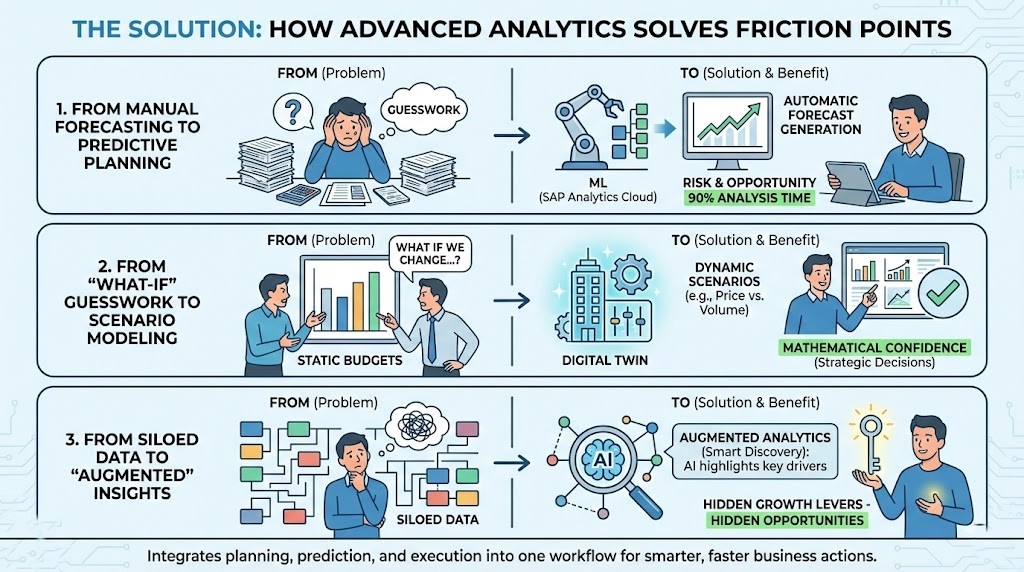
1. From Manual Forecasting to Predictive Planning
The Solution: Instead of asking department heads to “guess” their numbers for next quarter, use Machine Learning (ML) to generate a baseline. see SAP Analytics Cloud predictive planning documentation
How It Works: SAP Analytics Cloud can ingest 5 years of historical sales data, overlay it with external factors (like seasonality or economic indices), and generate a forecast automatically.
The Benefit: Your team stops spending 90% of their time creating the forecast and starts spending 90% of their time analyzing risks and opportunities.
2. From "What-If" Guesswork to Scenario Modeling
The Solution: Move from static budgets to dynamic scenarios.
How It Works: Create a “Digital Twin” of your business model. You can instantly simulate scenarios: “If we increase prices by 5% and volume drops by 2%, what is the net impact on EBITDA?”
The Benefit: You can make major strategic decisions-like entering a new market or changing suppliers-with mathematical confidence rather than just gut feeling.
3. From Silted Data to "Augmented" Insights
The Solution: Augmented Analytics.
How It Works: You don’t always know what to look for. “Smart Discovery” features use AI to scan your dataset and automatically highlight the key drivers of a metric. It might tell you, “Did you know that Customer Satisfaction is most strongly correlated with Delivery Time, not Price?”
The Benefit: You uncover hidden levers for growth that human analysts might miss in the noise.
Best Practices: How to Make the Leap
Implementing Advanced Analytics isn’t just a software install; it’s a mindset change. Here is the WMS roadmap for success:
Step 1: Unify Your Data Model
You cannot predict the future if your past is fragmented. Ensure your “Actuals” (SAP S/4HANA) and your “Plan” (SAP Analytics Cloud) share the same master data.
- Actionable Tip: Don’t build analytics on top of Excel exports. Connect SAC directly to your S/4HANA core so that every time a transaction happens, your forecast model is updated in real-time.
Step 2: Start with a Specific Use Case
Don’t try to “predict everything” on day one. Pick one high-value pain point.
- Actionable Tip: Start with Cash Flow Forecasting. It is notoriously difficult to do manually but perfect for predictive models because it relies on historical payment patterns. Showing a win here builds trust quickly.
Step 3: Democratize the Insights
Advanced Analytics shouldn’t be locked in the CFO’s office.
- Actionable Tip: Embed the insights where the work happens. Give your Sales Director a dashboard that doesn’t just show past sales, but predicts which deal is most likely to close next week based on interaction data. For teams who want to access these insights without dashboards, virtual assistants that let your team query enterprise data conversationally allow sales managers to simply ask “which deal is most likely to close this week?” and get an instant answer.

Conclusion: Turn the Headlights On
Your SAP investment has given you a powerful engine. But to drive it safely at high speeds, you need to turn on the headlights.
Moving beyond Business Intelligence is the key to unlocking the next level of value from your ERP. It empowers your CFO to be a strategic advisor, not just a scorekeeper. It empowers your analysts to be data scientists, not just spreadsheet jockeys.
To solve operational bottlenecks, discover how SAP Business One inventory management provides real-time warehouse control.
At WMS, we specialize in this transition. As an SAP Gold Partner, we have the technical expertise to configure the tools and the business acumen to ensure they solve your real-world problems.
Are you ready to stop looking in the rearview mirror?
Let’s discuss how we can help you build a predictive, data-driven roadmap for your business.
Frequently Asked Questions (FAQs)
What is the difference between BI and Advanced Analytics?
BI focuses on descriptive analysis (reporting on historical data to show what happened). Advanced Analytics uses predictive and prescriptive techniques (using ML/AI to forecast what will happen and suggest actions).
Do I need a team of Data Scientists to use SAP Analytics Cloud?
No. One of the biggest strengths of SAP Analytics Cloud is its “Augmented Analytics” features. It uses built-in AI to build models for you, allowing business analysts to generate forecasts without writing code.
Can we use Advanced Analytics if our data isn't perfect?
Yes, but with caveats. You don’t need “perfect” data, but you need “consistent” data. WMS often starts engagements with a Data Harmonization phase to ensure your historical data is clean enough to train predictive models.
How does "Predictive Planning" work?
It takes your historical data (e.g., 3 years of sales) and uses statistical algorithms to project that trend forward, accounting for seasonality and outliers. You can then manually adjust this baseline based on human knowledge (e.g., “We are launching a new product”).
Is SAP Analytics Cloud the only tool we need?
For most SAP-centric enterprises, yes. It bridges BI, Planning, and Predictive capabilities in one tool. However, for highly complex raw data mining, we might leverage SAP Datasphere or SAP BTP.
How long does it take to implement?
Unlike a full ERP implementation, an Analytics project can be fast. A standard “Financial Planning & Analysis” (FP&A) dashboard with predictive capabilities can often be deployed in 8-12 weeks.
Can we combine non-SAP data (like Salesforce or Google Analytics) into these models?
Absolutely. Advanced Analytics requires a 360-view. We can connect SAP Analytics Cloud to non-SAP sources so you can correlate, for example, website traffic (Google) with sales revenue (SAP).
What is a "Digital Boardroom"?
It is a capability within SAP Analytics Cloud that replaces static PowerPoint presentations. It allows executives to run meetings with live, interactive data, drilling down into numbers and running “what-if” scenarios in real-time during the meeting.
How does this help the CFO specifically?
It shifts the CFO from “Scorekeeper” to “Strategic Partner.” Instead of spending time explaining why the variance happened last month, the CFO can spend time advising the CEO on how to close the gap next month.
Why choose WMS for Analytics?
We don’t just build dashboards; we build decision frameworks. As an SAP Gold Partner, we understand the underlying data structures of S/4HANA, ensuring your analytics are accurate, performant, and actionable.

Mahitab Maher
SAP professional specializing in SAP products, helping companies turn complex processes into smooth, scalable operations.


We are currently dealing with data silos across departments, and this article clearly describes the challenges we face. Good insights.
Appreciate your comment, Mohammed. Data silos are a common challenge, and addressing them gradually can significantly improve collaboration and reporting accuracy.
Good explanation of how analytics can support real decisions, not just reporting.
Thanks Laura. Turning data into actual decisions is where the real value comes in.