


Last Updated 28/08/2026
Executive Summary
- Strategic Overview: Comprehensive guidance on maximizing roi from your sap investment: best practices from 100+ successful projects tailored for Middle East and GCC enterprises.
- Key Advantage: Eliminates departmental silos, standardizes reporting, and accelerates operational agility.
- Next Step: Consult with certified WMS Middle East SAP experts for tailored architecture sizing and cost estimation.
Imagine buying a Ferrari but only driving it in first gear. You have the power, the engineering, and the prestige, but you aren’t getting the performance you paid for.
For many Enterprise CFOs and Operations Leaders, this is exactly what their SAP investment feels like. You’ve spent millions on licenses, implementation fees, and infrastructure. You’ve endured the long hours of migration, testing, and training. And yet, months after “go-live,” the transformative results you were promised the seamless automation, the real-time insights, the double-digit efficiency gains still feel just out of reach.
You are not alone. A recent study by IBM revealed that 65% of CFOs feel immense pressure to accelerate ROI from technology investments, yet many struggle to bridge the gap between deployment and value realization.
Here is the hard truth: Going live is not the finish line. It is merely the starting line.
The difference between an SAP environment that acts as a costly ledger and one that becomes a growth engine lies in how you manage the ecosystem after the initial switch is flipped.
At WMS, we have guided over 100 enterprise clients through this journey. We’ve seen the pitfalls that drain value and the strategic moves that multiply it. We don’t just implement software; we engineer returns.
To evaluate technical partner qualifications and service levels, review our CFO checklist for choosing an SAP Gold Partner in Dubai.
In this guide, we are sharing the "secret sauce" from our 100+ successful projects. We will break down the core challenges preventing you from seeing full ROI and provide the exact best practices we use to turn those challenges into competitive advantages.
Challenge 1: The "Set It and Forget It" Trap
Why This Matters
How WMS Solves This
We approach SAP not as a software install, but as a Continuous Improvement Lifecycle. Our engagement doesn’t end when the system turns on. We embed “Optimization Sprints” into our post-implementation support, ensuring that every quarter, your system is tuned to match new business realities.
Actionable Best Practices
- Establish a Center of Excellence (CoE): Don't just rely on IT support tickets. Create a cross-functional team (IT + Finance + Ops) that meets monthly to review system performance and user feedback.
- Conduct "Value Audits" Every 6 Months: Just like a financial audit, you need a system audit. Look for unused modules or transaction codes (T-codes) that could simplify workflows.
- Phase Your Rollout: Don't try to boil the ocean. In our experience, clients who launch with a "Clean Core" and add advanced features (like AI or Predictive Analytics) in Phase 2 see faster initial adoption and higher long-term satisfaction.
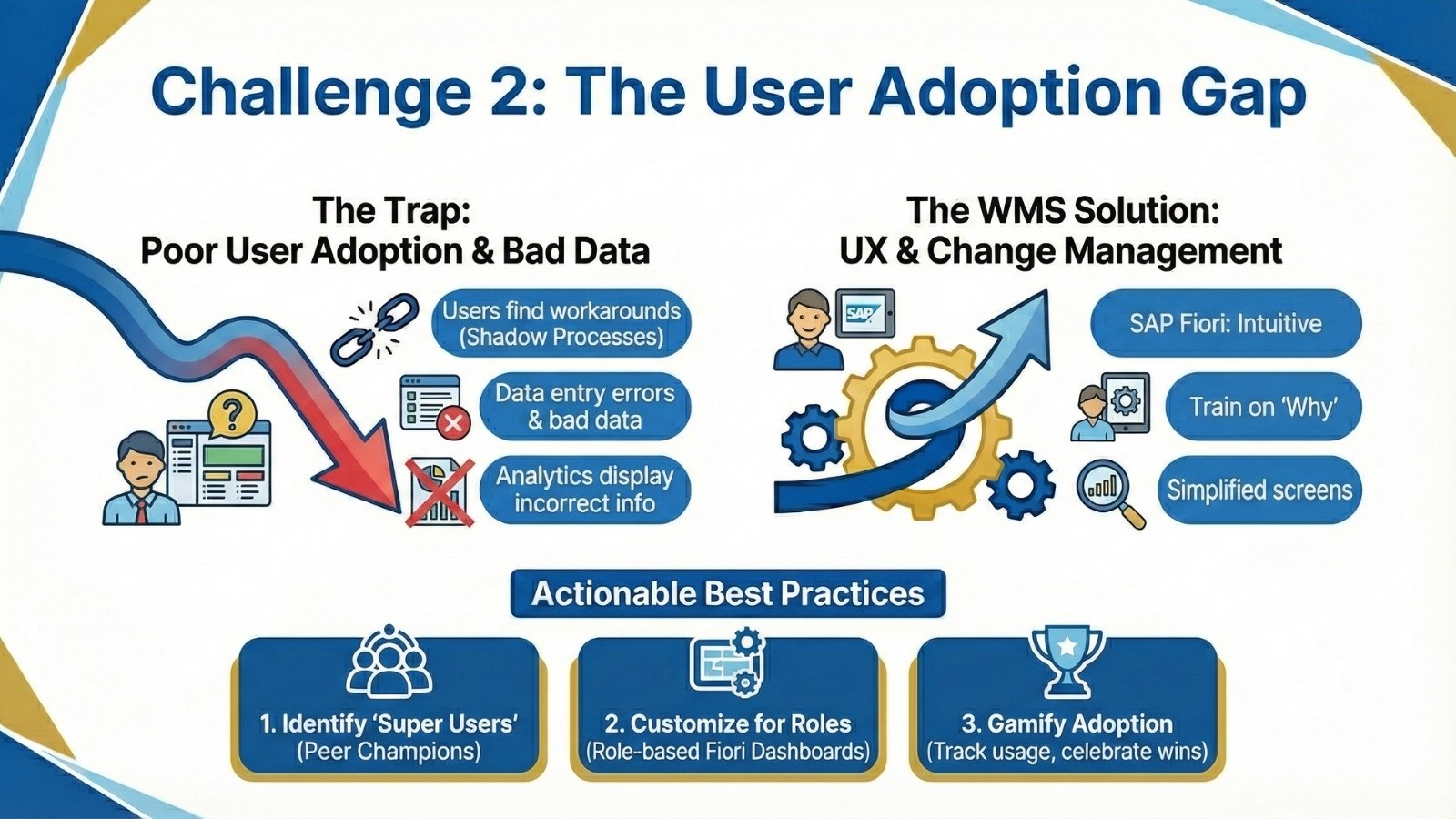
Challenge 2: The User Adoption Gap
Why This Matters
You can build the most sophisticated SAP S/4HANA environment in the world, but if your warehouse manager or procurement officer finds it too hard to use, they will find a workaround. These “shadow processes” Excel sheets, manual emails, paper notes are where ROI goes to die.
Poor user adoption leads to bad data. If users aren’t entering data correctly because the interface is confusing, your expensive analytics dashboards will display incorrect information. As the saying goes: “Garbage in, garbage out.”
How WMS Solves This
We prioritize User Experience (UX) and Change Management equally with technical configuration. By leveraging SAP Fiori (SAP’s modern, app-like interface), we simplify complex screens into intuitive tiles that require minimal training. We don’t just train your team on how to click the buttons; we train them on why the new process makes their life easier.
Actionable Best Practices
- Identify "Super Users" Early: In every one of our 100+ projects, the most successful ones identified champions in every department before the project started. These peers are far more effective at training their colleagues than any external consultant.
- Customize for Roles, Not Modules: Don't give a procurement clerk access to the entire Materials Management menu. Use Fiori to give them a dashboard with only the 3-4 apps they use daily. Simplicity drives speed.
- Gamify Adoption: Track usage metrics. Which department has the fewest errors? Which team processes orders the fastest? Celebrate these wins publicly to create a culture of pride around using the system correctly.
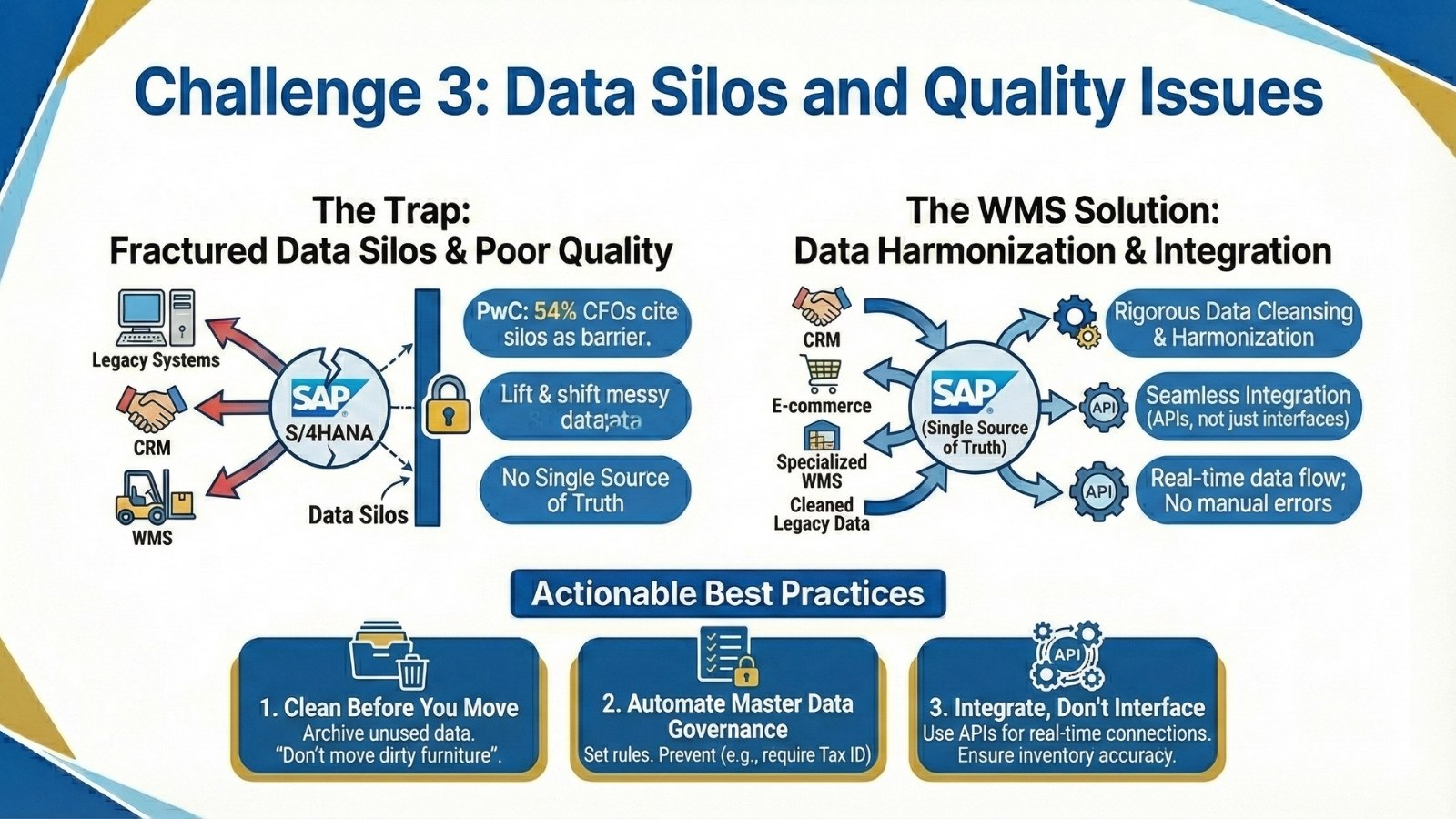
Challenge 3: Data Silos and Quality Issues
Why This Matters
In the rush to migrate, many companies lift and shift their old, messy data into the new system. Or, they leave legacy systems running “just in case,” creating fractured data silos.
A PwC survey found that 54% of CFOs cite skills shortages and data silos as the main barriers to innovation. If your SAP system can’t talk to your CRM or your 3rd party logistics software, you are missing the “Single Source of Truth” that justifies the SAP investment in the first place.
How WMS Solves This
Data integrity is the bedrock of our methodology. We employ rigorous Data Cleansing & Harmonization protocols before a single record is migrated. Furthermore, we specialize in seamless integration. Whether it’s integrating SAP Business One with a specialized WMS or connecting S/4HANA to e-commerce platforms, we ensure data flows automatically, eliminating manual entry errors.
Actionable Best Practices
- The "Clean Before You Move" Rule: Never migrate historical data that you haven't used in 3 years. Archive it. Migrating dirty data is like moving dirty furniture into a brand new house.
- Automate Master Data Governance: Use SAP tools to set rules. For example, prevent a user from creating a new vendor without a valid tax ID. Prevention is cheaper than correction.
- Integrate, Don't Interface: Move beyond simple file transfers. Use APIs to create real-time connections between your SAP core and other line-of-business apps. This ensures your inventory count in SAP matches what’s on your website in real-time.
Looking to implement or optimize this in Dubai or the UAE?
Speak with WMS Middle East certified SAP consultants for a customized architectural and cost assessment.
Challenge 4: Aligning IT Goals with Business Goals
Why This Matters
Often, SAP implementation is seen as an “IT Project.” The CIO leads it, IT manages it, and the business side just waits for it to be done. This disconnect is fatal. IT cares about uptime and security; the Business cares about cash flow, inventory turns, and customer satisfaction. When these goals misalign, you get a technically perfect system that solves none of the business’s actual problems.
How WMS Solves This
We bridge the gap. As an SAP Gold Partner, we speak both “ABAP” (technical code) and “EBITDA” (business language). We start every engagement with a Business Process Re-engineering (BPR) workshop. We map your current processes, identify bottlenecks, and configure SAP to solve those specific business pain points, rather than just turning on standard features.
Actionable Best Practices
- Define KPI-Based Success: Don't define success as "Go-Live on January 1st." Define success as "Reduce inventory days by 10%" or "Cut month-end close time from 10 days to 3 days."
- Involve the CFO in the Steering Committee: The CFO controls the purse strings and the ultimate ROI. Their active involvement ensures the project stays focused on value generation, not just technical hobbies.
- Map Processes to "Standard" First: Customization is expensive to build and expensive to maintain. We always challenge our clients: "Can you adapt your process to the SAP standard?" 90% of the time, the SAP standard is actually a global best practice you should adopt.
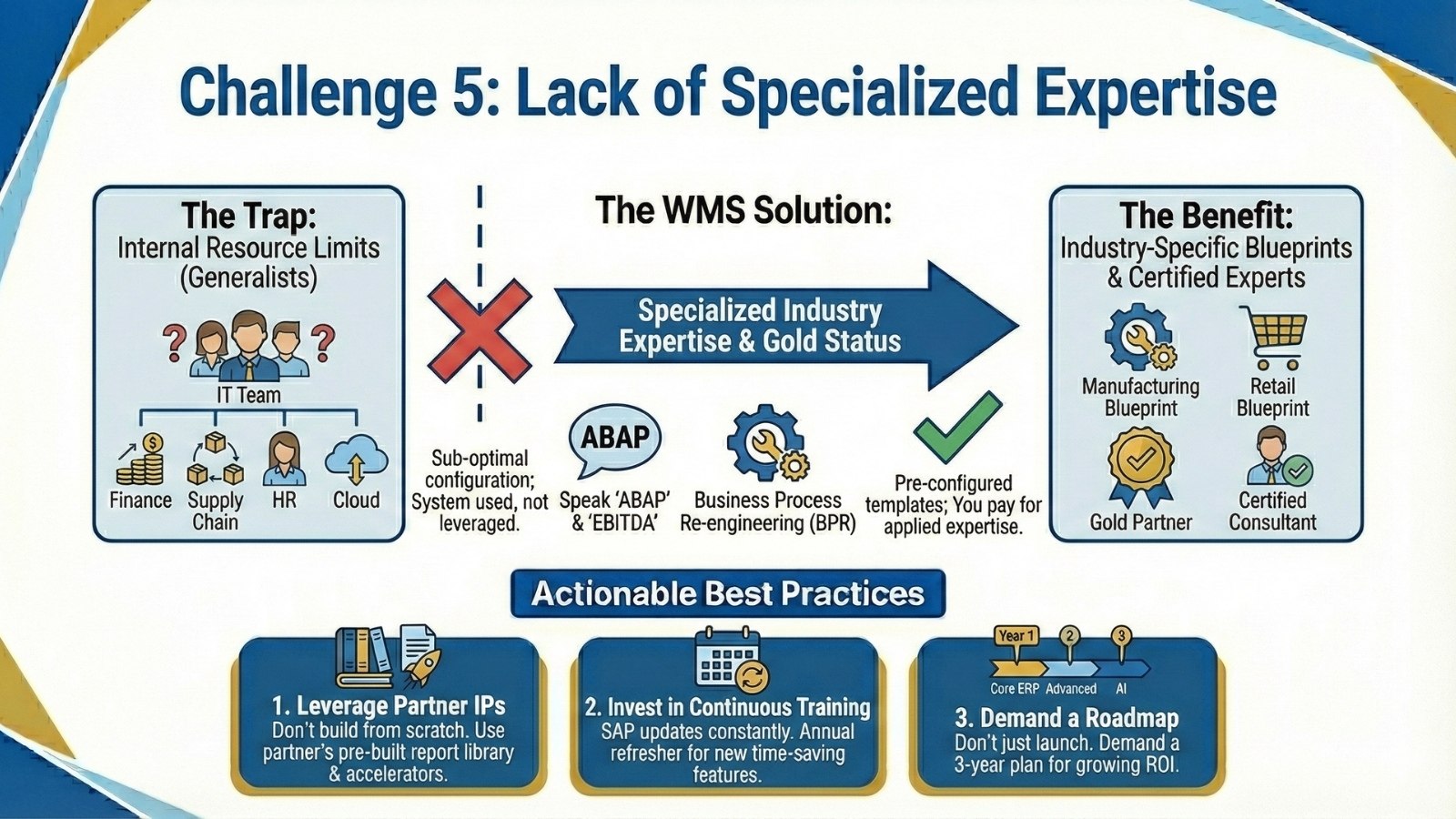
Challenge 5: Lack of Specialized Expertise
Why This Matters
SAP is massive. No single internal IT team can be an expert in Finance, Supply Chain, HR, and Cloud Infrastructure simultaneously. Relying solely on internal resources or generalist contractors often leads to sub-optimal configuration. You might use the system, but you aren’t leveraging it.
How WMS Solves This
This is where the “100+ Projects” experience becomes your greatest asset. We bring specialized industry templates. If you are in Manufacturing, we have a pre-configured blueprint for that. If you are in Retail, Browse our WMS client success stories to see the real results we have delivered across manufacturing, retail and distribution in the UAE. we have a blueprint for that. You don’t pay us to learn your industry; you pay us to apply our expertise to it.
Our SAP Gold Partner status certifies that our consultants maintain the highest level of rigorous training and certification directly from SAP.
Choosing the right partner goes beyond certifications discover what really matters when
Actionable Best Practices
- Leverage Partner IPs: Don't build custom reports from scratch if your partner already has a library of them. Ask us what "accelerators" we have for your industry.
- Invest in Continuous Training: SAP releases updates constantly (especially in the Cloud). Your team needs an annual training refresher to learn about new features that could save them time.
- Demand a Roadmap: Your partner shouldn't just deliver the project and leave. Demand a 3-year roadmap. "Year 1: Core ERP. Year 2: Advanced Warehousing. Year 3: AI & Automation." This keeps the ROI growing. For a detailed breakdown of how to implement AI within your existing SAP environment , read our practical guide for enterprise CTOs.

Conclusion: Your ROI is Waiting
Your SAP investment has the potential to be the most powerful asset on your balance sheet. It can automate the mundane, illuminate the complex, and scale with your ambition. But this potential doesn’t unlock itself. It requires a deliberate strategy, a focus on user adoption, and a partner who is committed to your long-term success.
At WMS, we don’t just measure our success by “on time and on budget.” We measure it by your success your faster closing times, your reduced inventory costs, and your happier employees.
With over 100 successful implementations behind us, we know the map. We know where the roadblocks are, and more importantly, we know the shortcuts to value.
To ensure seamless project governance, consult with an accredited SAP implementation partner in Dubai with proven regional experience.
Let’s have a conversation about your current challenges and how we can engineer a higher return for your business.
Not yet on SAP? Explore our SAP Cloud ERP options for your business and find the right starting point for your digital transformation journey.
Frequently Asked Questions (FAQs)
What makes WMS different from other SAP partners?
WMS is an SAP Gold Partner with a track record of over 100 successful implementations. Our unique approach focuses on “Business Process First,” ensuring the technology serves your goals, not the other way around. We also offer specialized support that extends well beyond go-live.
How long does it take to see ROI from an SAP implementation?
While timelines vary, clients who follow our best practices-like adopting standard processes and focusing on change management-typically see significant operational efficiency gains within 3-6 months post-go-live.
Can WMS help if we have already implemented SAP but aren't happy with the results?
Absolutely. A significant portion of our business comes from “rescue” or “optimization” projects. We can audit your current setup, identify bottlenecks, and re-configure the system to deliver the value you were originally promised.
Is SAP S/4HANA only for large enterprises?
What is the "Clean Core" strategy you mention?
“Clean Core” means keeping the base SAP system as standard as possible and building customizations outside the core (using the SAP Business Technology Platform). This makes future upgrades much faster, cheaper, and safer.
How does WMS handle user training?
We use a “Train the Trainer” approach combined with modern learning tools. We empower your key power users to become internal champions, and we create easy-to-follow digital guides specific to your workflows.
What industries does WMS specialize in?
We have deep expertise across Manufacturing, Retail, Wholesale Distribution, and Professional Services. Our “100+ projects” experience spans these verticals, giving us a library of industry-specific best practices.
Do you offer support after the project is finished?
Yes. We offer flexible Annual Maintenance Contracts (AMC) and support packages. We believe the real relationship begins after go-live, ensuring your system evolves as your business grows.
How can we reduce the cost of our SAP implementation?
The best way to reduce cost is to reduce complexity. By adopting SAP “Best Practice” standards rather than paying for heavy customization, you can reduce implementation costs by 20-30% and shorten the timeline.
How do I get started with WMS?
Simply click the “Contact Us” button or request a demo on our website. Our team will schedule a preliminary discovery call to understand your landscape and propose a tailored roadmap.

Mahitab Maher
SAP professional specializing in SAP products, helping companies turn complex processes into smooth, scalable operations.


Very relevant for the GCC market. It’s good to see content that reflects regional business realities.
Thanks, Emma. We aim to provide insights that are both globally relevant and regionally practical.
I appreciate the clarity in this post. Many articles discuss SAP at a high level, but this one provides practical understanding.
Thanks, Sophia. We aim to bridge the gap between strategy and practical implementation. Happy to hear it resonated with you.
Many businesses invest in SAP but fail to unlock full value. This article provides practical direction.
Thanks, Emma. Continuous optimization and strategic alignment are key to maximizing SAP ROI. We appreciate your thoughtful feedback.
Very informative post. The way SAP success factors were explained makes it easier for businesses to understand their value.
Thank you, Ahmed. We’re glad the explanation provided clarity. Helping organizations understand the real value of SAP solutions is our priority.
The focus on measurable ROI makes this article very practical. Many businesses invest in SAP but struggle to optimize long-term value.
Thank you, Sophia. Maximizing ROI requires continuous optimization and strategic alignment. We’re pleased you found the insights practical.
Many businesses invest in SAP but fail to unlock full value. This article provides practical direction.
Thanks, Emma. Continuous optimization and strategic alignment are key to maximizing SAP ROI. We appreciate your thoughtful feedback.
The focus on long-term optimization rather than just implementation is what makes this article stand out.
Thank you, Lauren. Maximizing ROI requires ongoing evaluation and strategic alignment beyond the initial deployment. We’re glad this perspective resonated with you.
ROI is something many companies struggle with after implementation. Good points here.
Thanks Jason. Ongoing optimization really helps in getting better returns over time.