

Last Updated 28/08/2026
Executive Summary
- Strategic Overview: Comprehensive guidance on grow with sap s/4hana: complete guide for growing middle east businesses tailored for Middle East and GCC enterprises.
- Key Advantage: Eliminates departmental silos, standardizes reporting, and accelerates operational agility.
- Next Step: Consult with certified WMS Middle East SAP experts for tailored architecture sizing and cost estimation.
When Success Creates Your Biggest Challenge
Six months ago, a Cairo-based food distribution company celebrated crossing the AED 80 million revenue milestone triple their size just three years earlier. Their executive team gathered for what should have been a victory celebration but instead became a crisis meeting.
Their Operations Director presented troubling data: order fulfillment errors had increased 40% despite adding warehouse staff, inventory discrepancies cost them AED 2.3 million in the past year and their financial close process now consumed 18 days each month up from 7 days two years earlier. Most alarming: they’d lost two major retail contracts because competitors could promise better delivery reliability.
The diagnosis was clear but uncomfortable. The very success they’d achieved growing from AED 25 million to AED 80 million had overwhelmed the basic ERP system that served them adequately at smaller scale. Their system couldn’t handle the complexity of 4 warehouses, 850 SKUs, 3 sales channels and multi-currency operations their growth demanded.
They faced the painful middle-market dilemma: too large for basic business software but seemingly too small for enterprise ERP platforms. Their CFO had received SAP quotes that appeared designed for companies five times their size with complexity and costs that made no business sense. (GROW with SAP was designed to close this gap see SAP’s official GROW page for the latest programmed details)
This scenario plays out repeatedly across Middle East markets. Growing businesses reach inflection points where existing systems become growth constraints rather than growth enablers. Yet the path forward appears blocked by enterprise ERP platforms seemingly designed for organizations with different needs and budgets.
Enterprises looking to fast-track their cloud adoption can leverage our 16-week SAP cloud migration roadmap for streamlined go-live execution
Who This Guide is For:
This guide addresses business leaders and decision-makers at fast-growing Middle East companies navigating the challenging middle-market ERP landscape:
By Role:
- Chief Executive Officers of rapidly scaling businesses
- Chief Financial Officers managing financial complexity and cost control
- Chief Operating Officers facing operational scaling challenges
- Finance Directors responsible for financial systems and reporting
- Operations Directors dealing with inventory and supply chain complexity
- IT Directors evaluating technology investments
By Company Profile:
- Growing mid-market businesses across UAE, Saudi Arabia and Egypt
- Annual revenue between AED 30 million and AED 300 million
- Employee headcount from 50 to 500
- Experiencing rapid growth (25%+ annually)
- Manufacturing, retail, construction and professional services
- Currently using basic ERP or outgrowing QuickBooks/SAP Business One
- Operating multiple locations or warehouses
- Expanding into new markets or channels
By Business Context:
- Outgrowing current business systems
- Experiencing operational inefficiencies despite adding staff
- Facing financial close delays and reporting challenges
- Managing multi-currency operations
- Expanding across Gulf markets or into Africa
- Planning significant growth over next 2-3 years
- Seeking competitive advantage through operational excellence
If your business success is creating operational complexity your current systems cannot handle or if growth plans are constrained by technology limitations, this guide explains why GROW with SAP S/4HANA emerges as the platform designed specifically for businesses exactly like yours.
This guide focuses on Middle East businesses specifically. If you need a decision framework before reading on, see our post on is GROW with SAP the right fit for your business? and our GROW with SAP complete guide for beginners
Understanding the Middle-Market ERP Gap
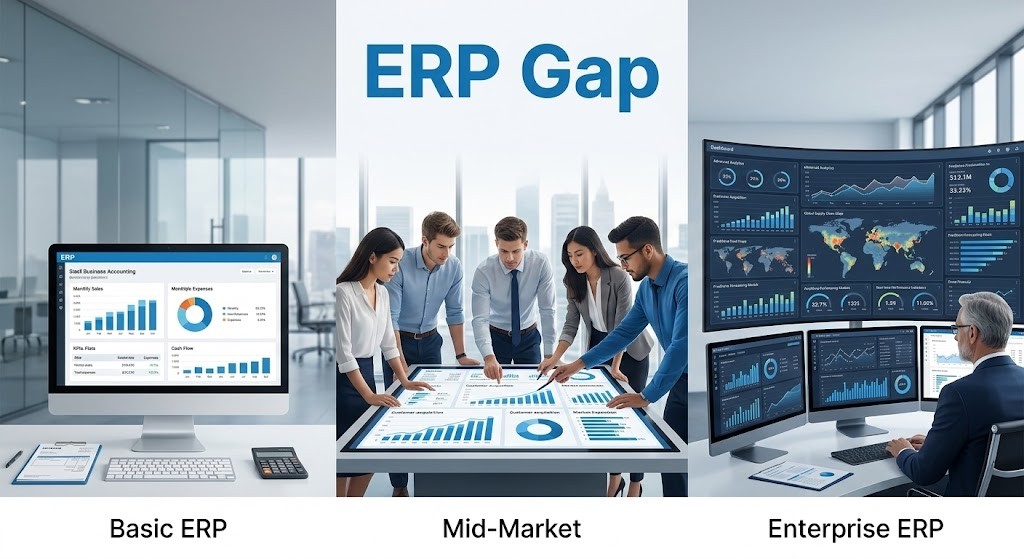
Before exploring solutions, Middle East business leaders must understand why the mid-market faces unique ERP challenges challenges that neither basic business software nor traditional enterprise ERP adequately addresses.
The middle-market challenge defined:
Growing businesses exist in uncomfortable territory between small business software and enterprise platforms. They face complexity requiring sophisticated ERP capabilities but lack the scale justifying traditional enterprise implementations.
Why basic ERP systems fail at scale:
Most Middle East mid-market companies began with platforms like QuickBooks, SAP Business One or basic cloud accounting systems. These tools served adequately through initial growth phases but reveal critical limitations as businesses scale.
Limited transaction volume: Basic systems slow dramatically or fail when processing thousands of daily transactions across multiple locations and channels. What took minutes at AED 30 million revenue takes hours at AED 100 million revenue.
Insufficient complexity handling: Multi-warehouse inventory, transfer pricing between entities, multi-currency consolidation and complex manufacturing workflows exceed basic system capabilities. Every workaround adds operational risk.
Inadequate reporting and analytics: Growing businesses need sophisticated financial analysis, inventory optimization and operational metrics. Basic systems provide transactional reports but lack the analytics enabling strategic decisions.
Integration challenges: As businesses add e-commerce platforms, warehouse management systems and CRM tools, basic ERPs struggle with integrations. Data silos emerge forcing manual reconciliation and creating error risk.
Scalability constraints: Basic systems cannot economically scale to handle projected growth. Adding users, locations or transaction volumes triggers performance issues or requires complete replacement.
Why traditional enterprise SAP seems inappropriate:
Conversely, traditional SAP implementations appear designed for organizations with fundamentally different needs and capabilities than mid-market businesses.
Complexity beyond requirement: Enterprise SAP offers thousands of functions most mid-market businesses never use. This complexity extends implementation timelines, increases costs and complicates user adoption.
Capital intensity: Traditional SAP requires substantial upfront licensing costs, hardware investments and implementation budgets often exceeding AED 2-3 million financial commitments that make CFOs uncomfortable in mid-market businesses.
Extended implementations: Full SAP implementations historically require 12-18 months before going live. Growing businesses cannot pause operations that long or absorb the organizational disruption.
Resource requirements: Enterprise SAP demands dedicated IT teams and specialist skills. Mid-market companies typically lack both, creating ongoing operational challenges and vendor dependence.
The mid-market gap:
| Business Characteristic | Basic ERP Reality | Enterprise ERP Challenge | Mid-Market Need |
|---|---|---|---|
| Revenue Scale | AED 30 --300M | Designed for AED 300M+ | Optimized for AED 50-250M |
| Implementation Timeline | 2 – 3 months | 12-18 months | Need operational quickly |
| Upfront Investment | AED 50 -150K | AED 2-5M+ | Budget-conscious CFOs |
| Functional Depth | Limited capabilities | Enterprise complexity | Growing capabilities |
| Technical Resources | Minimal required | Dedicated IT team | Limited internal IT |
| User Experience | Basic but simple | Powerful but complex | Staff need productivity |
Regional considerations for Middle East mid-market:
Middle East businesses face additional complexities beyond core operational challenges requiring specialized capabilities.
Multi-country expansion: Many successful UAE or Saudi businesses expand into neighbouring Gulf markets or Egypt creating multi-currency, multi-regulation and cross-border complexity basic systems cannot handle.
Regulatory compliance: ZATCA in Saudi Arabia, e-invoicing (as required by the UAE Federal Tax Authority for UAE-registered businesses) across Gulf markets and varied tax regimes demand ERP platforms with built-in compliance rather than costly customizations. Understanding compliance requirements is critical for regional businesses planning growth.
Family business structures: Many Middle East mid-market companies operate as family businesses with multiple entities requiring consolidated reporting whilst maintaining entity independence.
Rapid market dynamics: Middle East markets evolve quickly. ERP platforms must adapt to changing customer expectations, emerging sales channels and competitive threats without requiring complete system redesigns.
For a detailed walkthrough of how AI-powered SAP handles these compliance requirements in real time, read how AI is transforming SAP in the Middle East including the 2026 Peppol e-invoicing rollout timeline.
What GROW with SAP S/4HANA Delivers
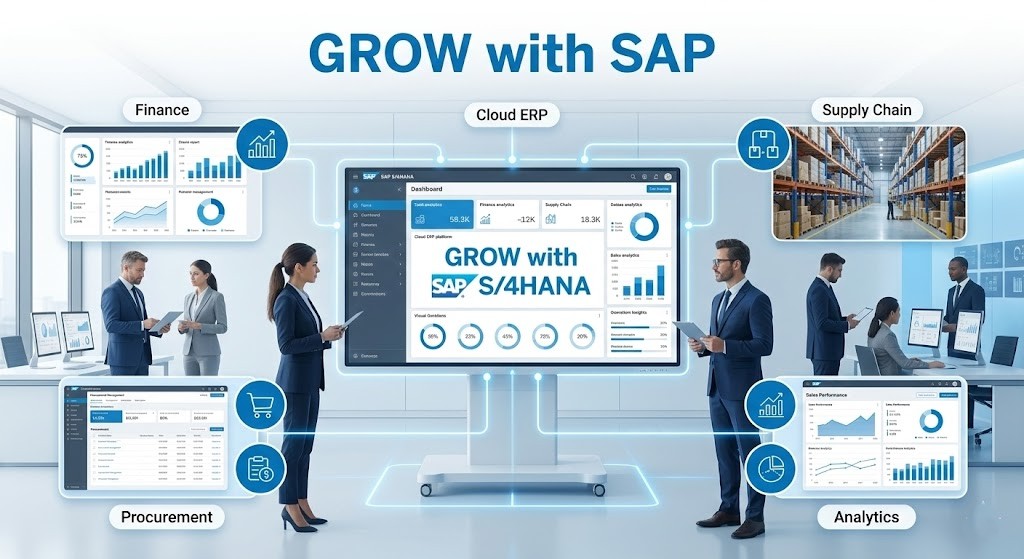
GROW with SAP S/4HANA represents SAP’s answer to the middle-market ERP gap a purpose-built offering combining enterprise-grade capabilities with mid-market economics and deployment speed.
Understanding GROW with SAP architecture:
GROW with SAP is not simplified enterprise SAP. It’s a comprehensive cloud ERP platform built on SAP S/4HANA Cloud Public Edition specifically designed for companies with 50-500 employees managing AED 50-300 million in revenue.
Core capabilities for mid-market businesses:
Financial management excellence: Complete financial accounting, accounts payable and receivable, asset management and financial close capabilities handling multi-currency operations and inter-company transactions. Critical for businesses operating across Gulf markets or managing multiple entities.
Supply chain and inventory optimization: Advanced inventory management supporting multiple warehouses, automated replenishment, transfer pricing and real-time inventory visibility. Particularly valuable for distribution and manufacturing businesses managing complex supply chains.
Sales and service management: Integrated quotation to cash processes including opportunity management, order processing, delivery coordination and billing. Supports multiple sales channels including direct sales, e-commerce and partner networks.
Procurement and vendor management: Purchase requisition through payment processes with vendor management, contract tracking and spend analytics. Enables procurement professionalization as businesses scale.
Reporting and analytics: Embedded analytics providing real-time operational and financial insights without requiring separate business intelligence platforms. Executive dashboards enable data-driven decisions.
Mobile accessibility: Complete mobile access for approvals, inquiries and key transactions enabling distributed teams essential given mobile-first workforce preferences across Middle East markets.
What distinguishes GROW from alternatives:
Pre-configured best practices: Unlike blank-slate implementations requiring everything designed from scratch, GROW includes proven business processes for distribution, manufacturing and services industries accelerating deployment.
Subscription economics: Single subscription covering software, infrastructure, security and updates eliminates capital expenditure hurdles whilst providing predictable operating costs appealing to cost-conscious CFOs managing growth investments.
Rapid deployment methodology: Structured approach combining best practices with guided configuration enables 4-6 month implementations versus 12-18 months for traditional SAP critical for businesses needing rapid operational improvement.
Continuous innovation: Quarterly updates deliver new capabilities automatically. Businesses benefit from SAP’s ongoing innovation without disruptive upgrade projects common with traditional ERP.
Managed cloud operations: SAP handles infrastructure, security, backup and performance management. Mid-market companies benefit from enterprise-grade operations without building internal IT teams.

GROW vs RISE with SAP: Choosing Your Path
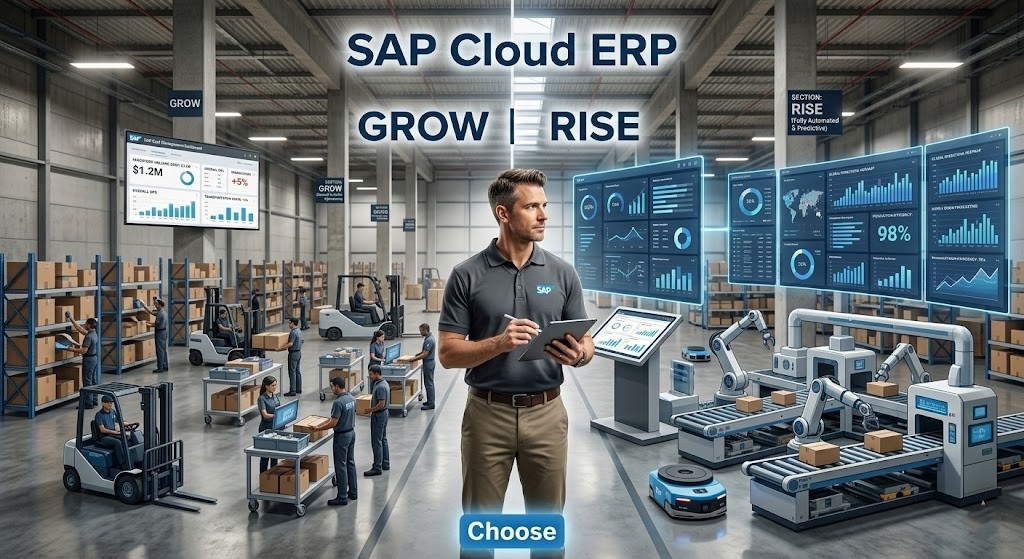
Many Middle East businesses confuse GROW with SAP with RISE with SAP. Understanding the differences ensures appropriate platform selection matching business requirements and growth trajectory.
| Comparison Dimension | GROW with SAP S/4HANA | RISE with SAP S/4HANA |
|---|---|---|
| Target Company Size | 50-500 employees, AED 50-300M revenue | 500+ employees, AED 300M+ revenue |
| Cloud Model | Public Cloud (multi-tenant) | Private or Public Cloud options |
| Deployment Speed | 4-6 months typical | 6-12 months typical |
| Customization Approach | Limited customization, configuration-focused | More extensive customization possible |
| Industry Fit | Distribution, discrete manufacturing, services | Complex manufacturing, process industries, large enterprises |
| Implementation Complexity | Standardized, rapid implementation | Tailored implementation with more flexibility |
| Best For | Fast-growing mid-market needing rapid deployment | Established enterprises or complex operations |
When GROW with SAP makes sense:
Consider GROW when your business operates in the AED 50-250 million revenue range, needs sophisticated ERP quickly without extensive customization, values subscription economics over capital expenditure and can adopt best-practice processes rather than requiring everything customized.
Distribution businesses managing multiple warehouses, growing manufacturers with discrete production and retail businesses managing multi-channel sales particularly benefit from GROW’s pre-configured capabilities.
When RISE with SAP may be more appropriate:
RISE with SAP becomes the better choice when organizations exceed 500 employees, require extensive industry-specific customization, operate complex manufacturing with process controls or need deep integration with specialized equipment and systems.
If you are unsure whether GROW (public cloud) or RISE (private cloud) is right for your Middle East business, read our SAP Public vs Private Cloud ERP comparison.
Looking to implement or optimize this in Dubai or the UAE?
Speak with WMS Middle East certified SAP consultants for a customized architectural and cost assessment.
Middle East Implementation Success Factors
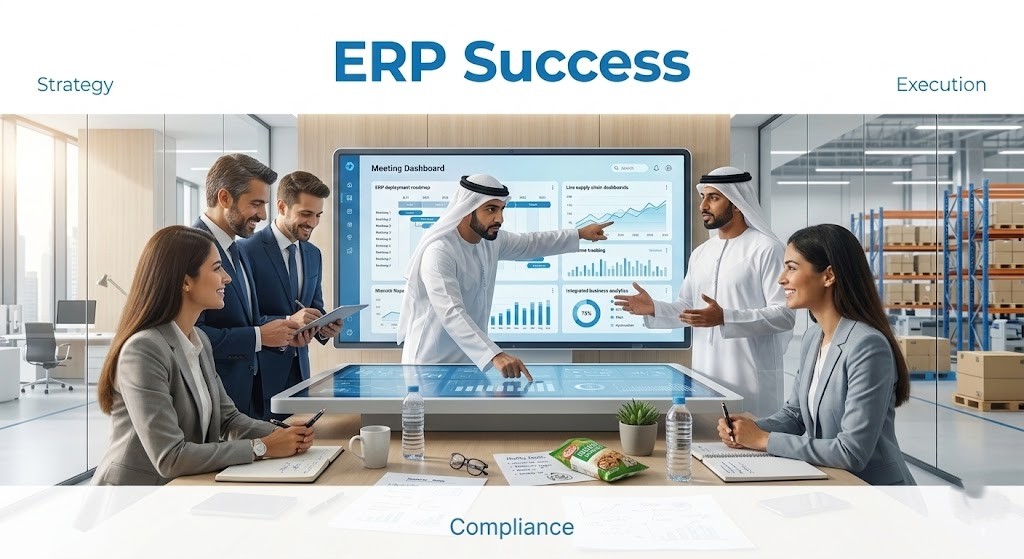
Executive clarity on objectives:
GROW implementations flounder when objectives remain vague. Successful projects begin with clear executive agreement on specific outcomes being pursued whether reducing financial close time, improving inventory turns, accelerating order fulfillment or enabling multi-country expansion.
Willingness to adopt best practices:
GROW’s value proposition depends on leveraging pre-configured best-practice processes. Organizations insisting on replicating every legacy process miss the point entirely. Successful implementations identify which unique processes provide genuine competitive advantage versus which can adopt standard approaches.
Dedicated project resources:
Mid-market companies often struggle dedicating resources to implementations whilst maintaining operations. However, trying to implement GROW “when people have time” guarantees failure. Successful projects designate key staff with protected time commitments typically 40-60% of capacity for core team members.
Change management investment:
Technology changes faster than people. GROW implementations require communication plans, comprehensive training and ongoing support ensuring users understand not just how to operate the system but why processes changed and how changes benefit them.
Partner selection for mid-market expertise:
Implementation partners must understand mid-market business reality. Many consultancies lack experience working within mid-market budget and timeline constraints or fail to appreciate that mid-market companies need simpler approaches than enterprise implementations.
At WMS Middle East, we specialize in mid-market ERP implementations across UAE, Saudi Arabia and Egypt combining SAP technical expertise with practical understanding of middle-market business realities, budget constraints and rapid deployment requirements.
Regional compliance from day one:
Middle East businesses cannot treat compliance as afterthought. ZATCA integration for Saudi operations, multi-currency management for cross-border businesses and industry-specific regulations must be addressed during implementation not as expensive post-go-live retrofits.
‘For the full picture on what WMS does to maximize your SAP return post go-live, read our guide on maximizing SAP ROI from 100+ successful implementations
Common Mid-Market Implementation Challenges
Understanding typical challenges enables Middle East businesses to prepare effectively and avoid preventable problems.
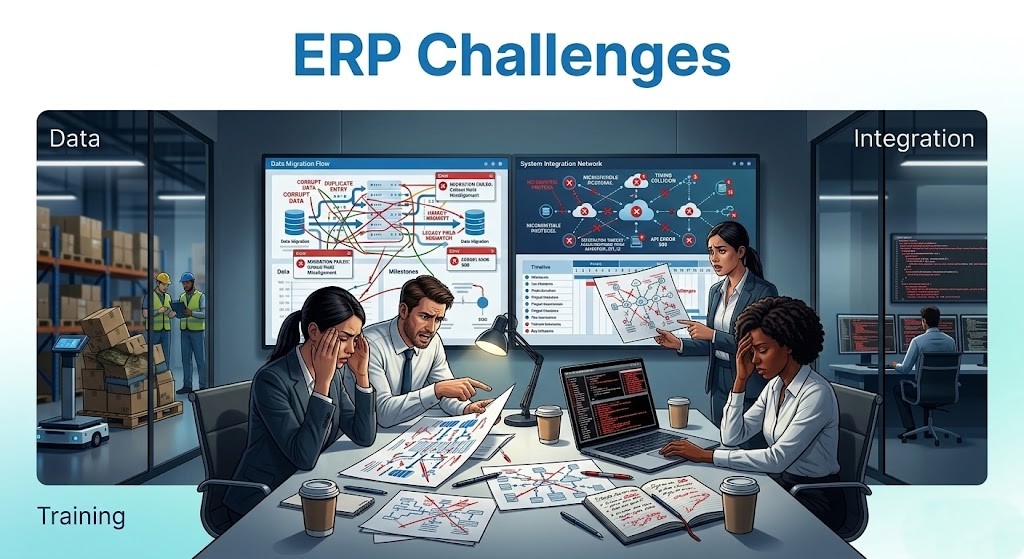
Challenge: Scope creep through "while we're at it" additions
The problem: Mid-market implementations start focused on core requirements but gradually expand as stakeholders request additional capabilities or customizations, extending timelines and inflating budgets.
The solution: Rigorous change control distinguishing must-have from nice-to-have requirements. Phase 1 focuses ruthlessly on core capabilities enabling operations. Phase 2 addresses enhancements after stabilization. This disciplined approach delivers value faster whilst controlling costs.
Challenge: Data migration complexity
The problem: Growing companies accumulate years of data in various formats and systems. Cleansing and migrating this data proves more complex than anticipated.
The solution: Begin data preparation months before implementation. Focus on data quality over quantity clean current operational data matters more than perfect historical archives. Establish data governance ensuring ongoing quality post-implementation.
Challenge: Under-investing in training
The problem: Organizations spend adequately on system configuration but inadequately on user training, resulting in technically functional systems that staff struggle to use effectively.
The solution: Comprehensive role-based training using realistic scenarios. Provide multiple training opportunities initial training, refreshers closer to go-live and ongoing learning resources. Designate super-users supporting colleagues.
Challenge: Attempting too much integration initially
The problem: Mid-market businesses often run multiple systems requiring integration. Attempting complex integrations during initial implementation adds significant complexity and risk.
The solution: Phased integration approach starting with critical integrations (typically payroll and banking) whilst accepting manual processes temporarily for less critical connections. Add sophisticated integrations post-stabilization.
Measuring Success: Expected Outcomes
Middle East businesses evaluating GROW with SAP must define clear success metrics enabling objective assessment of return on investment.
| Performance Area | Typical Improvement | Timeline to Realization |
|---|---|---|
| Financial Close Speed | 40-50% reduction in days | 3-6 months post-go-live |
| Inventory Accuracy | 95%+ accuracy vs 75-85% | 6-12 months post-go-live |
| Order Fulfillment Cycle | 30-40% faster processing | 3-6 months post-go-live |
| Procurement Efficiency | 25-35% reduction in purchasing costs | 6-12 months post-go-live |
| Reporting Time | 60-70% reduction in manual report generation | Immediate post-go-live |
| Financial Visibility | Real-time vs week-delayed insights | Immediate post-go-live |
| Working Capital | 15-20% improvement in inventory turns | 6-12 months post-go-live |
| Operational Capacity | Support 2-3× growth without proportional staff increase | Ongoing benefit |
Return on investment timeline:
Months 1-3 post-implementation: Initial efficiency gains from process automation and improved data access. Reduced time spent on manual data reconciliation and report generation.
Months 4-9: Measurable improvements in key operational metrics as organization optimizes processes and staff gain proficiency. Working capital improvements become visible.
Months 10-18: Full value realization with strategic capabilities enabling growth that previous systems constrained. Ability to expand into new markets or channels without system limitations.
Making the GROW with SAP Decision
GROW with SAP addresses specific middle-market segment experiencing particular pain outgrowing basic ERP but not requiring full enterprise platform complexity. For businesses fitting this profile, GROW offers compelling value proposition combining enterprise capabilities with mid-market economics and deployment speed.
Evaluating fit for your organization:
Consider these questions:
- Is revenue between AED 50-250 million with plans to grow further?
- Do current ERP limitations constrain growth or operational efficiency?
- Can your organization embrace best-practice processes versus demanding everything customized?
- Does subscription economics appeal over large capital expenditure?
- Do you need deployment within 6 months versus waiting 12-18 months?
- Will your business benefit from continuous platform innovation?
If these questions resonate positively, GROW with SAP warrants serious evaluation as the platform enabling your next growth phase without the complexity and cost of traditional enterprise ERP.

Ready to explore whether GROW with SAP aligns with your business growth journey?

At WMS Middle East, we help growing businesses across UAE, Saudi Arabia and Egypt evaluate ERP options matching their growth trajectory and operational requirements. Our approach combines SAP technical expertise with practical understanding of mid-market business realities.
We provide honest guidance on whether GROW with SAP is the right choice for your specific circumstances or whether alternative platforms better serve your needs. No pressure. No predetermined recommendations. Just experienced counsel from people who understand both mid-market business challenges and SAP technologies.
Before starting your migration, review our SAP implementation cost in Dubai analysis to plan your project budget accurately.
Talk to our GROW with SAP specialists to discuss your business's operational challenges, growth objectives and technology requirements. We'll help you make informed decisions supporting sustainable growth and operational excellence.
Related Resources:
- Comparison: “GROW with SAP vs RISE with SAP: Which Cloud ERP is Right?”
- Guide: “Mid-Market ERP Selection Framework for Middle East Businesses”
- Calculator: “GROW with SAP ROI Calculator for Growing Companies”
- Regional: “SAP Solutions for Growing Businesses Across UAE, KSA and Egypt”
Frequently Asked Questions (FAQs)
How is GROW with SAP different from SAP Business One?
GROW with SAP and SAP Business One serve different stages of business growth. SAP Business One is designed for smaller companies with around 10-150 employees and simpler operations. GROW with SAP, built on the SAP S/4HANA platform, targets mid-market companies with 50-500 employees and more complex needs. It supports advanced capabilities such as multi-entity consolidation, real-time analytics and scalable supply chain management. For businesses outgrowing Business One, GROW provides a natural upgrade path with modern cloud architecture and greater long-term scalability.
Can GROW with SAP support operations across multiple countries?
Yes. GROW with SAP supports multi-country operations commonly seen in Middle East businesses expanding across UAE, Saudi Arabia and Egypt. The system manages multiple legal entities, currencies and regulatory requirements within a single platform. Companies can maintain separate financial records for each country while also generating consolidated group reports. It also supports localization features for regional compliance such as tax reporting, regulatory requirements and multi-currency financial management.
What happens if our company grows beyond the intended size for GROW with SAP?
GROW with SAP is designed for companies with up to around 500 employees and AED 300 million in revenue, but many businesses continue using it successfully beyond that size. The platform can scale in terms of users and transactions. If your organization eventually requires more advanced customization or industry-specific functionality, it can transition to other SAP S/4HANA deployment models such as private cloud without changing the core platform.
How can we implement GROW with SAP without disrupting daily operations?
Most companies keep their existing systems running during the implementation process while the new ERP system is configured and tested. Implementation activities are often scheduled during lower business periods to reduce disruption. Before going live, teams perform detailed testing and training to ensure key processes work correctly. Although some adjustment is expected during the first few weeks after launch, GROW’s typical 4-6 month implementation timeline helps limit long-term operational disruption.
Can GROW with SAP be implemented in phases?
Yes, many mid-market companies adopt a phased approach. Phase one usually focuses on core ERP capabilities such as financial management, purchasing and inventory. Later phases may introduce advanced capabilities like warehouse management, analytics or integrations with other systems. This approach allows businesses to start benefiting from the platform sooner while spreading investment and change management over time.
Is GROW with SAP secure since it is cloud-based?
GROW with SAP runs on SAP’s enterprise-grade cloud infrastructure with strong security controls. These include data encryption, role-based access management, activity monitoring and compliance with international security standards. SAP also provides backup systems and disaster recovery processes to maintain business continuity. For most mid-market companies, the platform offers a higher level of security and reliability than maintaining their own infrastructure.
Is subscription pricing more cost-effective than traditional ERP?
GROW with SAP uses a subscription model that includes software, infrastructure, updates and security in a single recurring cost. Traditional ERP implementations often require large upfront investments for licenses, hardware and implementation. While total costs over several years may be comparable, the subscription model improves cash flow, reduces capital expenditure and provides predictable operating costs. This approach is often more practical for growing mid-market companies.
What if GROW with SAP doesn’t meet all our specific requirements?
GROW with SAP is designed around industry best practices rather than heavy customization. In many cases, businesses adapt processes to these proven standards. When additional functionality is required, organizations can extend capabilities using SAP Business Technology Platform or integrate specialized third-party solutions. If a company requires extensive customization or highly specialized workflows, other SAP S/4HANA deployment models may be more suitable.

Mahitab Maher
SAP professional specializing in SAP products, helping companies turn complex processes into smooth, scalable operations.


This was a helpful read. We’re currently exploring SAP options for our growing team, and the way you explained GROW with SAP made it much easier to understand.
Thanks, Daniel. Glad the article helped clarify things. Wishing you the best as you explore your SAP options.
GROW with SAP is something we’ve been hearing about lately. This helped clear things up.
Thanks Hannah. Glad it helped simplify things a bit.
Useful read for companies looking at modern ERP options while scaling.
Thanks Rachel. Glad you found it useful for growing business needs.