


Last Updated 01/09/2026
Executive Summary
- Strategic Overview: Comprehensive guidance on what can you achieve in just 16 weeks? a complete sap cloud erp migration roadmap tailored for Middle East and GCC enterprises.
- Key Advantage: Eliminates departmental silos, standardizes reporting, and accelerates operational agility.
- Next Step: Consult with certified WMS Middle East SAP experts for tailored architecture sizing and cost estimation.
A 16-week SAP Cloud ERP migration is not about rushing an enterprise transformation. It is about focusing the project on the highest-value work first so a Dubai business can move from legacy ERP to a modern cloud foundation without losing control of operations.
For many UAE organisations, the real challenge is not the technology itself. It is deciding what to migrate, what to standardise, what to defer, and how to keep the business stable during change. That is exactly where a structured roadmap matters. A well-run 16-week program can deliver a working cloud ERP foundation, cleaner data, improved visibility, and a phased path for future enhancement.
Enterprises looking to fast-track their cloud adoption can leverage our 16-week SAP cloud migration roadmap for streamlined go-live execution.
Why a 16-week roadmap matters
Many SAP migration projects fail because they try to solve every problem at once. That usually creates delays, too much customisation, and weak user adoption. A 16-week roadmap works better when the organisation is ready to simplify, prioritise, and move with discipline.
For Dubai businesses, this approach is especially useful when leadership wants faster time to value, but the business still needs proper governance, compliance, and change control. A short roadmap does not mean a weak implementation. It means the project is designed around a clear sequence of decisions and milestones.
Who this roadmap is for
This roadmap is most relevant for UAE businesses that already know they need SAP Cloud ERP and want a practical migration path. It suits SMEs and mid-market companies that are moving away from legacy systems, or existing SAP customers who are shifting to a cloud-first operating model.
It is also useful for businesses with a small internal IT team that needs an implementation partner to do the heavy lifting. If the organisation has multiple legal entities, local compliance requirements, or integration dependencies, the 16-week plan still works, but the scope must be tightly controlled.
What 16 weeks can realistically deliver
A focused 16-week migration can achieve five important outcomes:
- A clear business process blueprint.
- A clean and tested cloud ERP environment.
- Core finance and operations processes running in the new system.
- Prioritised data migration for master data and essential transactional history.
- A trained user base with a support model after go-live.
That said, a 16-week project is not usually the right time to rebuild every workflow in the business. The value comes from launching the core foundation quickly, then improving the system in later phases.

Looking to implement or optimize this in Dubai or the UAE?
Speak with WMS Middle East certified SAP consultants for a customized architectural and cost assessment.
The 16-week roadmap
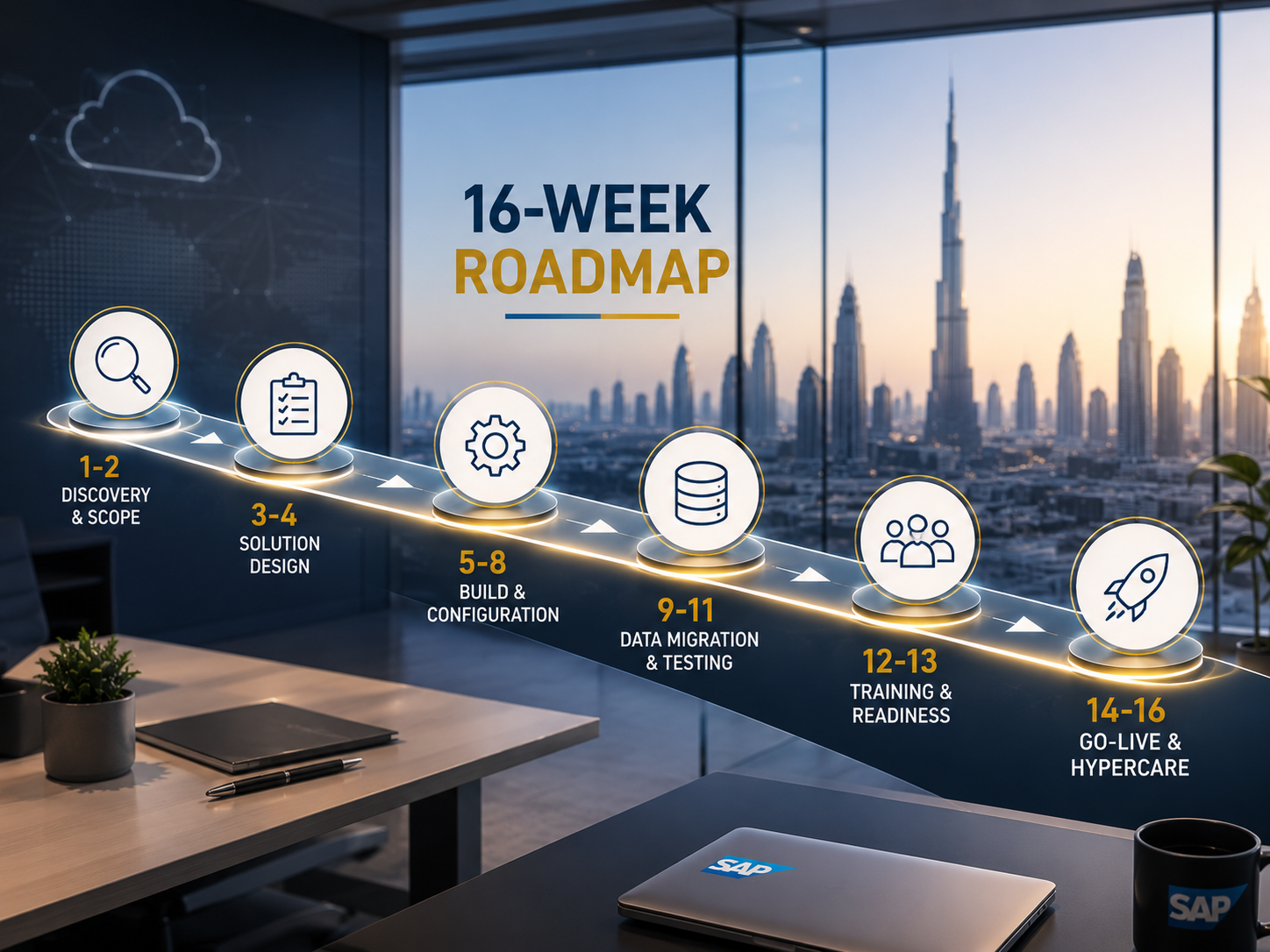
Weeks 1 to 2: Discovery and scope
The first two weeks are about understanding the current state. The implementation team reviews processes, pain points, system dependencies, data quality, and reporting needs. This stage also identifies the items that must be in scope for go-live and the items that can wait.
This is the most important planning step because it protects the rest of the project. If scope is unclear here, the timeline will slip later.
Weeks 3 to 4: Solution design
Once the scope is agreed, the team designs the future-state process. This includes a chart of accounts structure, approval flows, user roles, basic reports, and any local compliance requirements. The design should favour standard cloud ERP capabilities wherever possible.
A good design phase also decides what data will be migrated. Not every historical record needs to move on day one. Many businesses only need essential master data and selected open transactions to go live successfully.
Weeks 5 to 8: Build and configuration
This is the core implementation window. The cloud ERP is configured, key processes are set up, and initial integrations are built if required. The project team should work in short cycles so business users can review progress early instead of waiting until the end.
During this period, the project should stay tightly controlled. Every extra change request has a cost in time and effort, so the focus should remain on the minimum viable go-live scope.
Weeks 9 to 11: Data migration and testing
Data migration begins once the structure is stable. Master data, opening balances, and essential historical records are cleaned, mapped, and loaded into the new environment. Testing should include both technical validation and business process testing.
User acceptance testing is especially important here. The business team must confirm that the new system reflects real operational needs before go-live. If testing is rushed, launch day becomes a problem instead of a milestone.
Weeks 12 to 13: Training and readiness
Training should happen after the system is stable enough to reflect the final process design. This is the point where users learn how to work in the new ERP, not just how to click through screens. Training is most effective when it is role-based and tied to real tasks.
Readiness also includes support planning. The project team should define who handles issues after launch, how tickets will be managed, and what the escalation path looks like.
Weeks 14 to 16: Go-live and hypercare
The final three weeks cover production cutover, launch, and hypercare support. This is when the system goes live and users begin working in the new environment. Hypercare is critical because it gives the business a short period of intensive support to resolve issues quickly.
A 16-week migration is only successful if go-live is stable. That means the team should focus on core business continuity, not on adding major new features during the launch window.

What makes the timeline work
The 16-week model works best when the business keeps the project simple. Strong executive sponsorship, fast decision-making, clean data, and limited customisation all make the roadmap more realistic. Businesses that want rapid value should be willing to adopt standard processes rather than recreate every old workflow in the new system.
It also helps when the implementation partner has strong local experience. Dubai projects often involve VAT, bilingual processes, regional reporting, and multi-entity structures. Those requirements do not need to break the timeline, but they must be identified early.

Risks to watch for
A third risk is over-customisation. If the team keeps building exceptions, the project stops behaving like a 16-week roadmap and starts behaving like a full transformation program. The best way to protect the timeline is to separate what is essential for go-live from what can be delivered later.
Why WMS Dubai offers this approach

WMS Dubai uses a structured migration method because UAE businesses need speed without losing governance. The goal is not to deliver a huge system all at once. The goal is to create a practical SAP Cloud ERP foundation that supports the business immediately and leaves room for future growth.
That is where a roadmap like WMS Grow Booster, our internal SAP Cloud ERP acceleration package becomes useful. It gives the business a clearer sequence, a more manageable project, and a stronger link between implementation effort and business outcomes.
Final takeaway
A 16-week SAP Cloud ERP migration can achieve a great deal, but only if the organisation is ready to focus on the essentials. The roadmap should cover discovery, design, build, migration, testing, training, and go-live support in a disciplined sequence. For Dubai businesses that want speed and control, this can be the right balance between ambition and practicality.
Before starting your migration, review our SAP implementation cost in Dubai analysis to plan your project budget accurately.

Frequently Asked Questions (FAQs)
Can SAP Cloud ERP really be migrated in 16 weeks?
Yes, for the right scope and the right business profile. The project must be focused, well-governed, and free from unnecessary customisation.
What should be migrated first?
Usually the most important master data, opening balances, and core process data. Historical data can often be phased later if the business does not need it immediately.
Is 16 weeks enough for UAE compliance work?
It can be, if compliance requirements are defined early and the scope is controlled. Local requirements should be part of the initial design, not discovered near go-live.
What causes SAP migration projects to slip?
The main causes are unclear scope, poor data quality, slow decisions, and too many changes during implementation.
What happens after go-live?
The project should move into hypercare and then ongoing support. That is when the business stabilises the system and plans the next improvements.
What industries use SAP Business One in Dubai?
SAP Business One is used across a wide range of industries in Dubai and the UAE, including: wholesale and general trading, food and beverage distribution, light manufacturing and assembly, construction and contracting, real estate development, automotive spare parts, healthcare and pharmaceuticals, professional services, logistics and 3PL, and retail. WMS Dubai has implemented SAP B1 across all of these sectors within the UAE market — with industry-specific configuration for each.

Mahitab Maher
SAP professional specializing in SAP products, helping companies turn complex processes into smooth, scalable operations.


