


Last Updated 01/09/2026
Executive Summary
- Strategic Overview: Comprehensive guidance on 10 signs your distribution business has outgrown manual warehouse management tailored for Middle East and GCC enterprises.
- Key Advantage: Eliminates departmental silos, standardizes reporting, and accelerates operational agility.
- Next Step: Consult with certified WMS Middle East SAP experts for tailored architecture sizing and cost estimation.
Manual warehouse management can work for a while, especially when a distribution business is small, order volumes are predictable, and the team knows every process by memory. But as the business grows, manual processes start to break under pressure. Orders increase, product ranges expand, inventory moves faster, and the warehouse becomes harder to control without a system.
For distribution companies in Dubai and across the UAE, the warning signs usually appear before a full breakdown happens. The challenge is that many businesses treat those warning signs as temporary operational problems instead of indicators that the warehouse has outgrown spreadsheets, paper logs, and informal tracking. By the time those gaps become visible in customer complaints or missed deliveries, the business is already paying the price.
To evaluate technical partner qualifications and service levels, review our CFO checklist for choosing an SAP Gold Partner in Dubai.
This guide explains the most common signs that manual warehouse management is no longer enough, why those problems matter, and how a more structured warehouse management approach can help a growing distribution business regain control.
Who this is for
This article is for distribution managers, operations leaders, warehouse supervisors, and business owners in wholesale, trading, FMCG, and multi-location distribution businesses. It is especially relevant for UAE companies that manage inventory across one or more warehouses, free zones, or regional delivery points.
If the business is still using spreadsheets, shared drives, paper pick lists, or WhatsApp messages to manage stock movement, this topic applies directly.

Why manual warehouse management stops working

Manual warehouse processes often begin as a practical solution. They are simple, cheap, and familiar. A small team can usually track stock with a spreadsheet, update quantities at the end of the day, and manage order fulfilment without much formal structure.
That approach breaks down when volume grows. More SKUs create more chances for error. More orders create more picking pressure. More locations create more coordination problems. More staff create more inconsistency. At that point, manual methods stop being efficient and start becoming a risk.
1. Inventory counts no longer match reality
The first and most obvious sign is that the stock record no longer matches what is physically in the warehouse. Items appear available in the system but cannot be found on the shelf. Other items sit in the warehouse but are not recorded correctly. This creates delays, backorders, and unnecessary rechecking.
When inventory accuracy becomes unreliable, every downstream process suffers. Sales teams lose confidence in availability data, purchasing teams buy the wrong quantities, and operations teams spend too much time correcting mistakes.
2. Picking mistakes are increasing
Manual processes usually depend on memory, printed lists, or staff familiarity with the warehouse layout. That works only until the warehouse becomes too large or the order profile becomes too complex. Once pick errors start increasing, the business begins to lose time, money, and customer trust.
Incorrect items, missing quantities, and wrong batch selection all point to a process that needs more structure. A warehouse that depends on individuals remembering where things are will always be vulnerable to turnover, fatigue, and rushed shifts.
3. Order fulfilment is slowing down
If orders take longer to process than they used to, manual management may be the cause. The team may be spending too much time searching for stock, checking quantities, reconciling records, or reworking orders after mistakes are found. This is usually a sign that the warehouse has become too complex for informal control.
In distribution businesses, speed matters because customers expect faster turnaround and more accurate delivery windows. When fulfilment slows down, the warehouse becomes a bottleneck instead of a support function.
4. Stock differences keep showing up
Frequent stock variances are a classic warning sign. If the numbers are always changing, always being corrected, or always requiring manual reconciliation, then the warehouse does not have reliable real-time control. This often happens when goods receipt, transfers, returns, and adjustments are tracked inconsistently.
The longer this goes on, the harder it becomes to trust the numbers. Once leadership stops trusting inventory reports, decision-making also becomes slower and more reactive.
5. The team relies on one or two key people
Another major sign is knowledge concentration. If only one or two people truly understand where products are stored, how adjustments are made, or how orders are prioritised, the business has a fragile process.
That kind of dependency creates risk. If those employees are absent, leave the company, or become overloaded, warehouse performance drops immediately. Manual management depends heavily on memory and tribal knowledge, which is difficult to scale.
6. Reporting takes too long
Manual warehouse management usually means reporting is prepared after the fact. Someone has to pull figures from spreadsheets, compare versions, and compile data before management can see what is happening. By the time reports are ready, the information may already be outdated.
Distribution businesses need faster visibility into stock movement, order status, and warehouse productivity. If reporting takes hours or days to produce, the business is making decisions too late.
7. Returns and exceptions are difficult to track
Returns, damaged goods, short shipments, and customer exceptions need clear tracking. When they are managed manually, they often get recorded inconsistently or not at all. That creates confusion in inventory records and makes it hard to see why problems keep repeating.
A growing distribution business needs a process that can capture exceptions cleanly and connect them back to the original order or shipment. Without that, root-cause analysis becomes guesswork.
8. Multi-warehouse coordination is becoming messy
The moment a business starts moving stock between warehouses or serving customers from multiple locations, manual tracking becomes much harder. Transfers get missed, duplicated, or delayed. One site may believe stock is available while another site has already allocated it.
This is a common pain point in UAE distribution businesses that operate across Dubai, Abu Dhabi, Sharjah, or free zones. The more locations involved, the more important it becomes to have one shared operational view.
9. Customer complaints are rising
Warehouse problems eventually show up in customer experience. Late shipments, wrong items, incomplete orders, and poor availability all affect trust. Even if the sales team is strong, distribution problems can damage the customer relationship.
This is often the point where leadership realises the warehouse is no longer just an internal issue. It is a revenue and retention issue.
10. Growth is creating more complexity than the current process can handle
The clearest sign of all is when business growth starts outpacing warehouse control. More SKUs, more orders, more channels, and more customer expectations all increase the pressure on the system. If the warehouse cannot scale with the business, manual management becomes a constraint on growth.
That is usually the moment when a warehouse management system becomes a strategic requirement rather than a nice-to-have upgrade.
What a better warehouse model changes
A structured warehouse management approach gives the business better inventory visibility, cleaner order processing, stronger control over stock movements, and more reliable reporting. It also reduces dependence on memory and manual reconciliation.
For distribution businesses, the goal is not technology for its own sake. The goal is operational control. When the warehouse runs on a more disciplined system, the business can fulfil orders faster, reduce errors, and scale with less disruption.
How WMS Dubai supports distribution businesses
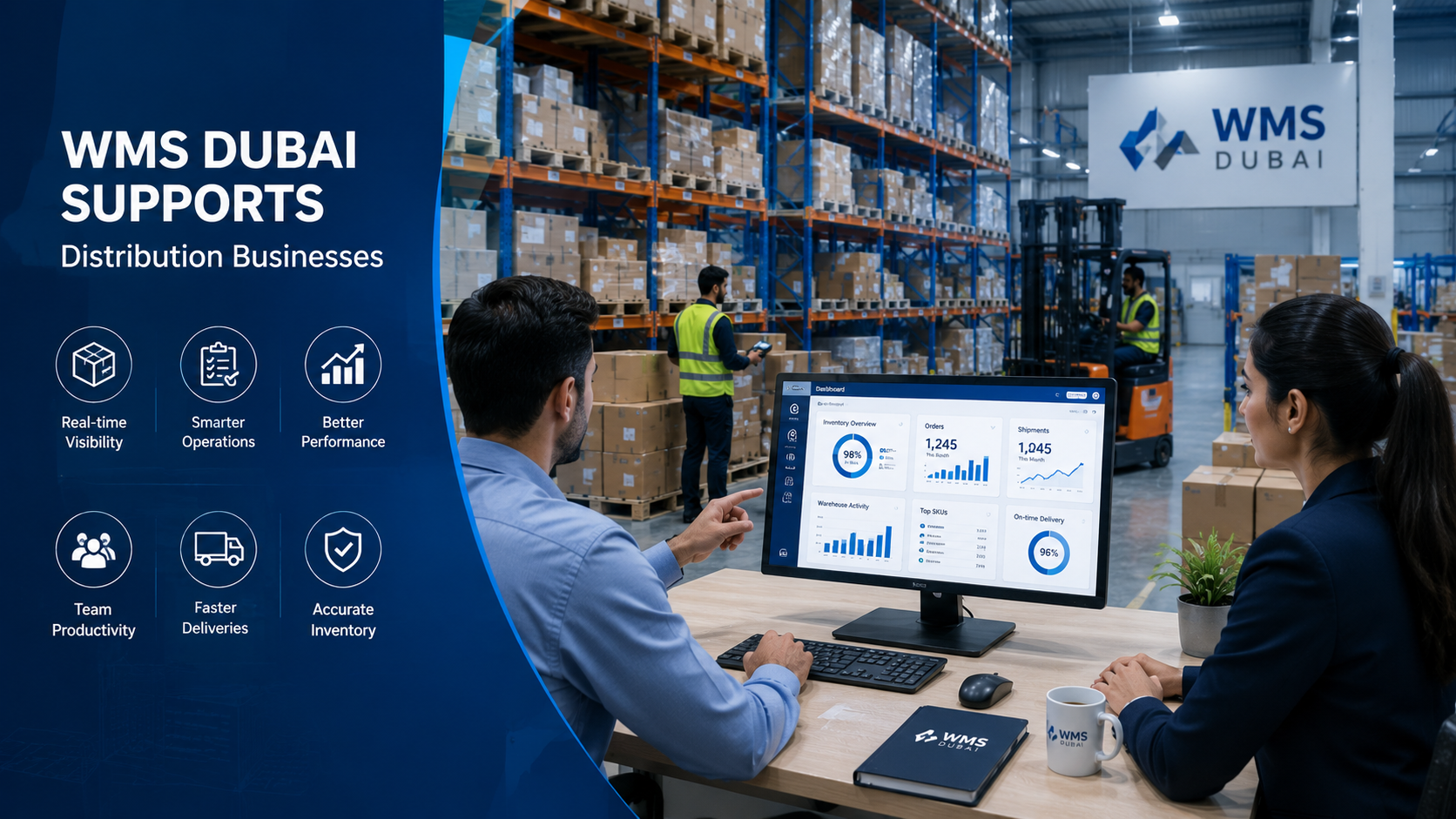
WMS Dubai helps distribution companies move from manual warehouse control to a more scalable operating model. The focus is on understanding how the warehouse works today, identifying where manual processes are creating risk, and then designing a system that fits the company’s distribution flow.
That matters because no two distribution businesses are identical. A wholesale importer, a multi-warehouse FMCG distributor, and a regional trading business all face different operational pressures. The right solution has to reflect those differences.
Conclusion
Manual warehouse management usually fails gradually, not all at once. The signs are clear: inaccurate stock, slower fulfilment, more errors, poor reporting, and increasing dependence on a few people. For a distribution business in Dubai or the wider UAE, those problems are strong indicators that the warehouse has outgrown manual control.
The sooner the business recognises those signs, the easier it is to move to a more scalable model before mistakes begin to affect customers and margins.
To ensure seamless project governance, consult with an accredited SAP implementation partner in Dubai with proven regional experience.

Frequently Asked Questions (FAQs)
When should a distribution business move away from spreadsheets?
When stock accuracy, order speed, or reporting reliability starts to break down regularly, it is time to move away from spreadsheets.
What is the biggest risk of manual warehouse management?
The biggest risk is that the business makes decisions using inaccurate or delayed inventory information.
Does manual warehouse management work for small businesses?
It can work for a while, but only when order volume, SKU count, and warehouse complexity are still low.
What is the first sign that a warehouse needs a system?
Inventory counts that no longer match physical stock are usually the first major warning sign.
Is multi-warehouse management possible without software?
It is possible only at a very small scale. Once multiple locations start sharing inventory, a structured system becomes far more reliable.

Mahitab Maher
SAP professional specializing in SAP products, helping companies turn complex processes into smooth, scalable operations.


