
Last Updated: 01-04-2026
Here is a situation we are seeing in boardrooms from Riyadh to Dubai:
You have successfully migrated to the cloud. Your ERP system is live. But when you ask, “What will our cash flow look like next quarter if oil prices drop by 5%?” or “Which supplier is most likely to delay our shipment next month?”, your system gives you a blank stare.
You are sitting on a goldmine of data, yet you are still making decisions based on spreadsheets and gut feeling.
This is the “Intelligence Gap.”
For Enterprise Tech Leaders and Innovation Officers in the Middle East, closing this gap is no longer just about competitive advantage—it’s about survival. With national mandates like Saudi Vision 2030 and the UAE National Strategy for Artificial Intelligence 2031 setting a blistering pace, the era of “static” ERP is over.
The future belongs to the Intelligent Enterprise.
At WMS, we are witnessing a seismic shift. SAP implementations are no longer just about recording transactions; they are about predicting them.
In this guide, we will explore how AI and Machine Learning (ML) are rewriting the rules of SAP implementation in the region, the specific challenges they solve, and how you can leverage them to turn your data into your most valuable asset.

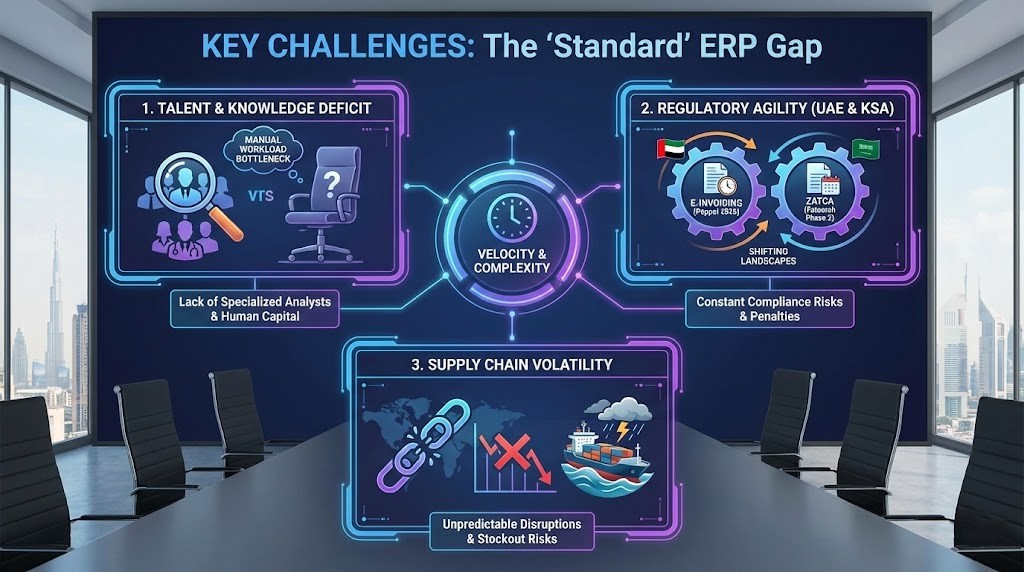
Key Challenges: Why "Standard" ERP is No Longer Enough
The Middle East market operates at a velocity and complexity that standard legacy systems simply cannot match. Based on our work with regional enterprises, here are the three friction points keeping leaders up at night:
1. The Talent & Knowledge Deficit
The region is growing faster than the talent pool can support. Finding specialized controllers or supply chain analysts who know how to run complex queries is becoming harder and more expensive. Companies are drowning in manual work because they lack the human capital to analyze the data they create.
2. Regulatory Agility (VAT & E-Invoicing)
From the introduction of Corporate Tax in the UAE to the ZATCA e-invoicing phases in Saudi Arabia, regulatory landscapes are shifting constantly. Manual compliance is not just slow; it’s a liability risk.
The 2026 Inflection Point: UAE E-Invoicing Launch
Implementation Timeline:
Phase |
Pilot Program |
Deadline to Appoint Accredited Service Provider (ASP) |
Mandatory Implementation Date |
|---|---|---|---|
|
Pilot Program |
Selected businesses (invited by Ministry of Finance) |
Not Applicable |
July 1, 2026 |
|
Phase 1 |
Large businesses (revenue ≥ AED 50 million) |
July 31, 2026 |
January 1, 2027 |
|
Phase 2 |
Businesses with revenue < AED 50 million |
March 31, 2027 |
July 1, 2027 |
|
Phase 3 |
All UAE Government Entities |
March 31, 2027 |
October 1, 2027 |
Technical Architecture: The Peppol-Based Model
Unlike legacy systems that rely on point-to-point connections, the UAE’s e-invoicing framework is built on the Peppol network, a decentralized, international standard for electronic document exchange. This requires structural changes to how enterprises generate and route invoices.
Mandatory Technical Requirements
Structured Digital Format: All invoices must be generated in XML or JSON format that conforms to the FTA’s data dictionary. PDF invoices will no longer be acceptable for compliance purposes.
Accredited Service Provider (ASP) Integration: Enterprises cannot directly connect to the FTA. Instead, they must appoint an accredited service provider who validates invoices, applies digital signatures, and routes transactions through the Peppol network to both the buyer and the FTA.
Data Integrity & Digital Signatures: Every invoice must include cryptographic signatures and be validated in real-time before transmission. This ensures tamper-proofing and audit-readiness at the point of generation.
In-Country Data Storage: All e-invoices, credit notes, and associated data must be stored within the UAE in compliance with the Tax Procedures Law.
The Compliance Risk Landscape
After mandatory dates, issuing in-scope B2B or B2G invoices outside the e-invoicing system results in:
Penalty exposure and VAT reporting inaccuracies
Invoices not accepted by buyers or government entities, creating payment delays and supply chain friction
Data quality liability where the enterprise—not the ASP—bears the compliance risk
The Multi-Jurisdictional Complexity: Saudi Arabia as a Cautionary Tale
The Problem: Different Technical Stacks
- ZATCA (Saudi Arabia): Direct integration with the Fatoorah portal using XML/UBL formats, UUID generation, QR codes, and cryptographic stamps.
- UAE (New System): Peppol-based decentralized model with ASP intermediaries, different data dictionary, and structured XML/JSON formats.
A multinational enterprise operating in both jurisdictions must:
Maintain separate e-invoicing solutions
Map transaction data to two regulatory schemas
Train teams on two distinct workflows
Manage two separate ASP relationships
AI-Driven Compliance: Zero-Touch Regulation Across Jurisdictions
SAP’s Machine Learning and Generative AI capabilities embedded in SAP S/4HANA and SAP Joule can now automatically:
Classify transactions by jurisdiction
Auto-map data fields to required schemas
Perform real-time validation
Adapt to new compliance rules automatically
Real-World Impact: A Dubai-based trading enterprise unified KSA and UAE invoice generation using SAP Business AI, reducing invoice exceptions by 87% and recording zero compliance findings post-audit.
3. Supply Chain Volatility
Global logistics disruptions hit the Middle East hard. Traditional ERPs look at historical lead times. But in a world of geopolitical shifts, relying on “what happened last year” to predict “what will happen next week” is a recipe for stockouts.
Addressing supply chain volatility starts with building a single source of truth across your enterprise systems so every team is working from the same live data.
The Solution: AI-Driven SAP Implementations
This is where the conversation shifts from “Information” to “Intelligence.”
New-age SAP solutions, powered by SAP Business AI and Joule (SAP’s generative AI copilot), don’t just store your data—they learn from it. At WMS, we are helping clients deploy these tools to solve specific regional challenges.
AI for Finance: From "Bean Counting" to Strategic Forecasting
The Benefit: Instant Liquidity Visibility
Instead of waiting for month-end close, AI algorithms embedded in SAP S/4HANA can analyze thousands of receivables and payables in real-time to predict your cash position 30, 60, or 90 days out.
- Real-World Impact: We helped a Dubai-based logistics firm automate invoice matching. The AI learned to recognize vendor invoice formats (even with different layouts), reducing manual data entry by 80% and flagging potential duplicate payments before they happened.
AI for Compliance: Zero-Touch Regulation
The Benefit: Automated Adherence to KSA/UAE Laws
Machine Learning models can now automatically classify transactions for tax purposes. If a new tax rule is introduced, the system updates its logic, flagging non-compliant invoices automatically.
- Real-World Impact: For our clients in Saudi Arabia, this means seamless integration with ZATCA portals, ensuring every invoice generated is compliant without human intervention.
AI for Supply Chain: Predictive, Not Reactive
The Benefit: Demand Sensing
Traditional forecasting looks at sales history. AI-driven “Demand Sensing” looks at external signals—weather patterns, port congestion data, and even social media sentiment.
- Real-World Impact: A retail client used SAP's predictive analytics to adjust inventory levels ahead of Ramadan. By analyzing historical spikes and current buying trends, they reduced stockouts of high-demand items by 15% while cutting excess inventory of slow movers.
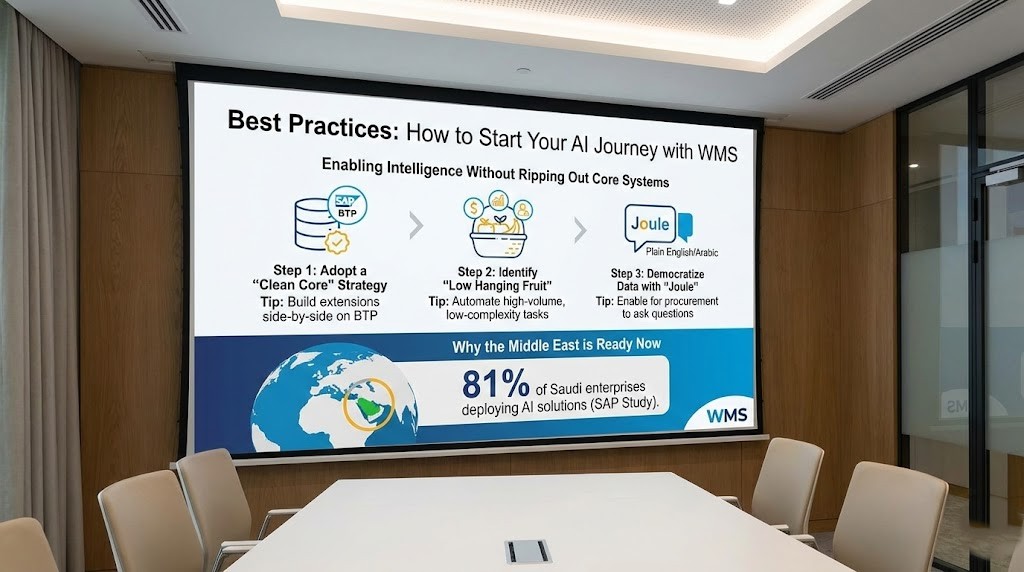
Best Practices: How to Start Your AI Journey with WMS
Implementing AI doesn’t mean ripping out your core system. It means enabling the intelligence layers that are already there. Here is our 3-step roadmap for success:
Step 1: Adopt a "Clean Core" Strategy
AI models are only as good as the data they feed on. If your current SAP system is heavily customized with “spaghetti code,” AI cannot function effectively.
- Actionable Tip: Stop building custom code inside your ERP. Use the SAP Business Technology Platform (BTP) to build extensions side-by-side. This keeps your core data clean and readable for AI algorithms.
- A clean core is also the foundation for maximizing your SAP ROI post go-live — read our guide for enterprise CFOs and Operations Leaders.
- For the full deployment framework our consultants follow, read our SAP AI implementation methodology guide.
Step 2: Identify "Low Hanging Fruit"
Don’t try to automate everything at once. Start with high-volume, low-complexity tasks.
- Actionable Tip: Look at your Finance and HR departments. Are they manually matching bank statements? Are they screening thousands of CVs? These are perfect candidates for your first AI pilot.
- To see exactly how automation works in practice, read how SAP BTP drives intelligent automation for GCC businesses with real process-level examples.
- Actionable Tip: Enable Joule for your procurement teams. Instead of running complex reports, they can simply ask, “Show me all suppliers in Riyadh with a risk score higher than 50,” and get an instant answer.
Why the Middle East is Ready Now
The numbers speak for themselves. A recent SAP study revealed that 81% of Saudi enterprises are already deploying industry-specific AI solutions. The region is not “catching up” to the West; in many ways, it is leapfrogging it by adopting cloud-first, AI-native architectures from day one.
The government is doing its part. The infrastructure is there. The technology is ready. The only variable left is your willingness to adopt it.

Conclusion: Turn Your Data into Direction
We are standing at the edge of a new era in enterprise software. The days of the passive ERP are gone. Your SAP system should be an active member of your team—one that warns you of risks, identifies opportunities, and automates the mundane so your people can focus on the extraordinary.
We don’t just implement software; we build engines for growth.
At WMS, we specialize in bridging the gap between the technical promise of AI and the practical reality of business operations in the Middle East. As an SAP Gold Partner, we have guided over 100 organizations through their digital transformation.
Ready to make your SAP system smarter?
Let’s discuss how AI can unlock hidden value in your specific industry.
Frequently Asked Questions (FAQs)
Is AI in SAP only for large enterprises?
No. With SAP S/4HANA Public Cloud, AI capabilities are available to mid-sized businesses as standard features. You don’t need a team of data scientists; you just need the right partner to switch them on.
How does AI help with Saudization (Nitaqat) requirements?
AI-driven HR modules in SAP SuccessFactors can analyze your workforce data in real-time, predicting if you are at risk of dropping into a lower Nitaqat zone and suggesting hiring actions to maintain compliance.
Is my data safe if I use AI features?
Yes. SAP’s “Business AI” is built on strict data privacy and security standards. Your data is not used to train public AI models (like ChatGPT) without your permission. It remains your data, within your secure tenant.
What is "Joule"?
Joule is SAP’s generative AI copilot. Think of it like ChatGPT, but it lives inside your SAP system, understands your business context, and is secure. You can talk to it to generate reports, summarize documents, or navigate the system.
Can AI help reduce our implementation timeline?
Yes. WMS uses AI-powered tools during the implementation phase itself—for code generation, data migration mapping, and automated testing—which can reduce project timelines by up to 30%.
Do we need to be on the Cloud to use these AI features?
Mostly, yes. While some on-premise systems have basic automation, the powerful GenAI and predictive capabilities run on the cloud (SAP BTP). Moving to the cloud is the first step to unlocking this value.
How specifically does WMS help with AI adoption?
We start with a “Value Discovery Workshop.” We look at your pain points and map them to specific AI use cases (e.g., “Automate Invoice Matching”). We then configure, test, and train your team on these specific features.
What is the biggest risk in adopting AI for SAP?
Poor data quality. If your historical data is messy (duplicates, missing fields), the AI will make bad predictions. WMS places a huge emphasis on “Data Cleansing” before turning on any AI models.
Can AI predict machine failures?
Yes. For manufacturing and oil & gas clients, SAP Asset Performance Management uses AI to analyze sensor data from your machines, predicting failure weeks in advance so you can repair it during scheduled downtime.
What is the cost implication of adding AI?
Many AI features are embedded in the standard SAP S/4HANA Cloud license at no extra cost. Advanced features (like specific BTP services) may have consumption-based pricing. We help you model these costs upfront so there are no surprises.

Mahitab Maher
SAP professional specializing in SAP products, helping companies turn complex processes into smooth, scalable operations.


Very informative post. The explanation around automation and enterprise scalability was particularly useful.
Thank you, Khaled. Scalability and automation are critical for long-term growth, and we’re glad the article provided clarity.
This article provides strong insight into how AI is enhancing SAP capabilities in the region. The connection between automation and improved business intelligence is especially valuable.
Thank you, Jonathan. AI-driven intelligence is reshaping how organizations approach SAP implementations, particularly across the Middle East. We’re glad the insights resonated with you.
AI-driven enhancements in SAP are reshaping enterprise capabilities. The practical examples shared here make the transformation easier to understand.
Thank you, Victoria. AI integration within SAP environments enables smarter, faster decision-making. We’re glad the examples added clarity.