
It is the paradox of the modern Enterprise CTO: You are under immense pressure to “deploy AI,” yet you know that 80% of AI projects fail to move past the pilot phase.
We see it constantly. A company invests in a cutting-edge machine learning tool. They feed it data. They get a few cool insights. And then… nothing. The pilot sits in a silo, unconnected to the core business processes, providing zero impact on the P&L.
Why? Because they treated AI as a feature, not a discipline.
For Enterprise CTOs and Data Officers, the challenge isn’t buying AI technology; SAP has already embedded it into S/4HANA. The challenge is implementing the methodology that turns that technology into business value. Without a structured framework, AI becomes just another expensive shadow IT project—risky, ungoverned, and impossible to scale.
At WMS, we believe that AI implementation is less about code and more about context. It requires a rigorous methodology that bridges the gap between “what the model can do” and “what the business needs.”
In this practical guide, we are pulling back the curtain on the methodology we use to help enterprises successfully deploy SAP Business AI. We will move beyond the hype and focus on the engineering, governance, and process architecture required to make AI work.
The Core Challenge: The "Pilot Purgatory"
Why do so many SAP AI initiatives stall? In our experience across 100+ projects, we see three recurring roadblocks:
1. The Data Reality Check
Your AI model is only as smart as the data it consumes. In many legacy SAP environments, master data is fragmented. Customer names are duplicated; inventory codes are inconsistent. When you feed this “dirty data” into a predictive model, you don’t get intelligence; you get confident hallucinations.
2. The "Bolt-On" Fallacy
Many teams try to build AI outside the core ERP and then “connect” it back. This creates latency and integration nightmares. If your AI predicts a stockout, but that insight isn’t embedded directly into the procurement officer’s purchase requisition screen, it’s useless.
3. The Governance Void
Who is responsible when the AI makes a mistake? If an automated algorithm denies a credit limit increase for a key customer, is there a human in the loop? A lack of clear governance creates a fear of deployment, keeping valuable models stuck in testing forever.
The WMS Methodology: A 4-Step Framework for Value
To break out of “Pilot Purgatory,” you need a methodology that treats AI as an integral part of your SAP lifecycle. We call this the “Clean Core, Smart Edge” approach.
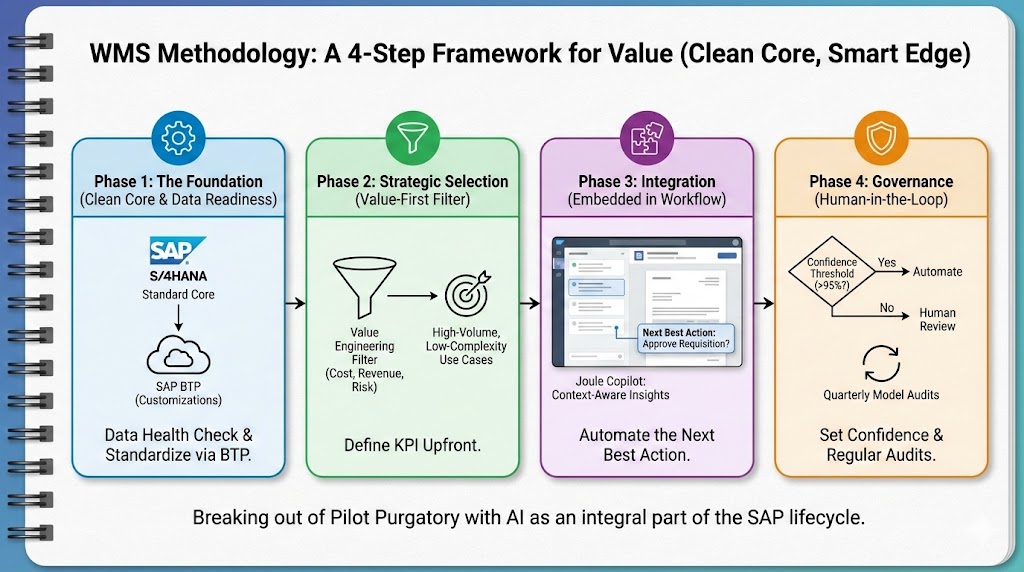
Phase 1: The Foundation (Clean Core & Data Readiness)
Before you deploy a single algorithm, you must prepare the soil. AI cannot thrive in a chaotic landscape.
The Challenge: Legacy customizations (Z-codes) that lock data in non-standard formats.
The Solution: A “Clean Core” strategy. By keeping the SAP S/4HANA core standard and moving customizations to the SAP Business Technology Platform (BTP), you ensure your data structure is readable by standard AI services.
Actionable Best Practices:
- Conduct a “Data Health Check”: Before starting an AI project, run a master data audit. Use tools like SAP Information Steward to score your data quality. If your “Vendor Master” accuracy is below 90%, fix that first.
- Standardize via BTP: Do not modify the core code to fit your AI. Build your AI extensions on BTP so they can “read” the core data without “breaking” it during upgrades.
Phase 2: Strategic Selection (The "Value-First" Filter)
The biggest mistake CTOs make is starting with the coolest tech rather than the biggest problem.
The Challenge: Implementing AI for AI’s sake (e.g., “Let’s use a chatbot!”) rather than solving a P&L problem.
The Solution: Value Engineering. We use a rigorous filter to select use cases. We ask: Does this reduce cost, increase revenue, or mitigate risk? If it doesn’t do one of those three measurably, we don’t do it.
Actionable Best Practices:
- Start with “High-Volume, Low-Complexity”: Don’t start with a complex predictive maintenance model for your rarest machine. Start with Cash Application. AI is excellent at matching thousands of incoming payments to invoices. It’s high volume, low risk, and delivers immediate time savings.
- Define the KPI Upfront: Never launch a pilot without a success metric. “Improve customer service” is not a metric. “Reduce average query resolution time by 20%” is a metric.
Phase 3: Integration (Embedded vs. Side-by-Side)
This is where the architecture matters. How does the user actually consume the AI?
The Challenge: Insights are delivered in a separate dashboard that users have to log into separately.
The Solution: Embedded AI. The insight must appear in the flow of work.
Actionable Best Practices:
- Use “Joule” for Context: SAP’s copilot, Joule, is designed to be context-aware. If a user is looking at a Sales Order, Joule should offer insights about that order (e.g., “This customer usually delays payment by 5 days”).
- Automate the “Next Best Action”: Don’t just show a prediction (e.g., “Stockout likely”). Configure the system to propose the solution (e.g., “Stockout likely. Create Purchase Requisition for 500 units?”). The user just has to click “Approve.”
Phase 4: Governance & The "Human-in-the-Loop"
Trust is the currency of AI adoption. If users don’t trust the black box, they won’t use it.
The Challenge: “Black Box” algorithms where the logic is opaque.
The Solution: Explainable AI and Human-in-the-Loop workflows.
Actionable Best Practices:
- Set Confidence Thresholds: Configure your AI to automate only high-confidence tasks. For example, “If the AI is >95% sure this invoice matches this PO, post it automatically. If confidence is <95%, route it to a human for review.”
- Regular “Model Audits”: AI models drift over time. A model trained on 2023 supply chain data might be useless in 2025. Establish a quarterly review where data scientists check the model’s accuracy against recent reality.
The "WMS Difference": Why Methodology Matters
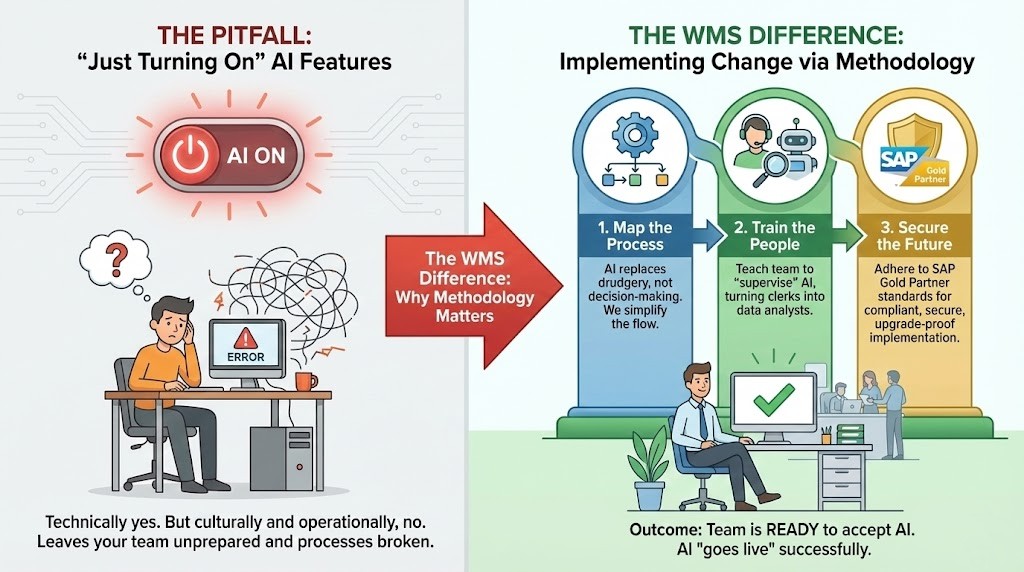
You might ask, “Can’t we just turn on the AI features in SAP S/4HANA?”
Technically, yes. But culturally and operationally, no.
At WMS, we don’t just turn on features. We implement change. Our methodology ensures that when the AI “goes live,” your team is ready to accept it.
- We map the process: We ensure the AI replaces the drudgery, not the decision-making.
- We train the people: We teach your team how to “supervise” the AI, turning them from data entry clerks into data analysts.
- We secure the future: By adhering to SAP Gold Partner standards, we ensure your AI implementation is compliant, secure, and upgrade-proof.

Conclusion: From Experimentation to Engineering
The time for playing with AI is over. The time for engineering value from it is now.
For the Enterprise CTO, the opportunity is massive. By applying a disciplined methodology—Clean Core, Value Selection, Embedded Integration, and Governance—you can transform AI from a shiny toy into a core business driver.
You have the data. You have the platform. What you need is the method.
At WMS, we have the roadmap. We have helped over 100 enterprises navigate the complexities of SAP implementation, and we are ready to help you build your Intelligent Enterprise.
Stop piloting. Start performing.
FAQS:-
What is the "Clean Core" and why is it crucial for AI?
Clean Core” means keeping your main SAP software standard and unmodified. This allows you to upgrade easily to the latest version. Since SAP releases new AI features in every upgrade, a Clean Core ensures you can actually access and use these new tools immediately.
Do we need data scientists to implement SAP Business AI?
Not necessarily. SAP has “embedded” many AI scenarios (like Cash Application or Sales Prediction) that are pre-trained. However, for custom use cases, you will need data expertise. WMS provides this expertise so you don’t have to hire a full internal team immediately.
How do we measure the ROI of an AI project?
We measure it by “Time Saved” or “Error Reduction.” For example, if AI automates the matching of 5,000 invoices a month, we calculate the hours saved multiplied by the hourly rate of the staff, plus the cost savings from avoiding late payment penalties.
Is our data safe? Does SAP use our data to train public models?
SAP follows strict “Responsible AI” guidelines. Your data remains in your tenant and is not used to train public foundational models (like the public version of ChatGPT) without your explicit consent. It is secure and private.
How long does an AI implementation take?
Standard embedded AI features (like those in Finance) can be activated in as little as 4-6 weeks. Custom predictive models built on SAP BTP typically take 3-4 months to pilot and refine.
What if the AI makes a mistake?
This is why “Human-in-the-Loop” is part of our methodology. We set thresholds so that critical decisions (or low-confidence predictions) always require human approval before execution.
Can AI help with migrating to SAP S/4HANA?
Yes! We use AI tools during the migration process itself. AI can help map legacy data fields to new SAP fields, generate test scripts automatically, and even scan code for errors, speeding up the migration by 30%.
What is SAP BTP and do I need it for AI?
SAP Business Technology Platform (BTP) is the innovation layer that sits on top of your ERP. It is where most “heavy lifting” AI services live. While some basic AI is inside S/4HANA, BTP is essential for building custom, scalable AI applications.
How do we start if our data is "messy"?
We start with a Data Cleansing phase. We can actually use AI tools to help clean the data—identifying duplicates and suggesting standardizations—before we build the final predictive models.
Why choose WMS for AI implementation?
As an SAP Gold Partner, we don’t just know the technology; we know the business processes. We ensure that AI isn’t just “installed,” but that it is integrated into your workflows in a way that drives actual P&L value.

Mahitab Maher
SAP professional specializing in SAP products, helping companies turn complex processes into smooth, scalable operations.


The step-by-step explanation of AI methodology within SAP makes this topic much easier to understand for business leaders.
Thank you, Olivia. Our goal is to bridge the gap between AI innovation and business value. We’re pleased the methodology approach was clear.
A practical and well-structured explanation of SAP-driven innovation. The regional perspective makes it even more relevant.
Thank you, Ahmed. We aim to provide regionally relevant insights that align with enterprise priorities across the GCC and beyond.
Great insights, especially for organizations planning digital transformation in the GCC region.
Thank you, Fatima. We aim to provide regionally relevant insights that support strategic digital transformation initiatives.
A very comprehensive overview of how CMMS platforms support maintenance teams and improve infrastructure reliability.
Thank you, Daniel. Reliable maintenance operations are essential for long-term asset performance, and CMMS plays a critical role in achieving that.
The structured AI methodology outlined here provides practical clarity. Many enterprises struggle to connect AI strategy with measurable SAP outcomes.
Thank you, Victor. Aligning AI initiatives with measurable business value is essential for successful SAP adoption. We’re glad the structured approach was helpful.