
When Your Data Works Against You
The board meeting starts at 2 PM. At 1:45 PM, three executives stand in the hallway locked in a heated debate.
The CFO: “Q2 revenue was $87 million. It’s right here in the ERP.”
The CMO: “No, our CRM shows pipeline converted to $94 million in actual bookings.”
The COO: “You’re both wrong. Operations dashboard shows $81 million in delivered revenue.”
Who’s right? All of them. And none of them.
Each executive is looking at a different slice of data, recorded at different times, using different definitions of what “revenue” means. In one system, revenue recognizes when an invoice is created. In another, when payment clears. In a third, when goods are physically delivered. This scenario plays out daily across Middle East enterprises—and it reveals the core problem that plagues data-driven decision-making.
Most enterprises don’t have a data problem. They have an integration problem.
You have plenty of data. Customer data in your CRM. Financial data in your ERP. Operational data in custom systems. Supply chain data in logistics platforms. HR data in succession management tools. The problem isn’t the quantity of data—it’s that this data lives in isolated silos, speaks different languages, and can’t be reconciled without weeks of manual work.
The cost of this fragmentation is staggering. Organizations lose an average of $12.9 million annually due to poor data quality, with employees spending up to 27% of their time correcting bad data instead of using it to drive business decisions[1]. When the board asks “why,” your answer is “we’ll investigate and report back next month.” By then, your competitors have already adjusted strategy. The market has already moved.
This article is written for CIOs, data officers, and IT directors facing this exact situation. It explains what a Single Source of Truth (SSOT) actually is, why it’s harder to achieve than it sounds, what it costs to ignore it, and how to build it systematically without a massive rip-and-replace project.
What is a Single Source of Truth? (And Why It’s Harder Than It Sounds)
The Definition
Single Source of Truth (SSOT) = One authoritative system or repository where enterprise data is defined, stored, and accessed such that:
- Everyone uses the same data for decisions
- Everyone trusts the data (because they can see it’s correct)
- Data is consistent across all systems
- When data changes, it updates once and propagates everywhere automatically
- Clear ownership: someone is accountable for data quality
Illustrate the Problem: A Real Example
Without SSOT (Your Current Reality):
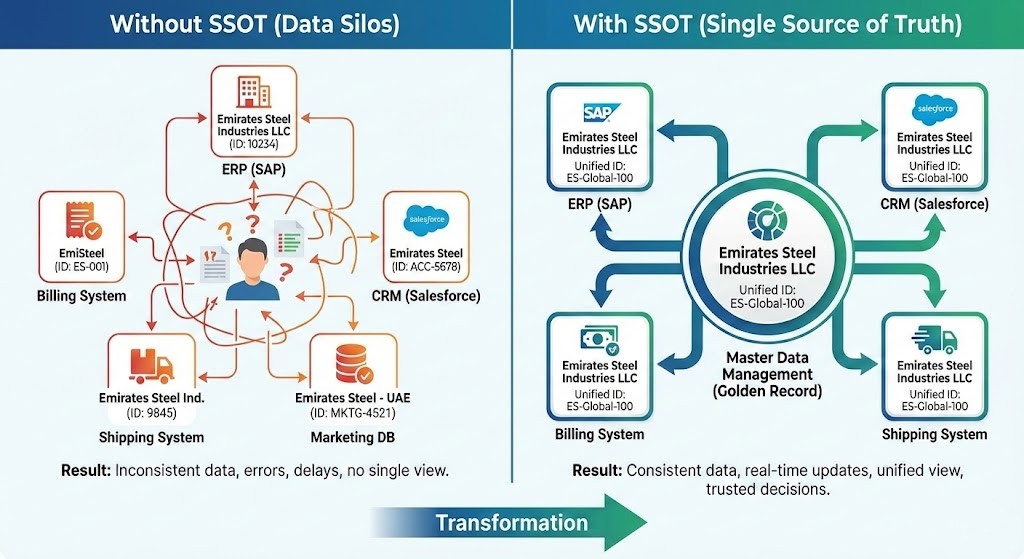
Customer “Emirates Steel” exists in five different ways: – ERP (SAP): “Emirates Steel Industries LLC” (Customer ID: 10234) – CRM (Salesforce): “Emirates Steel” (Account ID: ACC-5678) – Billing System: “EmiSteel” (Customer Code: ES-001) – Shipping System: “Emirates Steel Ind.” (Ship-To Code: 9845) – Marketing Database: “Emirates Steel – UAE” (Contact ID: MKTG-4521)
Result of this mess: – Sales reports revenue different from finance (they’re counting different systems) – Shipping delays because address fields don’t match perfectly (system can’t link the customer to invoices) – Analytics fails because you can’t connect customer purchases across systems – When Emirates Steel updates their address, you update it in 3 systems and miss 2 others – Duplicate customer records proliferate (is “Emirates Steel Industries” the same as “Emirates Steel Ind.”?) – Customer 360 view is impossible (you don’t know this customer bought through both sales and e-commerce channels)
With SSOT: – Master Data Management system holds the “golden record” for Emirates Steel (legal name, addresses, contact info, preferred payment terms, etc.) – All other systems (ERP, CRM, billing, shipping) reference this master record via APIs – Address changes once in the master → Updates everywhere in real-time – All reports show consistent customer view – Analytics can track this customer across all channels
Why SSOT Is Harder to Achieve Than It Sounds
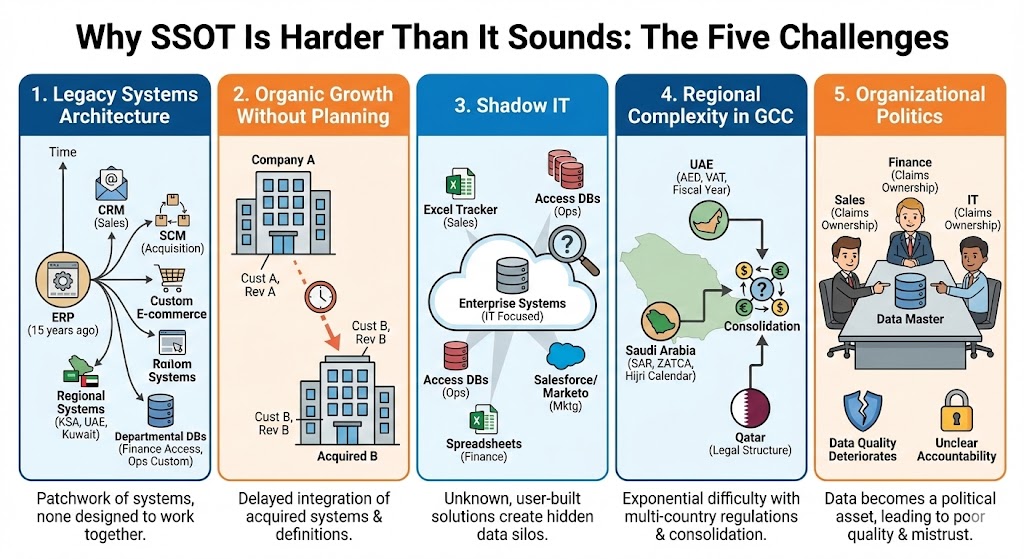
The challenge isn’t technology. The challenge is that most enterprises have legitimate reasons for their data fragmentation.
Challenge #1: Legacy Systems Architecture
Your company didn’t start with a master data management vision. You started small—one ERP system 15 years ago. Over time, you added: – CRM when you wanted better sales visibility – Supply chain system when you acquired a distributor – Custom e-commerce platform because legacy couldn’t handle web orders – Separate systems for each regional subsidiary (Saudi Arabia needs different charts of accounts than UAE; Kuwait has its own compliance requirements) – Departmental databases (Finance built an Access database for consolidation; Operations built custom inventory tracking)
Result: A patchwork of systems, none designed to work together, each with its own customer master data, product master data, and financial hierarchies.
Challenge #2: Organic Growth Without Planning
You grow by acquisition. You acquire competitors. Each acquired company has their own systems—and their own definitions of “customer,” “revenue,” and “profitability.” Integrating these systems and data models requires months of work. Meanwhile, you’re running the acquired business, so integration gets delayed indefinitely.
Challenge #3: Shadow IT
While IT was focused on the enterprise systems, business users built their own solutions: – Sales built an Excel tracker because CRM is “too slow” – Operations has three Access databases for inventory (different formats, different accuracy levels) – Marketing uses Salesforce for some campaigns and Marketo for others (different customer definitions) – Finance uses multiple spreadsheets for consolidation – Regional teams have their own local systems you don’t even know about
IT doesn’t even have a complete inventory of where company data lives.
Challenge #4: Regional Complexity in GCC
If you operate in multiple GCC countries, SSOT is exponentially harder: – UAE subsidiary uses AED, has VAT requirements, uses one fiscal year – Saudi subsidiary uses SAR, follows ZATCA e-invoicing rules, uses Hijri calendar – Qatar subsidiary operates through different legal structure – Consolidation requires currency conversion, intercompany elimination, tax adjustments – “Simple” question like “What’s our consolidated revenue?” requires translating between three accounting systems with different GL hierarchies
Challenge #5: Organizational Politics
Data becomes a political asset. Sales claims they “own” the customer master because they manage the customer relationship. Finance claims they own it because they maintain accounting accuracy. IT says it’s their responsibility because they manage systems. Meanwhile, nobody updates the data consistently because accountability is unclear.
The Consequence: Without clear ownership, data quality deteriorates. Without data quality enforcement, nobody trusts the system. Without trust, teams maintain their own spreadsheets. The original problem persists—multiple versions of truth.
The Hidden Cost of Data Chaos: What’s This Actually Costing You?
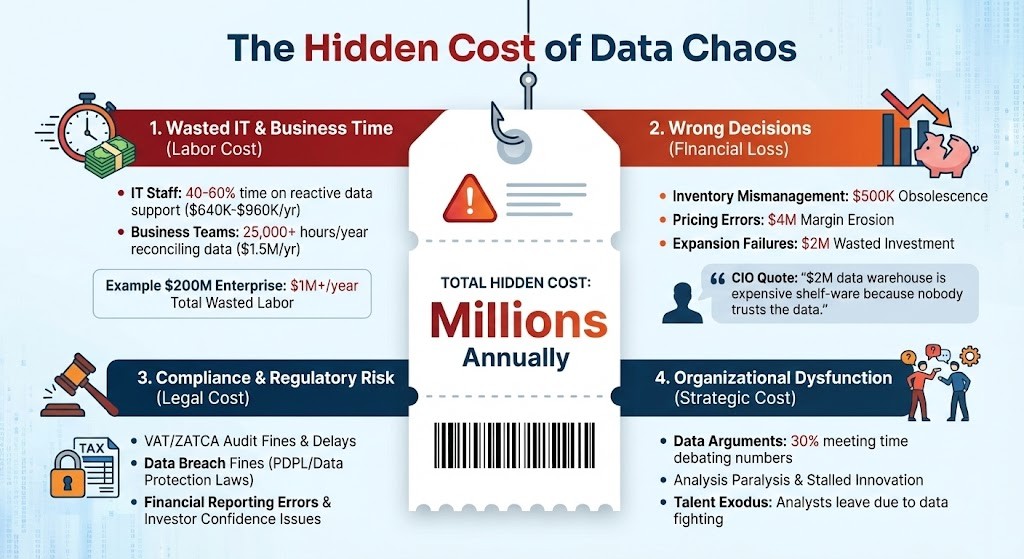
Before building SSOT, quantify the cost of not having it. Most CIOs can’t articulate the business case for SSOT because they haven’t calculated what data chaos is actually costing.
Category 1: Wasted IT and Business Time
IT staff on data requests: – 40-60% of IT team time spent responding to ad-hoc data requests instead of innovation – A 20-person IT team: 8-12 people effectively tied up on data support – At $80K salary: $640K-960K/year just on reactive data support
Business leaders on data reconciliation: – Finance team: 15-20 hours per week reconciling different revenue numbers across systems – Operations: 10-15 hours per week coordinating between ERP and logistics system – Sales operations: 12-18 hours per week cleaning and de-duplicating customer data – Across 50 people spending average 10 hours/week: 25,000 hours annually – At $60/hour loaded cost: $1.5 million annually in labor
- Example calculation for a $200M revenue Middle East enterprise: - 5 IT staff × 50% time × $80K salary = $200K/year - 20 managers × 12 hours/week × $60/hour × 50 weeks = $720K/year - Lost executive productivity waiting for data: Unquantifiable - Total labor cost: $1M+/year in wasted time
Category 2: Wrong Decisions Based on Wrong Data
- Inventory mismanagement: Ordered based on wrong demand forecast → $500K obsolescence
- Pricing errors: Analyzed wrong cost data → 2% margin erosion = $4M loss (on $200M revenue)
- Expansion decisions: Expanded into wrong market with wrong market analysis → $2M wasted investment
- Customer churn: Didn’t see warning signals because customer data was fragmented
- Supplier negotiations: Couldn’t see total spend across entities → missed consolidation savings
- Real quote from a UAE manufacturing CIO: > “We spent $2 million on a data warehouse five years ago. It has great data. But nobody uses it because they don’t trust it. Finance still uses spreadsheets. Sales still uses their own CRM. That warehouse is expensive shelf-ware sitting in the corner.”[
Category 3: Compliance and Regulatory Risk
- VAT audit discrepancies (UAE, Saudi): Potential fines if revenue can’t be reconciled
- Financial reporting errors: Board/investor confidence issues
- Data breach from unsecured shadow systems: Fines under UAE Data Protection Law and Saudi PDPL
- ZATCA compliance (Saudi): E-invoicing requires clean transactional data
- Audit delays: Month-end close extends because data quality issues must be resolved
- Regional consolidation errors: Multi-country companies struggle with intercompany elimination, creating audit findings
Category 4: Organizational Dysfunction
- Teams don’t trust each other’s data: “Is this from the ERP or from your spreadsheet?”
- Meetings devolve into data arguments: 30% of meeting time spent debating which number is “right”
- Analysis paralysis: Can’t agree on facts, so strategy debates never conclude
- Innovation stalls: No foundation to build on; teams focus on basic data accuracy instead of strategic analysis
- Talent exodus: Best analysts leave because they spend time fighting data instead of analyzing
Quantified Impact
For a mid-market Middle East enterprise ($200M revenue):
| Cost Category | Annual Impact |
|---|---|
| IT staff time on data requests | $200K–400K |
| Business staff reconciliation time | $1M–1.5M |
| Wrong decisions (inventory, pricing, etc.) | $2M–5M |
| Missed opportunities (by the time data ready, opportunity passed) | $1M–3M |
| Compliance risk and audit delays | $200K–500K |
| Total annual cost of data chaos | $4.6M–10.4M |
The kicker: Most of this is invisible. It’s buried in labor costs, lost revenue, and unmeasured inefficiency. The CFO doesn’t see a line item that says “cost of data chaos.” But it’s there—millions of dollars annually, silently eroding profitability.
The SSOT Framework: Building It Systematically
Achieving SSOT isn’t a big bang project where you rip out all systems and replace them with one golden platform. It’s a layered approach where you build capability incrementally.
Layer 1: Master Data Management (The Foundation)
What It Is: Master data is the critical business information that multiple systems and processes depend on: – Customers: Who are we doing business with? – Products/Services: What are we selling? – Suppliers: Who are we buying from? – Employees: Who works here? – Accounts (GL): How do we classify financially? – Locations/Assets: Where do we operate?
How It Works:
Traditional approach: Each system maintains its own copy of master data (customer, product, etc.). When data changes, it gets updated in ERP, then someone manually updates CRM, then someone updates shipping system. Inconsistency guaranteed.
Modern approach: One authoritative master copy. All systems connect to it via APIs.
Workflow: 1. Customer updates address in CRM (Salesforce) 2. CRM sends change event to master data system (SAP Master Data Governance or similar) 3. Master data system validates the change, applies business rules, triggers approval workflow if needed 4. Master record updates 5. All connected systems receive the update in real-time via API 6. By the time the user hits refresh in their system, address is updated everywhere
Middle East Specifics: – Multi-language: Master data supports English and Arabic – Multi-currency: Exchange rate management for AED, SAR, QAR, USD – Multi-entity: Handles legal entity relationships and intercompany transactions – Local compliance: VAT numbers, commercial registrations, regional tax codes
Technology: – SAP Master Data Governance (enterprise scale) – SAP S/4HANA with embedded MDM (mid-market) – SAP Cloud ERP with master data capabilities (smaller organizations) – Non-SAP alternatives: Salesforce Data Cloud (with MuleSoft), Informatica, Talend
Layer 2: Data Integration (The Plumbing)
The Challenge: You have 10 systems. Master data lives in system #1. But systems #2-10 also need access to customer, product, and GL master data. How do you connect them without creating a nightmare of 45 point-to-point integrations (system 1-to-2, 1-to-3, … 9-to-10)?
The Solution: Integration Platform (Hub-and-Spoke Model)
Instead of point-to-point: each system connects to a central integration platform.
Workflow: 1. ERP publishes customer master data change to integration platform 2. Integration platform routes to all subscribed systems 3. CRM receives update, applies its own business rules, updates its copy 4. Billing system receives update, updates customer billing address 5. Shipping system receives update, updates ship-to addresses 6. Portal receives update, updates customer website profile 7. All systems now have consistent, current data
SAP Approach: SAP Business Technology Platform (BTP) – Integration Suite handles connectivity – Pre-built connectors for SAP and non-SAP systems – API management capabilities – Supports real-time (streaming) and batch integration – Handles format transformation, business rule enforcement
Key benefit: Each system connects once to the platform. Platform handles the complexity of routing, transformation, and orchestration.
Middle East consideration: Integration must respect data residency—SAP BTP can route data through regional data centers (UAE, Saudi) ensuring data stays local if required.
Layer 3: Data Governance (The Rules)
Without governance, SSOT fails. Great technology doesn’t matter if nobody enforces rules.
Component 1: Data Ownership and Accountability – Who owns customer master? Typically: Sales (relationship owner) + Finance (accuracy owner) – Who owns product master? Operations or Product Management – Who owns GL chart of accounts? Finance – Clear approval workflows: Can’t create a customer without validating VAT number (UAE requirement) and commercial registration (Saudi requirement)
Component 2: Data Standards and Definitions – Customer naming: Legal name vs. trading name? What if both exist? – Address format: How do we standardize Middle East addresses (especially Arabic)? – Product classification: SAP uses one taxonomy; your legacy system uses another. Which is authoritative going forward? – Customer classification: Is “customer segment” based on industry, geography, revenue, or complexity?
Component 3: Data Quality Rules – Mandatory fields: Customer can’t be created without VAT number (UAE), CR number (Saudi), and email – Uniqueness validation: System prevents creating duplicate “Emirates Steel” if already exists – Format validation: Phone numbers must follow GCC format standards – Business rule validation: Sales rep can’t discount below 10% without manager approval
Component 4: Data Lifecycle Management – Creation: Who can create new customers? (Not every user) – Updates: What changes require approval? (Price changes: yes; address: no) – Archival: When do we mark customers as inactive? – Deletion: Can we ever delete data? (No—audit trail required) – Retention: How long do we keep deactivated customer records?
Organizational Structure: – Data Governance Council (monthly): CFO/COO, CIO, heads of Finance, Sales, Operations – Data Stewards (by domain): Customer steward, Product steward, GL steward—each responsible for data quality in their domain – Data Quality monitoring: Dashboards tracking accuracy, completeness, timeliness – Escalation path: What happens when a data quality issue can’t be resolved at steward level?
Best practice: Start governance with 2-3 critical entities (usually customers). Get it working. Then expand. Don’t try to govern all data at once.
Layer 4: Analytics and BI (The Value Layer)
Once you have SSOT, analytics becomes powerful.
Without SSOT, analytics is limited: – Problem: Analyst builds report on customer revenue. Sales team says “that’s wrong, we had $X in Q2.” Finance says “actually it’s $Y.” Analyst spends 3 days investigating which system is correct. – Solution: Remove the ambiguity. All data comes from SSOT. All systems trust it. All reports agree.
What becomes possible: – Single executive dashboard: Q2 revenue appears as one number. Everyone trusts it. No debate. – Customer 360: Complete view of customer across all channels (direct sales, e-commerce, partnerships) – Real-time analytics: Because data is current (not batch overnight) – Drill-down capability: See that revenue is down in Saudi; drill to see it’s a particular customer segment; drill further to see it’s one customer; drill further to see specific orders – Root cause analysis: Revenue down? System shows correlating factors: oil prices down (affects customer demand), competitor pricing down 8%, customer consolidation (two customers merged into one)
Platform: – SAP Analytics Cloud (if running SAP systems) – native connectivity to MDM, real-time – Alternative BI tools (Power BI, Tableau, Qlik) – work with SSOT data but require more configuration – Key requirement: All analytics pull from same source (SSOT), not different system views
Implementation Strategies: Three Approaches
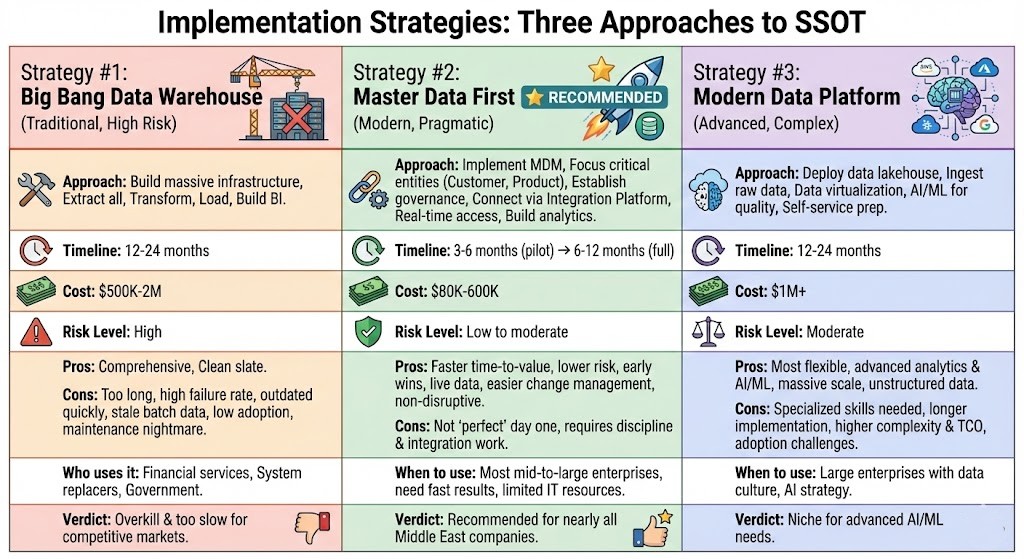
There’s no single way to implement SSOT. Different companies choose different paths based on timeline, budget, and risk tolerance.
Strategy #1: Big Bang Data Warehouse (Traditional, High Risk)
Approach: 1. Build massive data warehouse infrastructure 2. Extract all data from all 10+ systems 3. Transform into common format 4. Load into warehouse 5. Build BI layer on top
Timeline: 12-24 months
Cost: $500K-2M
Risk Level: High
Pros: – Comprehensive from day one – Clean slate to design correctly
Cons: – Takes too long; opportunities and market conditions change mid-project – High failure rate (data quality issues discovered late) – Becomes outdated quickly as source systems change – Data is copied, not live (batch refresh overnight means reports are stale) – Separate system = low adoption (business keeps using spreadsheets) – Requires building/maintaining ETL pipelines for all systems (maintenance nightmare)
Who uses it: – Financial services with strict data residency requirements – Organizations planning to replace most systems anyway – Government entities that can wait 18 months
Verdict for Middle East enterprises: Usually overkill and too slow for competitive markets.
Strategy #2: Master Data First (Modern, Pragmatic) ⭐ RECOMMENDED
Approach: 1. Implement Master Data Management system (SAP MDG, alternatives) 2. Focus on critical entity types: Usually customers first, then products, then GL 3. Establish data governance (who owns data, approval workflows) 4. Connect systems to master via integration platform (SAP BTP) 5. Leave transactions in source systems (they continue operating) 6. Use integration layer for real-time access to master data 7. Build analytics on top of integrated view
Timeline: 3-6 months (pilot on single entity type) → 6-12 months (full implementation)
Cost: $80K-600K (varies by scale and complexity)
Risk Level: Low to moderate
Pros: – Faster time-to-value (3-6 months to first success) – Lower risk (start with customers, expand to products) – Build organizational confidence through early wins – Live data (not batch overnight) – Easier to add new systems (integration framework already in place) – Easier change management (business sees incremental improvement) – Non-disruptive (keep existing systems running)
Cons: – Not “perfect” from day one – Requires ongoing governance discipline – Requires building integration connections (some work, but less than data warehouse approach)
When to use: – Most mid-to-large enterprises – If you need results in months, not years – If you want to prove value before big investment – If you have limited IT resources (no massive data engineering team)
Recommended for nearly all Middle East companies.
Strategy #3: Modern Data Platform (Advanced, Complex)
Approach: 1. Deploy data lake/lakehouse architecture (AWS, Azure, Google Cloud) 2. Ingest raw data from all systems 3. Use data virtualization to query across sources without copying 4. AI/ML for data quality, matching, and master data discovery 5. Self-service data preparation for analysts
Timeline: 12-24 months
Cost: $1M+
Risk Level: Moderate
Pros: – Most flexible – Supports advanced analytics and AI/ML – Scales to massive data volumes – Can handle unstructured data
Cons: – Requires specialized data engineering skills (scarce in Middle East) – Longer implementation – Higher complexity – Higher TCO over time – Adoption challenges (not intuitive for business users)
When to use: – Large enterprises ($500M+ revenue) with data-driven culture already – Organizations that can hire/train data engineering team – When advanced analytics and AI are core to strategy
Real-World Middle East Example: From Data Chaos to Data Trust
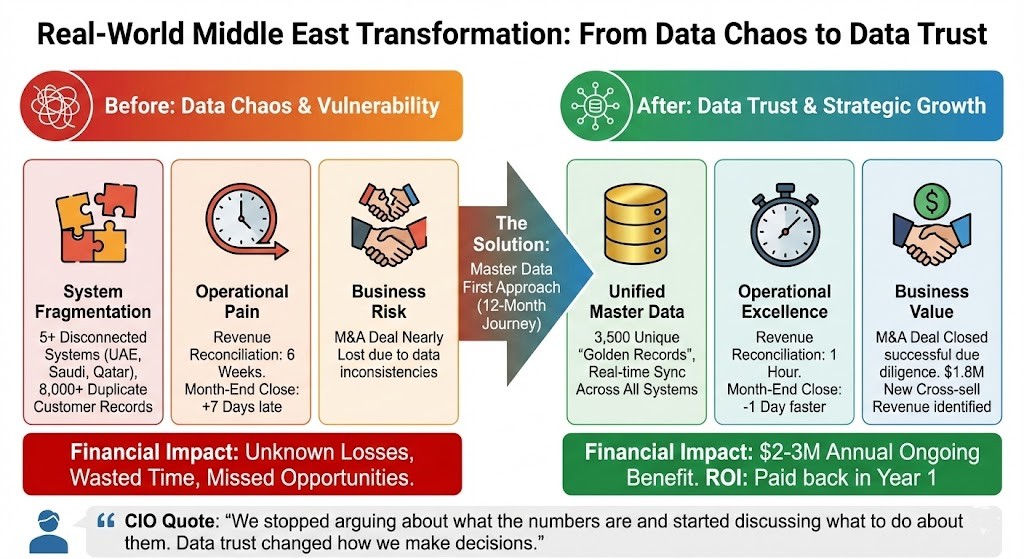
Company: Gulf Region Distributor (composite example based on real situations)
Profile: – Revenue: $180M – Employees: 450 – Operations: UAE (HQ), Saudi Arabia, Qatar – Products: Industrial equipment distribution (pumps, generators, hydraulics) – Markets: Construction, oil & gas, industrial
The Data Chaos
System fragmentation: – UAE operations: 15-year-old SAP ECC (legacy but functional) – Saudi operations: Local system (government compliance requirements mandate local system) – Qatar operations: Separate SAP instance (regulatory reasons) – CRM: Salesforce (sales team built this because they claimed SAP was “too slow”) – E-commerce: Magento (separate database, separate customer IDs) – Finance consolidation: Excel with manual data entry from each system – Master data chaos: – 8,000+ customer records across all systems – Same customer has 4-5 different IDs depending on system – Addresses don’t match between systems (costs shipping delays) – “Emirates Steel” vs. “Emirates Steel Industries” vs. “EmiSteel”
The Impact: – Revenue reconciliation: Finance can’t answer “What’s our Q2 revenue?” without 3-4 days of investigation – M&A vulnerability: Private equity investor considering acquisition did due diligence—data inconsistency almost killed the deal – Operational pain: Shipping department has to manually match customer names between order system and shipping label system – Analytics broken: Can’t create unified customer view; can’t track customer lifecycle
The Breaking Point: Private equity investor considering acquisition. Due diligence request: Consolidated Q1-Q2 financial reports by business unit, customer, and geography.
Company couldn’t deliver. Took 6 weeks of manual reconciliation. Data inconsistencies discovered. Investor concerned about data integrity. Nearly lost the deal.
CEO Mandate: “Fix this before we sell the company. We need clean, trustworthy financial data.”
The Solution (Master Data First Approach)
Phase 1: Foundation
(Months 1-3)
Activities: – Data audit: Mapped all customer records across systems – Governance framework: Defined customer master data standards, approval workflows, stewardship – Tool selection: Chose SAP Master Data Governance Cloud (quick to implement, cloud-based, no on-premise infrastructure) – Proof of concept: Cleaned up customers in one system (UAE) as pilot
Outcome: – Identified 3,500 unique customers (from 8,000+ records; 4,500+ were duplicates or inactive) – Defined customer master data model (company name, legal structure, VAT number, addresses, contacts, credit limit, payment terms, etc.) – Assigned data stewards (Sales owns customer relationships; Finance owns credit data; Operations owns delivery addresses) – Established governance council (monthly meetings, conflict resolution)
Phase 2: Implementation (Months 4-6)
Activities: – Migrated clean customer master to SAP MDG Cloud – Set up integration: Connected SAP UAE to MDG (real-time sync) – Connected Salesforce to MDG (via SAP BTP Integration Suite) – Connected Magento e-commerce to MDG – Built data quality rules (mandatory VAT number for Saudi customers per ZATCA; CR number for UAE) – Trained users
Outcome: – Single customer master with 3,500 “golden records” – When address updates in Salesforce → Updates in MDG → Pushes to SAP, billing system, shipping system (real-time) – Customer deduplication complete – All systems now reference same customer
Phase 3: Expansion (Months 7-9)
Activities: – Implemented product master (same approach as customers) – Connected Saudi and Qatar SAP instances to master – Established real-time data flow across all operations
Outcome: – Unified view of inventory across all regions – Product pricing consistent (no more different prices for same product in different regions) – Consolidated analytics possible
12-Month Results
| Metric | Before | After | Impact |
|---|---|---|---|
| Customer master records | 8,000+ | 3,500 | Eliminated duplicates and inactive records |
| Unique customers identified | Unknown | 3,500 | Now know actual customer count |
| Data quality score | 45% | 92% | Significant improvement in accuracy and completeness |
| Revenue reconciliation time | 6 weeks | 1 hour | Dramatic speed improvement |
| Month-end close timeline | +7 days (waiting for data) | -1 day (faster close) | 8-day improvement in close timeline |
| Customer 360 visibility | Impossible | Real-time | Can see each customer across all channels |
| Cross-sell opportunities discovered | 0 (couldn’t see) | 45 (identified) | UAE customers buying in Saudi without knowing they’re the same entity |
| Financial Impact Area | Value |
|---|---|
| Operational savings | $80K annually (finance analyst time saved) |
| Shipping efficiency | $60K saved (5% fewer delivery delays) |
| Working capital improvement | $150K (better credit management) |
| Cross-sell revenue | $1.8M new revenue (20% conversion of 45 opportunities) |
| M&A readiness | Enabled acquisition to close (data no longer a risk) |
| Investment Component | Cost |
|---|---|
| SAP MDG Cloud (software + first year) | $120K |
| Implementation (WMS Middle East) | $250K |
| Training & change management | $50K |
| Total Investment | $420K |
ROI: Paid back in first year from M&A readiness alone. Ongoing benefits: $2-3M annually.
CIO Quote: > “We stopped arguing about what the numbers are and started discussing what to do about them. Data trust changed how we make decisions. It’s actually enabled strategy instead of being a bottleneck.”
Technology Components Explained
For CIOs and data officers, here’s how the technical stack works:
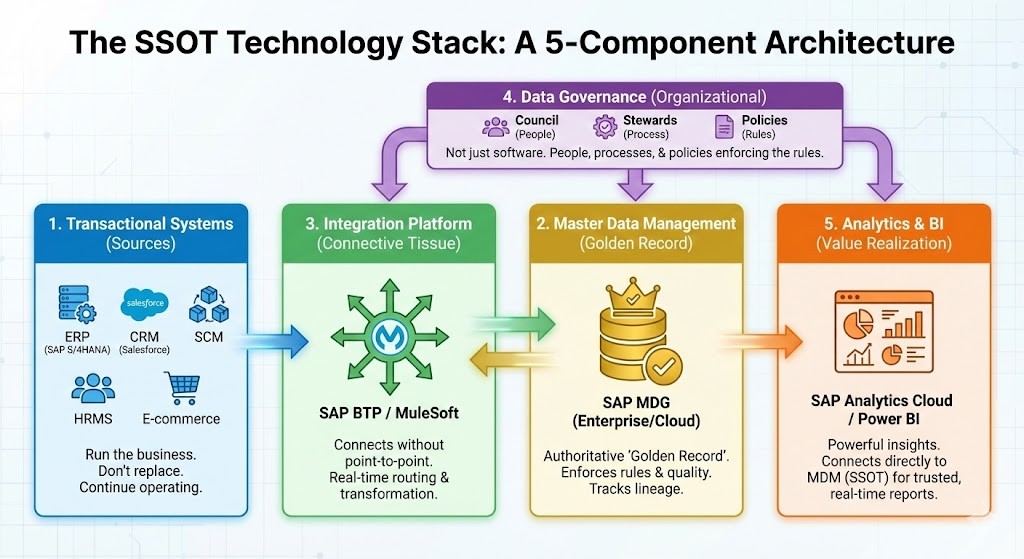
Component 1: Transactional Systems (Source Systems)
These systems run your business day-to-day. They don’t change: – ERP (SAP S/4HANA, SAP Cloud ERP, Business One): Financial, operational, inventory data – CRM (SAP Sales Cloud, Salesforce, Microsoft Dynamics): Customer interactions, pipeline, opportunities – SCM (SAP S/4HANA Integrated Supply Chain): Procurement, inventory, logistics – HRMS (SAP SuccessFactors): Employee, payroll, talent data – Specialized systems: E-commerce, industry-specific applications
Key point: You DON’T replace these systems to achieve SSOT. They continue operating, handling transactions.
Component 2: Master Data Management (Golden Record)
This is where authoritative master data lives: –
Option A (Enterprise): SAP Master Data Governance (on-premise or cloud) – Preconfigured for SAP systems – Full feature set (workflows, approvals, data quality management) – Cost: From $944K for baseline implementation – Timeline: 3-6 months for pilot
Option B (Cloud/Quick Start): SAP MDG Cloud Edition
- Lower cost entry: $93/month per 5,000 objects[4]
- Same capabilities as on-premise, cloud-delivered
- Faster deployment
- Good for SMBs or pilot project.
Function: – Stores authoritative master data (customers, products, GL accounts, etc.) – Enforces business rules and data quality – Manages approval workflows (e.g., “new customer can’t be created without CFO approval if credit limit > $1M”) – Tracks lineage and audit trails – Publishes master data to other systems
Component 3: Integration Platform (The Connective Tissue)
Purpose: Connect master data system to transactional systems without point-to-point integrations.
SAP Approach: SAP Business Technology Platform (BTP) – Integration Suite: Pre-built connectors for 300+ systems (SAP and non-SAP) – Real-time capability: Stream updates or batch at schedule – Transformation: Convert data formats between systems – API Management: Publish APIs for self-service integration – Monitoring: Track all data flows, troubleshoot issues
Alternative platforms: MuleSoft (if Salesforce-centric), Dell Boomi, Informatica
How it works: 1. Change happens in system A (e.g., customer address in Salesforce) 2. Integration platform captures the event 3. Applies transformation rules (convert Salesforce format to master data format) 4. Updates master data system 5. Routes update to all subscribed systems (ERP, billing, shipping, etc.) 6. Each system applies its own business rules 7. All systems now consistent
Cost: Part of SAP BTP subscription, typically $30-50K annually for typical enterprise integration needs.
Component 4: Data Governance (Organizational)
This is not software—it’s people, processes, and policies.
Software supports governance by: – Enforcing workflows (data change must be approved before taking effect) – Tracking audit trails (who changed what, when, why) – Monitoring data quality (dashboards showing accuracy, completeness, timeliness) – Automating validation rules (address must be formatted correctly)
But the governance itself is: – Data Governance Council: Monthly meeting of business and IT leaders – Data Stewards: Assigned owners of each data domain (Customer steward, Product steward, GL steward) – Policies: Rules for data creation, update, deletion – Standards: Common definitions and formats – Escalation path: How to resolve data quality disputes
Component 5: Analytics & BI (Value Realization)
Once master data system and integration layer are in place, analytics becomes powerful:
SAP Approach: – SAP Analytics Cloud: Cloud BI tool, native to SAP ecosystem – Connects directly to MDM for real-time insights – Self-service capabilities for business users – Mobile-ready dashboards
Non-SAP Alternatives: – Power BI: Microsoft ecosystem – Tableau: Salesforce ecosystem – Qlik: Independent
Key requirement: All BI tools connect to SSOT (master data), not to individual systems. Otherwise you recreate the problem.
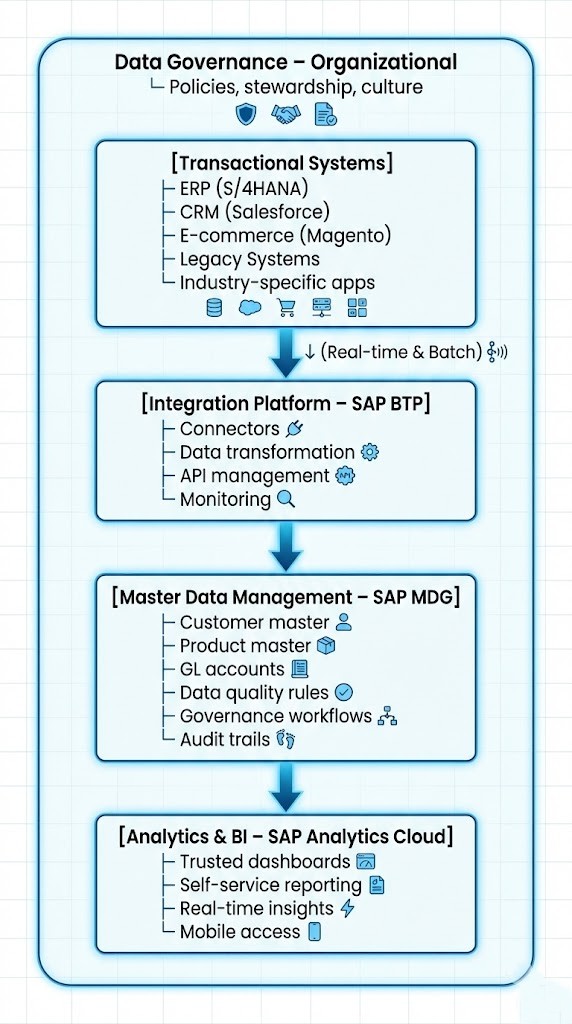
The Architecture Visual
[Transactional Systems]
├─ ERP (S/4HANA)
├─ CRM (Salesforce)
├─ E-commerce (Magento)
├─ Legacy Systems
└─ Industry-specific apps
↓ (Real-time & Batch)
[Integration Platform – SAP BTP]
├─ Connectors
├─ Data transformation
├─ API management
└─ Monitoring
↓
[Master Data Management – SAP MDG]
├─ Customer master
├─ Product master
├─ GL accounts
├─ Data quality rules
├─ Governance workflows
└─ Audit trails
↓
[Analytics & BI – SAP Analytics Cloud]
├─ Trusted dashboards
├─ Self-service reporting
├─ Real-time insights
└─ Mobile access
[Data Governance – Organizational]
Surrounds everything
└─ Policies, stewardship, culture
Key Principle
You don’t need to replace existing systems to achieve SSOT. You add a master data layer and integration layer on top. Existing systems keep doing their jobs. But now they’re connected, and now they’re governed.
Common Implementation Pitfalls (And How to Avoid Them)
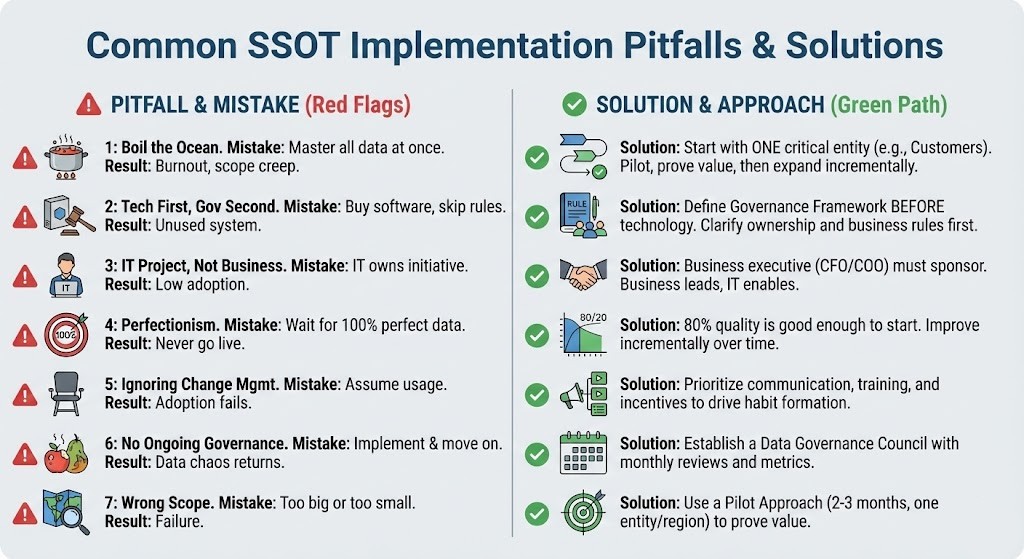
Pitfall #1: Boil the Ocean
Mistake: Try to master all data types at once (customers, products, suppliers, assets, GL accounts, vendors, employees, locations, etc.)
Result: 24-month project, team burnout, scope creep, features never implemented, value never realized.
Solution: Start with ONE critical entity type. Usually customers (everyone agrees they’re important, data quality impact is clear). Prove value. Build confidence. Then expand to products. Then GL. Then vendors.
Typical phasing: – Months 1-3: Pilot customers only – Months 4-6: Implement customers full enterprise – Months 7-9: Add products – Months 10-12: Add GL accounts
Pitfall #2: Technology First, Governance Second
Mistake: Buy SAP MDG software, assume data quality will magically improve. Skip the governance framework.
Result: System is implemented but data quality doesn’t improve because nobody enforces rules. System sits unused.
Solution: Define governance framework BEFORE implementing technology. – Who owns customer data? (Sales? Finance? Both?) – What are the business rules? (Can’t create customer without VAT number in UAE) – What’s the approval workflow? (New customer created by junior analyst, approved by manager, published to master) – What happens when rules are violated? (Rejection + notification + coaching)
Technology then enforces the governance you’ve defined.
Pitfall #3: IT Project, Not Business Project
Mistake: IT owns the SSOT initiative. Business sees it as “another IT project.”
Result: Low adoption. Business users don’t change behavior. They continue using spreadsheets and shadow systems.
Solution: Business executive must sponsor (CFO or COO). Business owns the initiative. IT enables.
Change from “IT is implementing MDM” to “Finance is leading a data governance transformation, with IT providing platform.”
Pitfall #4: Perfectionism
Mistake: “We can’t go live until 100% of our data is perfect.”
Result: Never go live. Perfect is enemy of good.
Solution: 80% data quality is good enough to start. The data quality improves over time as you validate, cleanse, and standardize incrementally.
Go live with clean customers (highest value). Then systematically clean products. Then expand.
Pitfall #5: Ignoring Change Management
Mistake: Build great technology, assume people will use it.
Result: System works. Nobody uses it. Adoption fails.
Solution: Change management is as important as technology. – Communication: Why are we doing this? (Appeal to shared pain) – Training: How to use the system? (Make it easy) – Incentives: What’s in it for users? (Faster approvals, less manual work, better decisions) – Habit formation: Make it easier to do the right thing than the wrong thing (new customer workflow routes through MDM, not alternative)
Pitfall #6: No Ongoing Governance
Mistake: Implement, then move on. Nobody maintains data quality.
Result: 12 months later, data chaos returns. Duplicates reappear. Quality deteriorates.
Solution: Data Governance Council meets monthly. Data quality metrics on executive dashboard. Make it part of culture, not one-time project.
Typical monthly governance council agenda: – Data quality metrics review (accuracy, completeness, timeliness) – Issues and escalations (data disputes, rule violations) – Master data changes (new customer types? new product categories?) – Policy updates
Pitfall #7: Wrong Scope
Mistake: Either too small (doesn’t solve the core problem) or too big (never finishes).
Result: Failure either way.
Solution: Pilot approach—2-3 months on one entity type, one region. Prove value. Get business sponsor excitement. Then expand.
Middle East Regional Considerations
Several factors unique to GCC enterprises affect SSOT strategy:
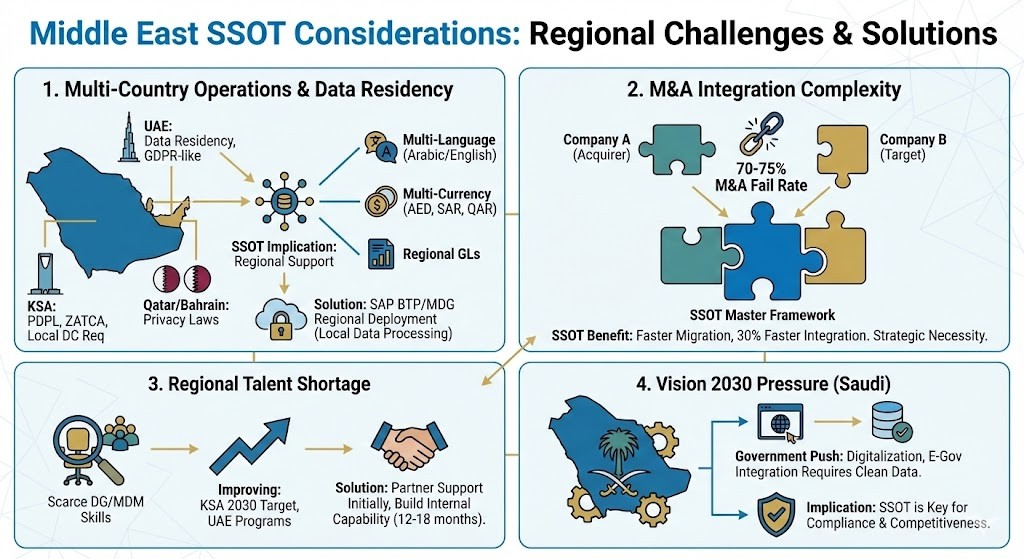
Multi-Country Operations and Data Residency
Most GCC companies operate in 2-3 countries. Each has different regulations: – UAE: Data Protection Law requires alignment with GDPR-like standards; banking sector has data residency (must store in UAE) – Saudi Arabia: PDPL (Personal Data Protection Law); ZATCA e-invoicing creates structured transaction data; National Cybersecurity Authority ES requirements; government contracts may require local data center – Qatar: Personal Data Privacy Protection Law (2016) – Bahrain: Data protection regulations (2018)
SSOT implication: Master data governance system must support: – Regional data center deployment (data doesn’t leave country boundaries) – Multi-language (Arabic + English) – Multi-currency (AED, SAR, QAR, USD conversion) – Regional GL structures (different tax treatments, withholding requirements)
Solution: SAP BTP and SAP MDG support regional deployment. Data can be processed in UAE data center, Saudi data center, etc., meeting residency requirements.
M&A Integration Complexity
The reality: 70-75% of M&A deals underperform or fail. Data integration is 60% of post-M&A challenges. Only 14% of organizations achieve complete integration success.[5]
When you acquire a company: – Their systems use different customer IDs – Their GL structure is different – Their product taxonomy is different – Consolidation requires integrating these disparate master data sets
SSOT benefit: If acquirer has master data governance framework in place, acquired company’s data can be migrated into the same framework. Reduces integration complexity and timeline significantly. 30% faster integration possible.[6]
Implication: If you’re an acquisition target or predator, SSOT is not optional—it’s strategic.
Regional Talent Shortage
Data governance and master data management skills are scarce in Middle East. But improving: – Saudi Arabia investing in AI talent (20,000 data specialists target by 2030) – UAE universities adding data science programs – Consulting firms (including WMS Middle East) have regional expertise
Solution: Implement with partner support initially. Build internal capability over 12-18 months. Partner can train your team.
Vision 2030 Pressure (Saudi)
Saudi companies face government push toward digitalization and data-driven governance. E-government integration requires clean transaction data. Companies without SSOT struggle with government integrations.
Implication: Saudi companies should prioritize SSOT as part of Vision 2030 compliance and competitiveness agenda.
Assessing Your SSOT Readiness: Maturity Model
Before building SSOT, understand where you are today. Most Middle East enterprises fit into one of five maturity levels.
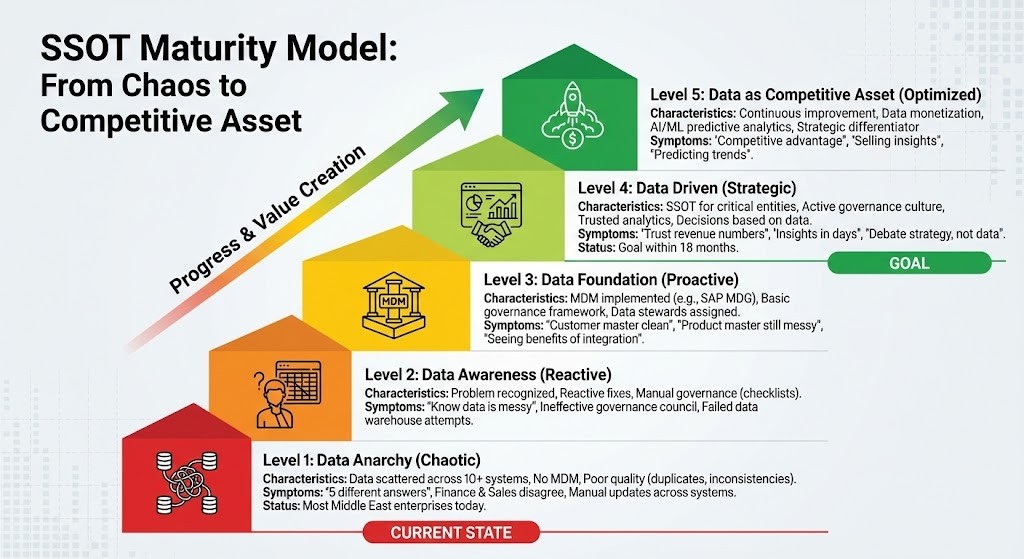
Level 1: Data Anarchy (Chaotic)
Characteristics: – Data scattered across 10+ systems – No master data management – Different departments have different versions of truth – No data governance – Data quality poor (duplicates, inconsistencies, gaps) – Each system maintains its own copy (updates inconsistent across systems)
Symptoms: – “We have 5 different answers to the same question” – “Finance and Sales can’t agree on revenue numbers” – “When I update a customer address, I have to update it in 3 systems” – “We don’t know which data to trust”
This is where most Middle East enterprises are today.
Level 2: Data Awareness (Reactive)
Characteristics: – Recognized that data fragmentation is a problem – Started talking about MDM/SSOT – Some manual data governance (spreadsheets, checklists) – Still mostly reactive (fix problems as they surface) – Some attempt at data quality improvement
Symptoms: – “We know our data is messy but don’t know how to fix it” – “We have a data governance council but it’s not effective” – “We tried to build a data warehouse but it didn’t work out”
Level 3: Data Foundation (Proactive)
Characteristics: – MDM system implemented (SAP MDG or similar) – Basic governance framework in place – Starting to see value from data quality improvements – Data stewards assigned – Approval workflows enforced
Symptoms: – “Our customer master is clean and consistent” – “But our product master is still a mess” – “We’re starting to see the benefit” – “Integration is helping with data consistency”
Level 4: Data Driven (Strategic)
Characteristics: – SSOT established for critical entities (customers, products, GL) – Active governance culture – Data quality monitored continuously – Analytics trusted because data is trusted – Decisions made based on data, not gut feel – Clear ROI demonstrated
Symptoms: – “We trust our revenue numbers” – “We can get insights in days instead of weeks” – “Different departments agree on the facts; we debate strategy, not data” – “Data quality is part of how we manage the business”
Level 5: Data as Competitive Asset (Optimized)
Characteristics: – Continuous improvement mindset – Data monetization (insights sold to customers, partners) – Predictive analytics embedded in operations – AI/ML leveraging clean master data – Data is strategic differentiator
Symptoms: – “Our data gives us competitive advantage” – “We’re selling insights, not just products” – “We’re predicting market trends before competitors”
Goal for most Middle East enterprises: Reach Level 4 (Data Driven) within 18 months.
Summary: Your Competitive Inflection Point
The hallmark of mature, competitive organizations is one thing: data trust.
When different departments agree on the facts and debate strategy instead of data, everything changes. Decisions get made faster. Quality improves. Organizational energy shifts from “which number is right?” to “what should we do?”
This isn’t theoretical. Organizations with SSOT make decisions 5x faster than those without it. They avoid wrong decisions based on wrong data. They move confidently into new markets because they have reliable information.
The cost of building SSOT is real: $80K-600K depending on scale and complexity. The cost of not building it is higher: $4.6M-10.4M annually in wasted time, wrong decisions, and lost opportunities.
For Middle East enterprises, the window for SSOT adoption is NOW. Technology is accessible. Regional expertise is available. Your competitors are starting to build it. The question isn’t whether SSOT makes sense—it absolutely does. The question is: Will you be an early mover capturing competitive advantage, or will you follow after the market has moved?
The journey to Single Source of Truth starts with one conversation, one assessment, one use case. It doesn’t require perfect conditions. It doesn’t require years of preparation. It requires deciding that data trust is foundational to your competitive strategy.
Data-driven decision-making isn’t about algorithms or analytics tools. It’s about everyone trusting the same facts. Everything else flows from that.

Start Your Journey
Building SSOT doesn’t require a massive transformation. It starts with one decision, one use case, one team.
If you’re at Level 1-2 (Data Anarchy or Awareness) and want to move toward Level 4 (Data Driven):
Next steps:
☐ Data Maturity Assessment (30-min workshop) – Where are you today on the maturity model? – What’s costing you most (wasted time? wrong decisions? compliance risk? – Which use case has highest impact? – Contact WMS Middle East for free assessment
☐ Quick Wins Identification (2-hour workshop) – What’s your highest-value master data to start with? (Usually customers) – What would change if that data were perfect and consistent? – Quick win: Clean up and govern customer master in one region or department – Prove value in 6 weeks → Build confidence → Expand
☐ Pilot Roadmap (Free consultation) – 90-day plan to implement SAP MDG for customer master (1 entity, 1 region) – Cost: $80-150K depending on scope – Outcome: Proof of concept that reduces manual data work, improves quality, builds business case for expansion
☐ Governance Framework Template (Download) – Data Governance Council charter – Data steward role descriptions – Data quality metrics and KPIs – Approval workflow templates – Customizable for your organization
Contact WMS Middle East for a free assessment.
Frequently Asked Questions (FAQs)
Do we have to rip out and replace our existing systems?
No. SSOT is a layer on top. Your ERP, CRM, etc. stay in place. You add master data management and integration layer. Systems keep operating but now they’re connected and governed.
How long does it take to implement?
Depends on scope. Pilot (one entity type, one region): 2-3 months. Full implementation (all critical entities, all regions): 6-12 months with iterative approach. Big bang (traditional data warehouse): 12-24 months.
What if we have non-SAP systems (Salesforce, Oracle, custom-built)?
Common situation in Middle East. SAP BTP can integrate with non-SAP systems. You don’t need all-SAP to achieve SSOT. We’ve implemented master data solutions in 100% non-SAP environments using alternative platforms.
Who owns the master data – IT or business?
Business owns (e.g., Sales owns customer master, Finance owns GL, Operations owns product master). IT enables and enforces. Data governance is cross-functional accountability.
What about data privacy and compliance (GDPR, PDPL, ZATCA)?
SSOT actually helps compliance. When you have one authoritative record with clear lineage and audit trail, it’s easier to prove compliance. Data Privacy Law (PDPL in Saudi) requires knowing where data lives and who has access—SSOT provides this transparency.
Can we implement this while running business-as-usual?
Yes. Non-disruptive. Implement alongside existing systems. Gradual cutover (customers move to master, then products, etc.). Business doesn’t stop.
What if our data is really, really messy?
Everyone’s data is messy initially. Part of implementation is data audit and cleansing. Use 80/20 rule: clean 80% of your critical data, go live, improve remaining 20% incrementally.
How do we maintain data quality ongoing?
Combination of technology (validation rules, duplicate detection, business rule enforcement) and process (monthly governance council, data stewards, quarterly audits). Make data quality someone’s job, not everyone’s afterthought.
What’s the typical ROI timeline?
Pilot (2-3 months) delivers proof of concept. Full ROI within 12-18 months. Ongoing benefits: 2-3% improvement in operational efficiency, 15-20% reduction in time spent on data requests, better decision-making.
Do we need dedicated data governance staff?
Initially, can be part-time (2-3 data stewards, 0.5 FTE each). As maturity increases, may justify Chief Data Officer role (typically 1 FTE). Start small and scale as value is demonstrated
Can this work for companies with operations in multiple Middle East countries?
Yes, actually designed for it. Master data governance handles multi-currency, multi-language, multi-entity consolidation naturally. Regional data residency is supported by platform (data center options in UAE, Saudi Arabia, etc.).
We’re planning an ERP upgrade. Should we implement SSOT before or after?
Perfect time to implement SSOT during ERP upgrade. New ERP provides clean foundation for master data. Coordinate timing with implementation partner. Typically: new ERP → build MDM foundation → integrate other systems.

Mahitab Maher
SAP professional specializing in SAP products, helping companies turn complex processes into smooth, scalable operations.
References & Data Sources
[1] Organizations lose average $12.9-15M annually due to poor data quality; employees spend 27% of time correcting bad data (Gartner, Actian research)
[2] IT teams spend 40-60% of time responding to ad-hoc data requests instead of innovation (Industry surveys, data governance research)
[3] Composite quote based on multiple CIO interviews reflecting common experience
[4] SAP MDG Cloud pricing: $93/month per 5,000 objects (SAP pricing as of January 2026)
[5] 70-75% of M&A deals underperform; only 14% achieve complete integration success; 60% of post-M&A issues are IT-related (HCL Technologies research on post-M&A integration)
[6] 30% reduction in M&A integration cycle time possible with proper data foundation (HCL Technologies, Kuvera Consulting research on GCC M&A)
Based on research from: Gartner (data quality costs), Alation (data governance best practices), STIBO Systems (MDM ROI), SAP (MDM and BTP capabilities), HCL Technologies (M&A integration), Kuvera Consulting (GCC M&A complexity), InCountry (Middle East data residency), Clifford Chance (Middle East data protection laws)


The “single source of truth” concept really stood out to me. So many teams struggle because everyone is looking at different reports.
That’s a great point, Hannah. Having consistent data across teams really helps organizations make faster and more confident decisions.
Establishing a single source of truth is critical for leadership alignment. This article effectively highlights the importance of data consistency.
Thank you, Eleanor. Reliable and unified data enables confident, strategic decision-making across departments. We appreciate your thoughtful feedback.