


The Problem You Didn't Know You Had
Picture this: It’s Monday morning at your enterprise, and you’re sitting in a critical strategic meeting. The head of sales pulls up a customer count report showing 50,000 active customers. Meanwhile, the VP of Marketing is looking at their dashboard and seeing 47,500. Meanwhile, finance is reconciling against their own system and finding yet another number. Everyone’s looking at the same company, but they’re literally looking at different data.
Sound familiar?
You’re not alone. This isn’t a small inconvenience—it’s a fundamental business problem that costs organizations millions annually. When your teams can’t trust that they’re working with the same facts, decision-making becomes guesswork dressed up as strategy. And in today’s fast-moving market, guesswork is a luxury you simply cannot afford.
This is precisely why one thing has become non-negotiable for forward-thinking Enterprise Data Officers and CIOs: a Single Source of Truth (SSOT).
Why This Matters More Than Ever
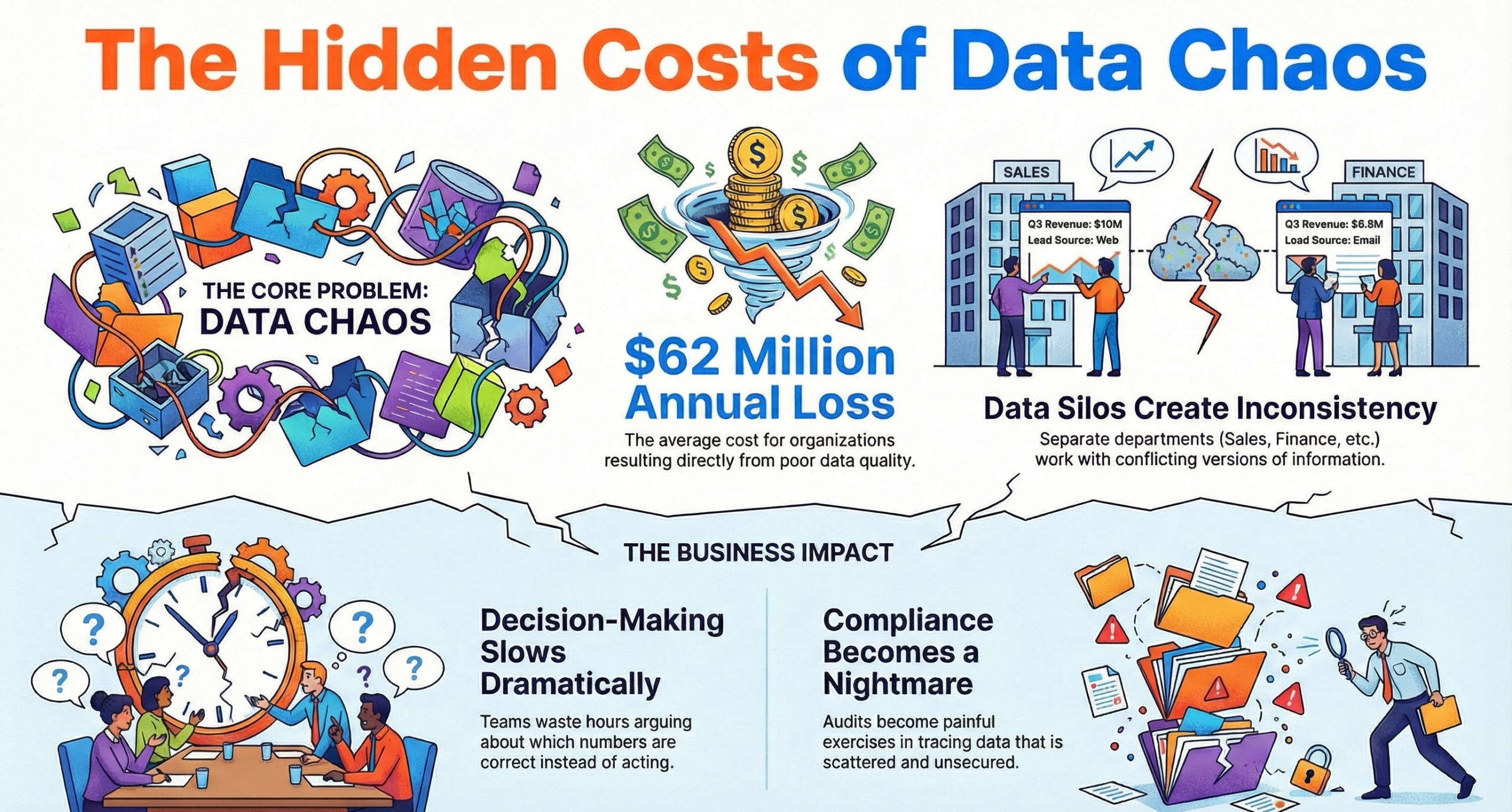
The data landscape has fundamentally changed. Companies aren’t drowning in a lack of information anymore—they’re drowning in too much of it. According to industry research, organizations are losing up to $62 million annually due to poor data quality alone. That’s not theoretical; that’s real money walking out the door.
Here’s what typically happens without a Single Source of Truth:
Data silos emerge naturally. Sales keeps customer data one way. Finance maintains it differently. Operations has their own version. Nobody’s trying to be difficult; teams just organize information in the way that makes sense for their immediate needs.
Inconsistency becomes the norm. Different departments work with different versions of the “same” data. Marketing thinks you have 100 high-value customers; sales thinks it’s 75. Both teams are making decisions based on information they believe to be accurate—but they’re not aligned.
Decision-making slows down dramatically. Instead of acting on insights, teams spend hours reconciling data, arguing about which numbers to trust, and building custom reports just to answer basic questions.
Compliance becomes a nightmare. When data lives everywhere, audits become painful exercises in data archaeology. You’re scrambling to prove where information came from and whether it’s been properly secured.

Missed opportunities multiply. By the time data is finally reconciled and analyzed, market conditions have shifted. You're always a step behind competitors who can act faster with trustworthy information.
The Building Blocks of a True Single Source of Truth
Creating a SSOT isn’t about buying one piece of software and declaring victory. It’s a thoughtful process that requires attention to several key components working in harmony.
1. Clear Data Ownership and Governance
This is where it all starts. Someone needs to be accountable for each piece of data. That doesn’t mean they personally manage every database entry—it means they own the quality, accuracy, and accessibility of that data domain.
Many organizations address this by:
Assigning a Chief Data Officer (CDO)
Establishing a data governance council
Setting data policies and standards
Ensuring data flows follow agreed-upon rules
Without clear ownership, governance becomes everyone’s responsibility, which is another way of saying it’s nobody’s responsibility.
2. Integration and Consolidation Infrastructure
Your data lives in many places: customer relationship systems (CRMs), enterprise resource planning (ERP) software, marketing automation tools, financial systems, and more. Getting all this data to flow into one unified location requires a robust integration strategy.
Modern solutions use ETL pipelines (Extract, Transform, Load) that automatically:
- Extract data from source systems
- Transform it into standardized formats and clean it for quality
- Load it into a centralized repository like a data warehouse or data lake
Tools like Apache Airflow help orchestrate these processes so data flows continuously and reliably.
3. Data Quality and Standardization
Raw data is messy. You’ll have duplicate records, inconsistent formatting, missing values, and outdated information. Before data can be trusted as a “source of truth,” it needs to be cleaned and standardized.
This means:
- Removing duplicate customer records
- Standardizing how dates, currencies, and categories are formatted
- Filling in missing information where possible
- Flagging or removing outdated data
Quality control isn’t a one-time task—it’s ongoing. As new data flows in, it needs to be validated against your standards.
4. Accessibility and Visibility
A Single Source of Truth locked away where only IT can access it isn’t much of a source of truth at all. Your SSOT needs to be accessible to the people who need it, when they need it.
This means:
- Building dashboards and reporting tools that make insights self-evident
- Creating role-based access so people see relevant data (without exposing information they shouldn’t have)
- Making data discoverable through cataloging and documentation
- Enabling both technical analysts and business users to work with the data
Think of it as bringing data to people in forms they can actually use—whether that’s a polished dashboard for executives or detailed tables for analysts.
5. Security and Compliance
Your SSOT houses sensitive business information. It needs fortified protection.
This includes:
- Encryption for data at rest and in transit
- Strict access controls and audit trails
- Compliance with regulations like GDPR, CCPA, and industry-specific requirements
- Regular security assessments and updates
When data is centralized, security becomes both easier to manage (you’re protecting one location rather than many) and more critical (because the impact of a breach is larger).
The Common Pitfalls to Avoid
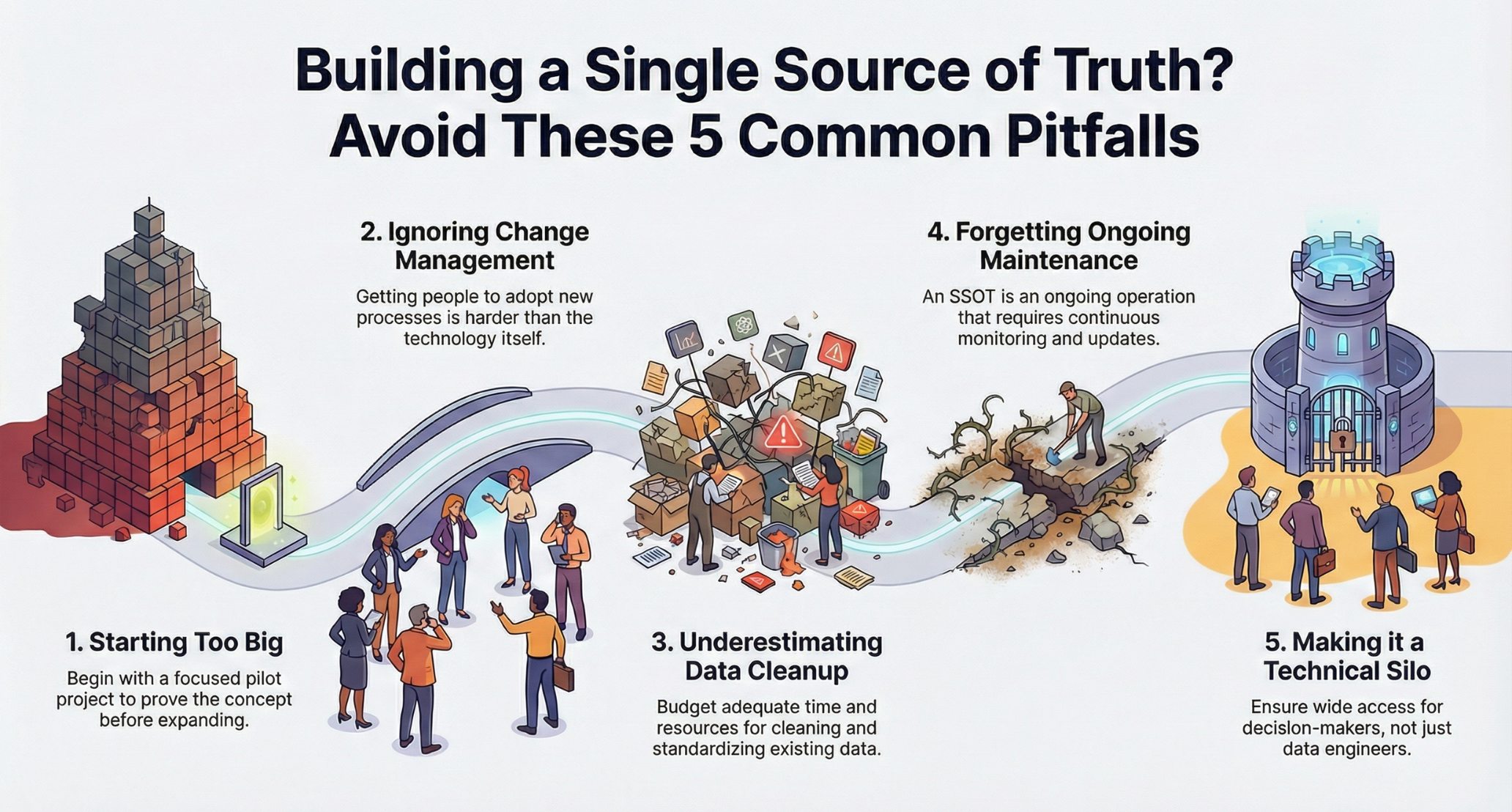
Building a SSOT is not simple, and many organizations stumble. Here’s what to watch for:
Starting too big. Trying to integrate everything at once is a recipe for failure. Start with a pilot project—perhaps one critical data domain. Prove the concept works. Then expand.
Ignoring change management. Technology is the easy part. Getting people to change how they work, trust new systems, and adopt new processes is harder. Plan for training, communication, and a phased rollout.
Underestimating data quality work. Most organizations are shocked by how much work it takes to clean and standardize existing data. Budget accordingly and don’t rush this phase.
Forgetting about ongoing maintenance. A SSOT isn’t a project with an end date. It’s an ongoing operation that requires monitoring, updates, and continuous improvement. New data sources emerge. Business rules change. Your governance model needs to evolve.
Making it too technical. If your SSOT is only accessible to data engineers, you’ve created a tool for specialists, not a foundation for organization-wide decision-making. Democratize access.
The Practical Path Forward
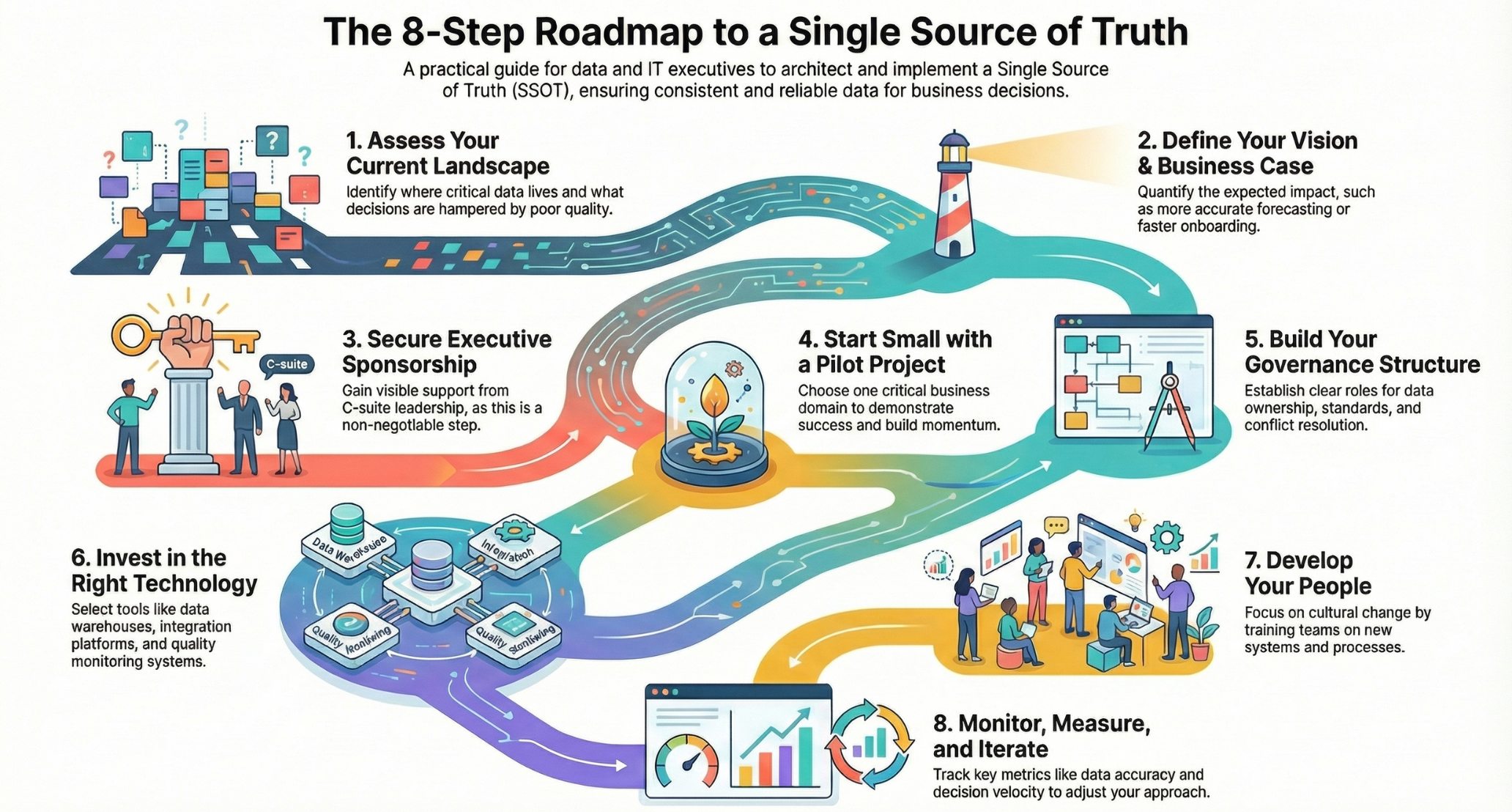
If you’re an Enterprise Data Officer or CIO ready to build your organization’s Single Source of Truth, here’s a practical approach:
Step 1: Start with assessment
Understand your current data landscape. Where does critical data live? What are the biggest sources of inconsistency? What decisions are most hampered by poor data quality? This assessment becomes your roadmap.
Step 2: Define your vision and business case
Be specific about what you’re trying to achieve. More accurate forecasting? Faster customer onboarding? Better compliance? Quantify the impact. This justifies investment and keeps the effort focused.
Step 3: Secure executive sponsorship
This is non-negotiable. You need visible support from C-suite leadership, not just IT. Data governance touches every part of the organization, and that requires organizational leadership, not just technical authority.
Step 4: Start small and pilot
Choose one critical business domain where you can demonstrate success. Show how a SSOT for customer data, for example, improves sales effectiveness or customer satisfaction.
Step 5: Build your governance structure
Establish clear roles: who owns each data domain? Who makes decisions about data standards? How do you handle conflicts? Document this clearly.
Step 6: Invest in the right technology
This might include data warehouse solutions, integration platforms, data cataloging tools, and quality monitoring systems. The specific stack depends on your organization’s needs and technical maturity.
Step 7: Develop your people
Train teams on new systems and processes. Help analysts learn to build dashboards. Help business leaders understand how to use the data that’s now available. Cultural change is as important as technical implementation.
Step 8: Monitor, measure, and iterate
Define success metrics: data accuracy rates, how many teams are using the SSOT, compliance audit results, decision velocity improvements. Measure these regularly and adjust your approach based on what you learn.
The Leadership Imperative
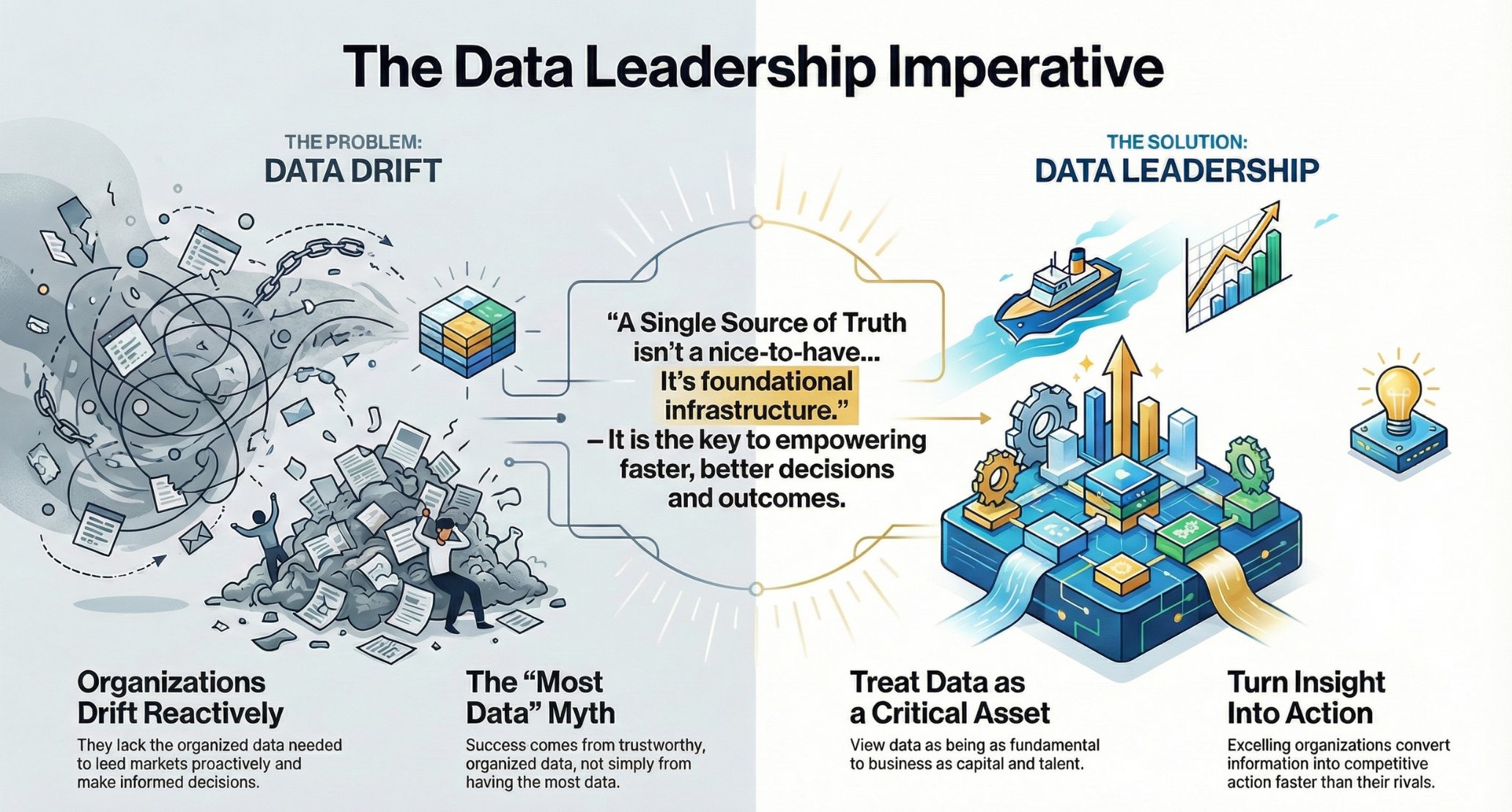
Here’s the truth that every CIO and Enterprise Data Officer must confront: data has become as critical to business operations as capital and talent. The organizations that excel in the next five years will be the ones that can turn information into insight and insight into action faster than competitors.
A Single Source of Truth isn’t a nice-to-have technical project. It’s foundational infrastructure for a modern, competitive enterprise. It’s what separates organizations that drift reactively through markets from those that lead proactively.
The organizations succeeding today aren't those with the most data. They're the ones with the most trustworthy data, organized in ways that empower faster decisions and better outcomes.
Your Next Move
You’re likely reading this because you feel the pain of data fragmentation. Maybe your teams are frustrated with conflicting numbers. Maybe compliance audits are more stressful than they should be. Maybe you know you’re making important decisions without the full picture.
That awareness is your starting point.
The question isn’t whether you need a Single Source of Truth. In today’s business environment, that’s a given. The question is: how quickly can you build it?
Start by assessing your current state. Identify your biggest pain point. Get your leadership aligned around a clear business case. Then take that first pilot project and show what’s possible when your entire organization operates from one version of the truth.
The organizations that move decisively on this issue today will find themselves significantly ahead of competitors one year from now. That’s not speculation—it’s what the data shows.
Ready to transform how your organization makes decisions? Organizations across industries are discovering that a Single Source of Truth is the most powerful foundation for modern, data-driven enterprises. If you're looking to build this infrastructure and establish trustworthy, accessible data as your competitive advantage, explore how platforms like WMS Solutions can support your enterprise data transformation journey.
From data governance frameworks to integration solutions, the right partner can accelerate your path to becoming a truly data-driven organization.
Your competitive advantage is waiting. It starts with one unified, trustworthy source of truth.
FAQS:-
What is a Single Source of Truth?
A Single Source of Truth is one unified location where all critical business data lives and is standardized across your organization. Instead of scattered spreadsheets and conflicting reports, everyone references the same authoritative data for decision-making.
Why is a Single Source of Truth important?
It eliminates data conflicts between departments, speeds up decision-making, reduces compliance risks, and saves organizations millions annually by ensuring everyone works with accurate, trusted information.
How long does implementation take?
A pilot project typically takes 3-6 months, while a full enterprise implementation usually takes 1-3 years depending on your data complexity and organizational readiness.
What technology do we need?
You’ll need a data warehouse or data lake for storage, ETL tools for data integration, data cataloging tools for discovery, and business intelligence platforms for reporting and analytics.
How much does it cost?
Pilot projects start at a few hundred thousand dollars, while full enterprise implementations can cost several million. Calculate ROI based on time saved, better decisions, and reduced compliance costs.
What's the main challenge?
The biggest challenge is organizational change resistance and data quality issues. Getting teams to adopt new processes and cleaning messy existing data requires careful planning and executive support.
How do we ensure data quality?
Remove duplicates, standardize formatting, fill missing values, and monitor data continuously through automated validation checks and regular audits with clear ownership of each data domain.
What's the business ROI?
Organizations typically see 200-400% ROI over three years from faster decisions, reduced data reconciliation time, better forecasting accuracy, improved customer service

Mahitab Maher
SAP professional specializing in SAP products, helping companies turn complex processes into smooth, scalable operations.


A well-written and insightful piece. It clearly reflects real-world enterprise challenges.
Appreciate your feedback, Michael. Addressing real-world business challenges is always our priority when sharing insights.