

Last Updated 02/09/2026
Executive Summary
- Strategic Overview: Comprehensive guidance on is your enterprise prepared for increasing risk and compliance pressure? tailored for Middle East and GCC enterprises.
- Key Advantage: Eliminates departmental silos, standardizes reporting, and accelerates operational agility.
- Next Step: Consult with certified WMS Middle East SAP experts for tailored architecture sizing and cost estimation.
Your SAP system contains the most sensitive data in your enterprise - financial records, payroll, vendor contracts, production plans, customer information. It is the operational backbone that most of your critical business processes run through. And in 2026, it is one of the most actively targeted systems in the cybersecurity threat landscape.
The threat is not theoretical. In January 2026, SAP released 17 security patches in a single patch cycle - including four HotNews alerts with CVSS scores reaching 9.9 out of 10. One vulnerability in SAP S/4HANA Financials (CVE-2026-0501) allowed an attacker with basic user credentials to run arbitrary SQL queries, read salary data, modify vendor payments, or delete financial records entirely. Another (CVE-2026-0500) required only a single employee click on a malicious link to enable full system takeover - no login required.
For enterprises in India and the Middle East - where SAP is deeply embedded across manufacturing, distribution, energy, and public sector - the stakes are especially high. Operational shutdowns caused by SAP breaches have already cost global manufacturers over $1 billion in documented losses. The question is no longer whether SAP security matters. It is whether your organisation is doing enough about it.
To evaluate technical partner qualifications and service levels, review our CFO checklist for choosing an SAP Gold Partner in Dubai.

Who Should Read This Guide?
- CIOs and IT Security Heads responsible for enterprise risk across SAP landscapes.
- SAP Basis Administrators managing patch cycles, access controls, and system configurations.
- CFOs and Finance Heads whose processes - AP, AR, General Ledger - depend on secure SAP environments.
- Risk Officers evaluating SAP-related vulnerabilities as part of broader enterprise risk programmes.
- IT leadership at companies migrating to SAP S/4HANA or expanding their SAP BTP footprint.
This guide does not require a security background. It is written for enterprise leaders and decision-makers who need to understand the landscape clearly enough to ask the right questions and take the right actions.

Why Is SAP Infrastructure a High-Value Target for Attackers?

SAP systems are attractive targets for exactly the same reasons they are valuable to businesses: they hold everything in one place. A successful SAP breach gives an attacker access to financial transactions, HR and payroll data, supply chain records, production schedules, and customer master data - simultaneously. That concentration of value makes SAP a priority target for ransomware groups, nation-state actors, and financially motivated attackers.
Several structural factors make the SAP attack surface larger and more difficult to defend than many organisations realise:
- Legacy architecture: Many SAP landscapes include systems and custom code built over decades, with security controls designed for a different threat era.
- Complex integrations: SAP rarely operates in isolation. Connections to cloud platforms, third-party applications, external APIs, and partner systems create entry points that are often poorly secured or monitored.
- Large user base: Hundreds or thousands of users across multiple roles, geographies, and entities create a wide access surface where Segregation of Duties violations and over-privileged accounts are common.
- Slow patch cycles: SAP releases security patches on a monthly cycle (Patch Tuesday), but many organisations fall months or years behind - leaving known vulnerabilities open for exploitation.
- AI-accelerated attacks: Attackers now use AI to reverse-engineer SAP patches and generate working exploits within hours of a vulnerability disclosure. The window between a patch release and active exploitation has collapsed from weeks to hours.
SAP’s cloud CFO tools address all of these challenges systematically - not by layering more software on top of the same broken process, but by replacing the process at its foundation.
The Top SAP Cybersecurity Threats in 2026
| Threat Category | How It Works | Business Impact |
|---|---|---|
| Unpatched Vulnerabilities | Attackers exploit known CVEs in unpatched SAP systems - often within hours of patch release. | Financial data breach, system takeover, regulatory penalties |
| Access Control Failures | Over-privileged users or SoD conflicts allow unauthorised transactions. | Fraud, data manipulation, audit failures |
| Custom ABAP Code Vulnerabilities | Custom code developed without security review introduces SQL injection and code execution risks. | Full system compromise via internal-built programs |
| Insecure RFC & API Connections | Poorly secured Remote Function Calls and API integrations allow lateral movement across systems. | Attackers traverse from low-value entry points to core ERP data |
| SAP BTP & Cloud Misconfigurations | Misconfigurations in SAP Business Technology Platform expose cloud-hosted workloads. | Cross-tenant data exposure, credential theft, AI core breaches |
| AI-Assisted Social Engineering | AI-generated phishing campaigns target SAP Basis admins with credential-harvesting attacks. | Privileged access compromise - highest-value target in an SAP breach |
| Ransomware Targeting SAP | Ransomware groups specifically target SAP landscapes to maximise leverage on enterprise victims. | Operational shutdown, multi-million dollar recovery costs |
Five Pillars of a Strong SAP Security Posture
1. Patch Management: Speed Is No Longer Optional
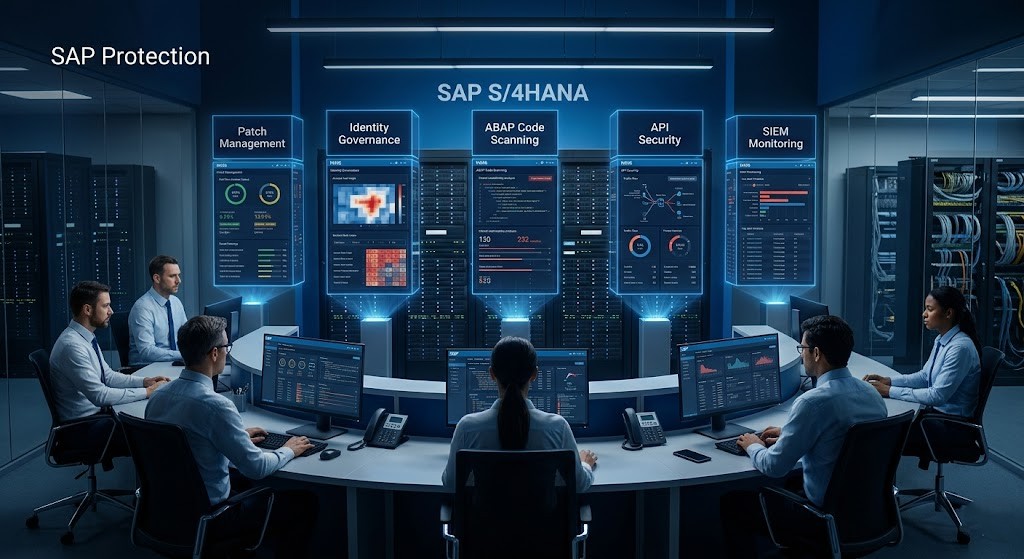
SAP releases security patches on the second Tuesday of every month. Given that attackers now weaponise SAP patches within hours of release - using AI to reverse-engineer vulnerabilities from the patch notes themselves - organisations that delay patching by weeks or months are leaving confirmed attack vectors open for exploitation. A robust SAP patch management programme requires automated vulnerability scanning, prioritised remediation based on CVSS scores, and a defined SLA for applying HotNews notes (SAP’s highest-urgency category).
2. Access Control and Identity Governance
Identity is the primary attack surface in modern SAP environments. Hybrid SAP estates spanning S/4HANA, BTP, Ariba, and SuccessFactors multiply the number of access points and user identities that need to be governed. Effective access control means enforcing Segregation of Duties rules that prevent a single user from combining conflicting activities - such as creating a vendor and approving a payment. SAP Access Control (part of the SAP GRC suite) automates SoD detection, user provisioning workflows, and access review cycles, replacing manual spreadsheet-based processes that cannot scale.
3. Custom ABAP Code Security Review
Custom ABAP code is one of the most consistently overlooked SAP security risks. Most SAP landscapes include thousands of custom programs developed over years, many of which were never subjected to a formal security review. Vulnerabilities in custom ABAP - including SQL injection, missing authorisation checks, and hardcoded credentials - can be exploited even in environments that maintain clean standard SAP configurations. Regular ABAP code vulnerability scanning is a non-negotiable component of a mature SAP security programme.
4. Securing SAP Interfaces, RFCs, and APIs
SAP systems are rarely standalone. Every integration point - RFC connections to other SAP systems, API calls to cloud platforms, third-party middleware connections - is a potential entry point for an attacker. Insecure integrations were ranked among the top threats to SAP security in 2025. Organisations need to continuously map and monitor all SAP interface connections, enforce authentication and encryption on RFC and API calls, and restrict administrative access to internal networks.
5. Continuous Monitoring and SIEM Integration
Periodic audits are not sufficient in an environment where attackers can move from initial access to data exfiltration within hours. Effective SAP security requires continuous monitoring - integrating SAP telemetry, system logs, and security events into a Security Information and Event Management (SIEM) platform that can correlate anomalies across the broader enterprise security landscape. Behaviour analytics helps identify unusual transaction patterns that may indicate account compromise or insider threat activity before they cause significant damage.
Looking to implement or optimize this in Dubai or the UAE?
Speak with WMS Middle East certified SAP consultants for a customized architectural and cost assessment.
SAP Security Priorities for India and the Middle East

| Region | Specific Security Priority | Why It Matters Now |
|---|---|---|
| India | Multi-entity SAP access governance, ABAP code review, GST compliance controls | Diverse SAP landscapes across legal entities require centralised access management; custom code built for localisation often lacks security review |
| Saudi Arabia (KSA) | ZATCA integration security, patch management, privileged access governance | January 2026 HotNews vulnerabilities directly affected S/4HANA systems widely deployed in KSA energy and manufacturing sectors |
| UAE | SAP BTP security, secure API integrations, cloud configuration governance | Rapid BTP adoption without security-first architecture is creating new attack surfaces across UAE enterprises |
| Egypt | Multi-currency ERP security, RFC connection auditing, access control for distributed operations | Multi-location operations with complex integration landscapes create lateral movement risks that require active monitoring |
The January 2026 SAP vulnerability alert specifically called out organisations in Asia and the Middle East as high-risk targets - noting that the region houses the world’s most vital energy, logistics, and retail operations, many of which run on SAP S/4HANA, SAP HANA Database, and SAP NetWeaver.
SAP Security: A Practical Readiness Checklist
Use this checklist to assess your current SAP security posture:
- Is your SAP patch cycle within 30 days of each monthly release for HotNews notes?
- Has your custom ABAP code base been scanned for security vulnerabilities?
- Are all RFC connections and external API integrations documented, authenticated, and encrypted?
- Is SAP telemetry integrated into your enterprise SIEM or security monitoring platform?
- Have your SAP Basis administrators received security awareness training in the last 12 months?
- Do you have an incident response plan specifically covering SAP system compromise scenarios?
- Have you reviewed your SAP BTP and cloud workload configurations against security baselines?
If more than three of these questions reveal gaps, your SAP security posture requires immediate attention.

How WMS Supports SAP Security Across the Enterprise
WMS works with enterprises across India and the Middle East on SAP implementation, optimisation, and security improvement programmes. Our experience spans SAP Access Control configuration, security architecture reviews, ABAP code vulnerability assessments, and SAP GRC implementation - ensuring that your SAP investment is protected by controls that match the actual threat landscape.
To ensure seamless project governance, consult with an accredited SAP implementation partner in Dubai with proven regional experience.
Whether you are running SAP Business One, SAP S/4HANA, or a hybrid landscape that includes SAP BTP, we can provide an honest assessment of your current security posture and a prioritised roadmap for improvement. Security should not be a post-implementation afterthought - it is a core part of how SAP should be run.

Frequently Asked Questions (FAQs)
Why are SAP systems a target for cyberattacks?
SAP systems contain concentrated enterprise-critical data - financials, HR, supply chain, customer records - making them high-value targets for ransomware groups, financial fraudsters, and nation-state actors. A successful SAP breach gives attackers access to everything in a single compromise.
What are the most common SAP security vulnerabilities?
The most common vulnerabilities include unpatched systems, over-privileged user access and SoD conflicts, insecure custom ABAP code, poorly secured RFC and API connections, and misconfigured SAP BTP cloud environments.
How quickly do attackers exploit SAP patches?
In 2026, AI-assisted attack tools can reverse-engineer SAP security patches and generate working exploits within hours of release. This makes rapid patch management - particularly for HotNews (CVSS 9.0+) notes - a critical operational priority.
What is a HotNews SAP patch?
HotNews is SAP’s highest-urgency security note category, used for vulnerabilities with CVSS scores of 9.0 or higher. These require immediate patching - typically within 24 to 72 hours of release. In January 2026, SAP released four HotNews alerts affecting S/4HANA, HANA Database, and NetWeaver.
What is SAP ABAP code security and why does it matter?
Custom ABAP programs are built by organisations or their partners to extend standard SAP functionality. If written without security review, they can introduce SQL injection, missing authorisation checks, or hardcoded credentials - vulnerabilities that exist entirely within the customer’s own code and are not covered by SAP’s standard patches.
How does SAP BTP affect security?
As organisations expand their SAP BTP footprint, each new integration, cloud service, and custom application becomes a potential attack entry point. BTP misconfigurations have been shown to enable cross-tenant data exposure and credential theft. Security-first architecture is essential in BTP environments.
Is SAP security relevant for companies in India and the Middle East?
Yes - and urgently so. SAP vulnerabilities disclosed in January 2026 explicitly targeted S/4HANA environments prevalent in Asia and Middle East energy, logistics, and manufacturing. The region’s concentration of SAP-dependent critical infrastructure makes it a primary target.
What is Segregation of Duties (SoD) in SAP?
SoD is a control principle that prevents a single user from performing conflicting activities - for example, creating a vendor and also approving payments to that vendor. SAP Access Control automates SoD detection and enforcement, replacing manual role review processes that cannot scale.
How does SAP integrate with a SIEM for security monitoring?
SAP telemetry, audit logs, and system events can be fed into a Security Information and Event Management (SIEM) platform, allowing security teams to correlate SAP activity with broader enterprise security data and detect anomalies in real time.
How can WMS help improve SAP security?
WMS provides SAP security assessments, access control reviews, GRC implementation, and ABAP code scanning services across India and the Middle East. If your organisation has gaps in patch management, access governance, or interface security, WMS can provide a prioritised remediation roadmap. Contact WMS to discuss your requirements. For enterprises that also want to address risk and compliance beyond cybersecurity, read how SAP data transforms enterprise risk management.

Mahitab Maher
SAP professional specializing in SAP products, helping companies turn complex processes into smooth, scalable operations.


