
Last Updated 02/09/2026
Executive Summary
- Strategic Overview: Comprehensive guidance on how enterprises in the middle east are competing globally tailored for Middle East and GCC enterprises.
- Key Advantage: Eliminates departmental silos, standardizes reporting, and accelerates operational agility.
- Next Step: Consult with certified WMS Middle East SAP experts for tailored architecture sizing and cost estimation.
The Middle East enterprise landscape is undergoing a structural shift that has no historical precedent in the region. Governments are not simply building better public services — they are building digital economies. Saudi Arabia has committed over $100 billion to technology investment by 2030. The UAE digital transformation market, valued at USD 1.82 billion in 2026, is on track to reach USD 3.75 billion by 2031. Sovereign wealth funds across the Gulf are channelling more than USD 100 billion into AI infrastructure projects, hyperscale data centres, and national cloud regions.
For enterprise leaders, this shift creates an unusually urgent question: Is your organisation’s digital infrastructure built for the economy that is being created — or for the one that existed a decade ago? The companies that will compete globally from a Middle East base in the next five years are already making the foundational technology decisions that will determine that outcome. The companies that delay are not standing still — they are falling behind a market that is moving faster than at any previous point in its history.
Enterprises looking to fast-track their cloud adoption can leverage our 16-week SAP cloud migration roadmap for streamlined go-live execution.

Who Is This Guide For?
- CEOs and business owners in UAE, KSA, Egypt, and Qatar evaluating digital transformation priorities.
- CIOs and IT Directors responsible for ERP modernisation, cloud migration, and system integration.
- CFOs navigating the financial planning and ROI case for enterprise technology investments.
- Operations and supply chain leaders whose processes depend on SAP or legacy ERP platforms.
- HR and workforce leaders managing organisational change as part of broader transformation programmes.
This guide does not advocate a single technology path. It explains the forces driving digital transformation across the Middle East, the strategic decisions enterprises must make, and how SAP’s cloud and ERP ecosystem fits into that picture.

Why Is Digital Transformation Accelerating So Rapidly Across the Middle East?

Three forces are converging to make digital transformation a competitive and regulatory necessity for Middle East enterprises in 2026 — not a strategic option.
Government Mandates Are Setting the Pace
Saudi Arabia’s Vision 2030, the UAE National AI Strategy 2031, and Egypt’s Digital Egypt programme are not abstract policy documents — they are reshaping the operating environment for every enterprise in the region. Saudi Arabia has set a target for 95% of government services to be fully digital and for 50% of GDP to come from the digital economy by 2030. The UAE targets digital channels for over 85% of transactions. For private-sector enterprises that interact with government procurement, licensing, and compliance, this means that digital readiness is now a baseline requirement for doing business — not a differentiator.
Competitive Pressure Is Intensifying
Digitally native competitors and international entrants are entering the Middle East market with operational cost structures and customer experience capabilities that legacy-technology incumbents cannot match using their existing systems. In sectors including retail, logistics, financial services, and manufacturing, the competitive gap between organisations running modern cloud ERP and those operating on outdated on-premise systems is widening faster than most incumbents realise.
Infrastructure Has Arrived
The infrastructure barrier that once made cloud adoption challenging in the Middle East has largely been resolved. Hyperscale cloud regions from AWS, Google, and Microsoft now operate in the UAE and Saudi Arabia. SAP’s RISE with SAP programme, which allows enterprises to move S/4HANA to the cloud on managed infrastructure, is available in the region. The technical barriers to transformation have fallen — what remains is primarily the organisational and strategic challenge of executing it.
How Big Is the Digital Transformation Opportunity in the Middle East?
| Country / Region | Key Digital Target / Investment | Market Signal |
|---|---|---|
| Saudi Arabia (KSA) | $100B+ tech investment by 2030; Vision 2030 digital economy target | 70%+ businesses actively digitalising; government services 95% digital target |
| UAE | $96B GDP impact from digital economy by 2030; USD 1.82B DX market in 2026 | National AI Strategy 2031; UAE digital market growing at 15.62% CAGR |
| Middle East (Regional) | DX market: USD 59.47B in 2025 → USD 71.64B in 2026 | AI/ML projected 18.07% CAGR 2026–2031; $100B+ sovereign AI investment |
| Egypt | E-invoicing mandates; multi-currency ERP requirements | Growing SAP adoption across manufacturing and distribution sectors |
Looking to implement or optimize this in Dubai or the UAE?
Speak with WMS Middle East certified SAP consultants for a customized architectural and cost assessment.
Where Does SAP Fit in a Middle East Digital Transformation Strategy?

Digital transformation is not a single technology decision — it is a sequence of connected decisions about data, processes, systems, and people. SAP’s role in that sequence varies by organisation, but for enterprises in the Middle East with meaningful operational complexity, it is typically foundational.
Here is why: SAP is the system of record for the most critical business processes in most large enterprises — finance, procurement, supply chain, manufacturing, HR. If the SAP layer is outdated, fragmented, or poorly integrated, every other digital initiative — analytics, AI, customer experience, supply chain visibility — is constrained by the quality of the data and processes underneath.
What Does SAP S/4HANA Enable That Legacy SAP Cannot?
| Phase | Focus | SAP / Technology Layer | Outcome |
|---|---|---|---|
| Phase 1: Foundation | Clean data, modern ERP core, stable integrations | SAP S/4HANA migration, master data governance | Single source of truth across finance, supply chain, operations |
| Phase 2: Compliance & Controls | Regulatory readiness, access governance, audit trail | SAP GRC, ZATCA / GST integration, SAP Process Control | Audit-ready, compliant enterprise with reduced regulatory risk |
| Phase 3: Intelligence | Real-time reporting, financial planning automation | SAP Analytics Cloud, SAP Group Reporting, SAP BTP See our SAP GRC guide for a detailed breakdown of how Access Control, Process Control and Risk Management work together. | Faster decisions, automated close, scenario-based planning |
| Phase 4: Competitive Edge | AI-driven operations, customer experience, supply chain optimisation | SAP AI, Joule copilot, SAP Ariba, SAP IBP | Operational advantage through predictive analytics and automation |
Each phase builds on the previous one. Organisations that attempt Phase 3 or 4 without completing Phase 1 consistently underperform — because analytics and AI cannot produce reliable insights from a fragmented, unclean data foundation.
For a deep dive on SAP’s cloud CFO tools, read how SAP Analytics Cloud and Group Reporting automate budgeting and consolidation.
What Are the Country-Specific Digital Transformation Priorities for Middle East Enterprises?

- Saudi Arabia: ZATCA Phase 2 e-invoicing compliance is now mandatory for enterprises above the threshold, requiring SAP integration with the ZATCA platform. Beyond compliance, Vision 2030 mandates create procurement and reporting requirements that favour enterprises with modern ERP architectures. NEOM and other giga-project supply chains are requiring digital procurement and ERP integration as a condition of participation.
- UAE: The UAE’s digital economy strategy targets the digital sector’s contribution growing from 12% to 20% of non-oil GDP by 2030. Enterprises competing for government contracts must meet digital maturity thresholds. The UAE’s National AI Strategy 2031 is accelerating AI adoption in finance, logistics, and healthcare — sectors where SAP BTP and SAP Analytics Cloud provide direct capability.
- Qatar: Vision 2030 digitisation targets in the public and energy sectors are creating demand for integrated ERP and compliance management systems capable of managing multi-entity, multi-currency operations at scale.
What Are the Most Common Digital Transformation Mistakes Middle East Enterprises Make?
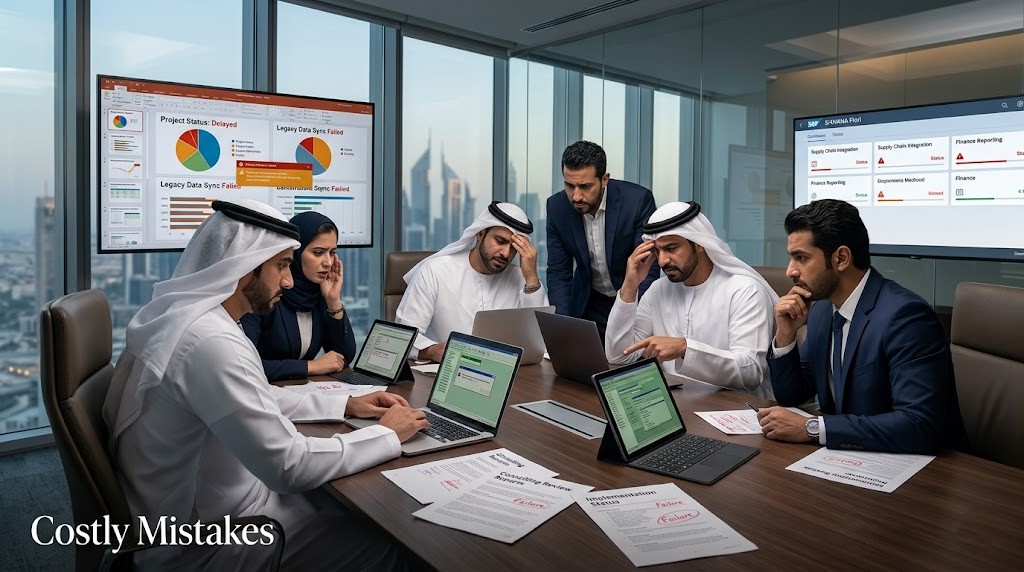
- Treating transformation as a technology project rather than a business change initiative — leading to technically successful implementations that are not adopted by the business.
- Skipping the data foundation phase — attempting analytics and AI on top of fragmented, inconsistent master data that undermines the accuracy of every insight generated.
- Underinvesting in change management — technology is replaced in months; the organizational habits and processes that determine whether it is used effectively take significantly longer.
- Choosing implementation partners based on price rather than regional expertise — Middle East regulatory requirements, including ZATCA, UAE VAT, and Egypt e-invoicing, require genuine localisation knowledge that not all global SAP partners have.
- Delaying SAP ECC migration past the planning horizon — organisations that have not initiated their S/4HANA migration by 2026 face compressing timelines that increase implementation risk and cost.
- UAE: The UAE’s digital economy strategy targets the digital sector’s contribution growing from 12% to 20% of non-oil GDP by 2030. Enterprises competing for government contracts must meet digital maturity thresholds. The UAE’s National AI Strategy 2031 is accelerating AI adoption in finance, logistics, and healthcare — sectors where SAP BTP and SAP Analytics Cloud provide direct capability.
- Egypt: Egypt’s e-invoicing mandate is expanding, and multi-currency ERP requirements for enterprises operating in the Egyptian market require SAP localisation and compliance configuration. Growing manufacturing and distribution sectors are accelerating SAP Business One and S/4HANA adoption.
- Qatar: Vision 2030 digitisation targets in the public and energy sectors are creating demand for integrated ERP and compliance management systems capable of managing multi-entity, multi-currency operations at scale.
To ensure seamless project governance, consult with an accredited SAP implementation partner in Dubai with proven regional experience.
How Does WMS Support Digital Transformation for Middle East Enterprises?
WMS works with enterprise leaders across the Middle East — UAE, Saudi Arabia, Egypt, and Qatar — on SAP implementation, migration, and digital transformation programmes. Our regional experience means we understand not just the technology but the regulatory context, local market dynamics, and organisational realities that determine whether a transformation programme succeeds.
Whether your organisation is planning an SAP ECC to S/4HANA migration, evaluating cloud finance solutions, implementing SAP GRC for compliance readiness, or designing the foundation for an AI-enabled enterprise, WMS can provide the strategic and implementation support to move from intent to outcome.
That means aligning SAP project structures, field updates, procurement, billing, and reporting with actual business practices in energy, construction, and EPC environments. When that happens, ERP becomes a control system rather than just a reporting tool.

Frequently Asked Questions (FAQs)
What is driving digital transformation in the Middle East in 2026?
Three converging forces are driving digital transformation: government mandates (Saudi Vision 2030, UAE National AI Strategy 2031, Egypt Digital Egypt), intensifying competition from digitally native entrants, and the arrival of cloud infrastructure from AWS, Google, and Microsoft in the region that removes the previous technical barriers to transformation.
How large is the digital transformation market in the Middle East?
What role does SAP play in Middle East digital transformation?
SAP provides the foundational ERP layer for most large Middle East enterprises. SAP S/4HANA is the modern platform that enables real-time analytics, embedded AI, cloud deployment, and localised regulatory compliance — including ZATCA in Saudi Arabia, VAT in the UAE, and e-invoicing in Egypt.
What is Vision 2030 and how does it affect enterprise technology?
Saudi Arabia’s Vision 2030 is a national programme to diversify the economy beyond oil. It includes over $100 billion in technology investment, targets 95% digital government services, and is mandating digital readiness — including ZATCA e-invoicing compliance — for enterprises operating in the Kingdom.
What is ZATCA and why does it require SAP integration?
ZATCA is the Zakat, Tax and Customs Authority in Saudi Arabia. Phase 2 of ZATCA’s e-invoicing programme requires real-time invoice transmission to the ZATCA platform, which requires deep SAP integration to automate invoice generation, signing, and submission without manual intervention.
What is RISE with SAP and is it available in the Middle East?
RISE with SAP is SAP’s managed cloud offering that allows enterprises to run SAP S/4HANA on cloud infrastructure managed by SAP. It is available in the Middle East, with hyperscale cloud regions from SAP’s partners operating in the UAE and Saudi Arabia.
What are the most common digital transformation failures in the Middle East?
The most common failures are treating transformation as a technology project rather than a business change programme, attempting analytics and AI on a poor data foundation, underinvesting in change management, choosing implementation partners without regional regulatory expertise, and delaying SAP ECC migration until timelines compress.
How does SAP S/4HANA differ from SAP ECC for digital transformation?
SAP S/4HANA is built on the SAP HANA in-memory database, enabling real-time analytics, embedded AI via SAP BTP, modern UX through SAP Fiori, cloud-native deployment, and pre-built localisation for Middle East regulatory requirements. SAP ECC cannot provide any of these capabilities natively.
Is digital transformation relevant for mid-size enterprises in the Middle East?
Yes. Government procurement, licensing, and compliance requirements in KSA, UAE, and Egypt are increasingly digital-first — making digital maturity a baseline requirement for doing business, not just a large-enterprise concern. SAP Business One provides a right-sized ERP platform for mid-size enterprises pursuing transformation.
How can WMS help with digital transformation in the Middle East?
WMS provides SAP implementation, migration, and digital transformation advisory services across the Middle East — including UAE, Saudi Arabia, Egypt, and Qatar. With regional regulatory expertise and SAP technical capability, WMS supports enterprises from strategy through to go-live and ongoing optimisation. Contact WMS to discuss your transformation roadmap.

Mahitab Maher
SAP professional specializing in SAP products, helping companies turn complex processes into smooth, scalable operations.


