
EXECUTIVE SUMMARY & KEY TAKEAWAYS
- The Core Architectural Moat: Enterprise leaders must respect architectural boundaries: Salesforce serves as the ‘System of Engagement’ for customer interactions, while SAP serves as the immutable ‘System of Record’ for financial truth and inventory.
- Lead-to-Cash Cycle Acceleration: Integrating Salesforce with SAP eliminates manual quote-to-order rekeying, reducing sales cycle duration by up to 45% and preventing costly order fulfillment errors.
- Modern Middleware over Point-to-Point: Avoid fragile point-to-point API connections. Leverage modern middleware like SAP BTP Integration Suite or MuleSoft to ensure event-driven, bi-directional, and auditable data synchronization.
- The WMS Dual-Engine Advantage: WMS Middle East is uniquely accredited as both an SAP Gold Partner and an Official Salesforce Consulting Partner, eliminating finger-pointing between separate CRM and ERP vendors.
Listen to This Article
Perfect for busy professionals who prefer learning on the go.
The Front-Office vs. Back-Office Chasm
In enterprise organizations across Dubai, Abu Dhabi, Riyadh, and Jeddah, a common operational paradox persists: commercial sales teams rely on Salesforce CRM for lead qualification, pipeline forecasting, and client communications, while finance and supply chain teams manage billing, inventory, and procurement within SAP ERP SAP S/4HANA Cloud or SAP Business One.
When these two powerhouses operate in isolation, friction inevitably multiplies:
• Sales reps negotiate deals with outdated inventory numbers, promising stock already committed elsewhere.
• Commercial managers generate custom quotes without visibility into customer credit limits or outstanding invoices.
• When an opportunity is won in Salesforce, finance teams spend hours manually re-keying customer information, line items, and pricing into SAP.
To establish true commercial agility, forward-thinking GCC enterprises must build an integrated Lead-to-Cash architecture that synchronizes Salesforce with SAP in real time.
To establish true commercial agility, forward-thinking GCC enterprises must build an integrated Lead-to-Cash architecture that synchronizes Salesforce with SAP in real time.

System of Engagement vs. System of Record: The Golden Architecture Rule
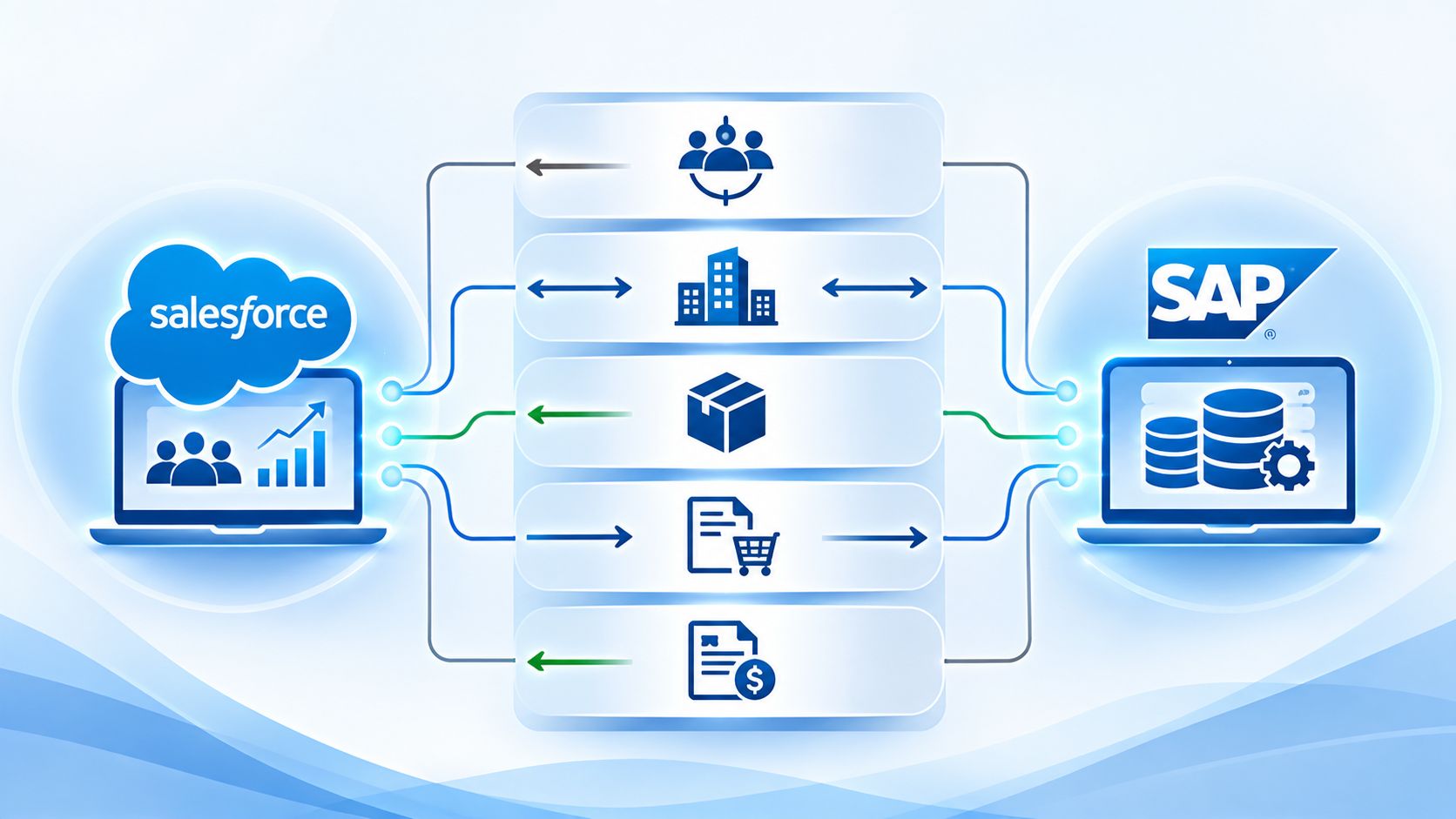
A successful CRM-ERP integration begins with strict data ownership governance. In enterprise IT architecture, confusion over data master ownership creates synchronization loops and corrupted databases.
| Data Domain | System of Engagement (Salesforce) | System of Record (SAP ERP) | Synchronization Direction |
|---|---|---|---|
| Leads & Opportunities | Primary Creator & Owner. Complete pipeline management and qualification. | No visibility required; pipeline data does not belong in the ERP ledger. | Salesforce Only |
| Customer Master (Accounts) | Prospect account creation during initial outreach and quoting. | Official legal entity master, credit limit owner, and tax identification (TRN). | Bi-Directional (Synced via unique Customer ID) |
| Product & Pricing Master | Sales catalogs, price books, and localized discount guidelines. | Single source of truth for standard SKU master, inventory valuation, and unit of measure. | SAP -> Salesforce (One-Way) |
| Quotes & Orders | Salesforce CPQ for dynamic quote generation and electronic customer approval. | Formal sales order creation, inventory allocation, and billing document generation. | Salesforce -> SAP (Trigger on Closed-Won) |
| Invoices & Payment Status | Read-only visibility for account executives to monitor customer credit health. | Full revenue recognition, payment collection, and statutory E-Invoicing transmission. | SAP -> Salesforce (Read-Only Event) |
Integration Patterns: Why Point-to-Point APIs Fail
Historically, IT teams attempted to link Salesforce and SAP via custom, hard-coded point-to-point REST or SOAP APIs. In modern enterprise environments, this approach quickly breaks down due to:
High maintenance overhead whenever SAP or Salesforce updates its API version.
Lack of message queuing, resulting in dropped transactions during network hiccups or ERP maintenance windows.
Inability to transform complex nested data structures without high latency.
The Recommended Architecture: Enterprise Middleware via SAP BTP or MuleSoft
WMS Middle East deploys modern, event-driven architectures utilizing SAP Business Technology Platform or Salesforce MuleSoft:
Pre-Built Adapters
Pre-configured connectors accelerate deployment while respecting SAP security requirements and role-based authorizations.
Asynchronous Message Queuing
If SAP S/4HANA is temporarily offline for planned maintenance, closed-won orders remain safely queued in the middleware and automatically process upon system reconnection, helping prevent data loss.
Real-Time Webhooks
Utilize event-driven architecture through SAP Event Mesh and Salesforce Platform Events to push real-time status updates instead of relying on slower batch polling.
Compliance, UAE E-Invoicing & Regional Data Governance
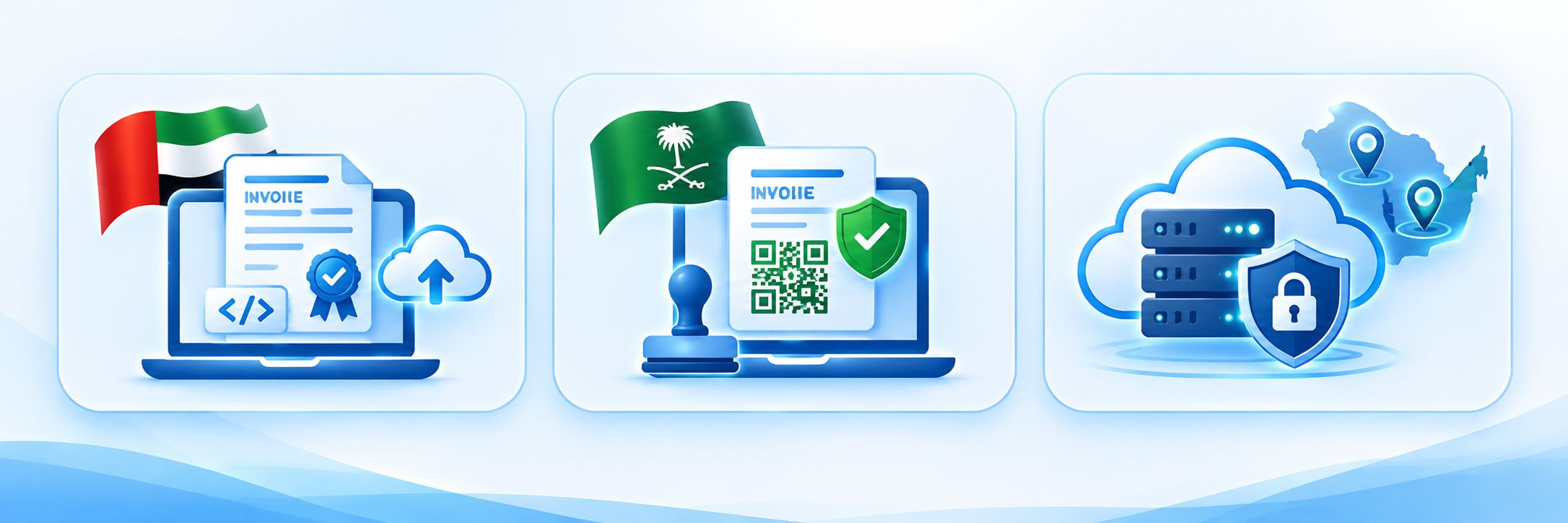
Operating across the GCC requires that CRM and ERP integrations satisfy stringent regional compliance standards:
Automated UAE FTA Tax Invoicing
When a contract is finalized in Salesforce, the resulting SAP billing document automatically generates an FTA-compliant XML electronic invoice with digital signature verification for direct transmission.
Saudi ZATCA Phase 2 Integration
For cross-border enterprises, the integrated workflow enforces mandatory ZATCA cryptographic stamping and QR code generation before customer invoice dispatch.
In-Country Data Residency
Middleware runtimes and integration pipelines are hosted within local UAE and Saudi cloud data centers, supporting adherence to applicable regional data privacy laws.
The WMS Middle East Advantage: The Dual-Certified Partner
The primary reason CRM-ERP integration projects fail is vendor finger-pointing: the Salesforce agency blames the SAP implementation partner, while the SAP partner claims the CRM team does not understand ERP data structures.
WMS Middle East LLC eliminates this risk entirely. As one of the only consulting firms in the GCC holding dual credentials as both an Accredited SAP Gold Partner and an Official Salesforce Consulting Partner, our cross-functional engineering teams manage both sides of the equation:
• Unified accountability under a single regional project manager.
• Deep mastery of both Salesforce Apex/Flows and SAP ABAP/BTP.
• Rapid time-to-value leveraging our pre-built Salesforce-SAP Lead-to-Cash integration accelerator.
Contact WMS Middle East today through our Enterprise Consulting Portal or explore our Salesforce Implementation Services to accelerate your commercial operations.

Frequently Asked Questions (FAQs)
Can Salesforce integrate with both SAP Business One and SAP S/4HANA Cloud?
Yes. WMS Middle East provides certified integration architectures connecting Salesforce CRM to both SAP Business One (via the SAP B1 Service Layer and integration framework) and SAP S/4HANA Cloud (via SAP BTP Integration Suite or standard OData/REST APIs).
How does integration prevent duplicate customer records between Salesforce and SAP?
Data governance establishes SAP as the single master source of truth for accounts. When a prospect reaches a qualified quoting stage in Salesforce, an automated check verifies against the SAP customer database before creating a synchronized SAP Business Partner ID linked directly to the Salesforce Account record.
What is the typical timeline to deploy a Salesforce-SAP Lead-to-Cash integration?
Utilizing WMS Middle East pre-built integration templates and standardized middleware mappings, a typical end-to-end Lead-to-Cash integration is implemented, tested, and deployed in 6 to 10 weeks.

Mahitab Maher
SAP professional specializing in SAP products, helping companies turn complex processes into smooth, scalable operations.


