

EXECUTIVE SUMMARY & KEY TAKEAWAYS
The 2027 Maintenance Horizon: SAP mainstream maintenance for SAP ECC 6.0 concludes on December 31, 2027. While optional extended maintenance is available through 2030 at a 2% base maintenance fee surcharge, delaying migration locks enterprises out of continuous innovation, in-memory architecture, and embedded AI capabilities.
Strategic Migration Pathways: Selection between Brownfield (system conversion), Greenfield (selective or complete re-implementation), and Selective Data Transition (hybrid) depends on architectural technical debt, custom code volume, and process harmonization requirements.
Practical Readiness Prerequisites: Successful projects require upfront execution of mandatory technical prerequisites: Business Partner (CVI) conversion, third-party add-on compatibility verification, interface and integration inventory mapping, and general ledger/asset data reconciliation.
Phased Statutory E-Invoicing Alignment: UAE enterprises must structure migration cutovers around Federal Tax Authority (FTA) phased mandates requiring integration with accredited service providers (ASPs) using standardized digital invoicing frameworks.
Enterprise Governance Over Blanket Promises: Complex ERP transformations cannot rely on generic “weekend cutover” or “risk-free” claims; they demand structured dress rehearsals, quantified downtime thresholds, and rigorous rollback criteria.
Listen to This Article
Perfect for busy professionals who prefer learning on the go.
The 2027 Maintenance Horizon: Why Regional Enterprises Must Plan Now
For more than two decades, SAP ECC 6.0 has anchored core enterprise operations across the United Arab Emirates and the broader GCC region—orchestrating supply chains, commercial trading, financial accounting, and manufacturing operations. However, the architectural lifecycle of ECC is finite: SAP mainstream maintenance for SAP ECC 6.0 officially ends on December 31, 2027.
While SAP provides an optional extended maintenance window extending through December 31, 2030, this option carries important commercial and strategic implications:
- Commercial Premium: Extended maintenance incurs an additional 2% surcharge on the annual maintenance base, increasing operational software costs without delivering new feature sets.
- Innovation Freeze: Enhancements, new industry capabilities, and generative AI innovations (such as SAP Joule) are engineered exclusively for the [SAP S/4HANA Cloud](https://wmsspl.com/sap-s4-hana-cloud/) code line. ECC landscapes remain confined to statutory patches and critical security fixes.
- Specialized Talent Scarcity: As system integrators across the Middle East concentrate their certified consultant base on S/4HANA Cloud transformations, availability of seasoned ECC functional and technical resources will steadily decline.
Given that an enterprise-scale SAP S/4HANA migration typically spans 9 to 18 months—encompassing assessment, business partner harmonization, mock conversions, testing, and operational cutover—enterprises operating in the UAE cannot afford prolonged planning cycles. Establishing an executable roadmap today is vital to secure skilled integration bandwidth and ensure unhurried, rigorous business validation.

Evaluating the Three Strategic Migration Pathways
Selecting the appropriate migration path represents the single most consequential architectural decision for enterprise leadership. Each pathway balances historical data retention, project duration, process standardization, and architectural cleanliness differently:
| Migration Pathway | Architectural Philosophy | Best Suited For | Critical Trade-Offs |
|---|---|---|---|
|
Brownfield (System Conversion) |
Complete technical in-place conversion of the existing ECC system to S/4HANA, preserving transaction history, custom configurations, and current business workflows. |
|
|
|
Greenfield (New Implementation) |
Complete re-platforming starting from a clean slate. Retires legacy ECC customizations to adopt standardized SAP Best Practice processes in S/4HANA Public or Private Cloud. |
|
|
|
Selective Data Transition (Hybrid) |
Combines process re-engineering with selective transfer of historical data. Uses specialized migration tooling, such as SAP Landscape Transformation, to carve out relevant organizational units and master data. |
|
|
Practical Readiness Criteria: Six Mandatory Prerequisites
CVI / Business Partner
Consolidate Vendors & Customers into Unified Business Partners
Add-On Compatibility
Audit 3rd-party vendor add-ons against target S/4HANA release
Integration Inventory
Map all RFC, IDoc, SOAP & REST interfaces for API modernization
Data Reconciliation
Reconcile GL, Subledgers, Asset Accounting & Material Ledger
End-to-End UAT
Rigorous business scenario testing with quantified sign-off gates
Cutover & Rollback
Detailed runbook with dress rehearsal milestones & go/no-go limits
1. Customer-Vendor Integration (CVI) & Business Partner Conversion
In SAP ECC, vendors (LFA1/LFB1) and customers (KNA1/KNB1) exist as independent master data objects. In SAP S/4HANA, the Business Partner (BP) model is mandatory. All customers, vendors, and contact persons must be synchronized into unified BP records prior to conversion. CVI synchronization requires comprehensive data cleansing resolving duplicate tax registration numbers, harmonizing postal codes, correcting bank account schemas, and aligning numbering ranges.
2. Third-Party Add-On & Component Compatibility
Enterprises frequently run third-party software add-ons embedded in their ECC application server—such as third-party barcode solutions, specialized tax calculation engines, or legacy banking connectors. Every add-on must be audited through the SAP Readiness Check 2.0 to verify:
- Whether the vendor provides a certified S/4HANA-compatible version for the target release (e.g., S/4HANA Cloud Private Edition 2023 or 2025).
- Whether the add-on can be decommissioned in favor of standard S/4HANA capabilities or modernized as a side-by-side extension on SAP BTP.
3. Comprehensive Interface & Integration Inventory
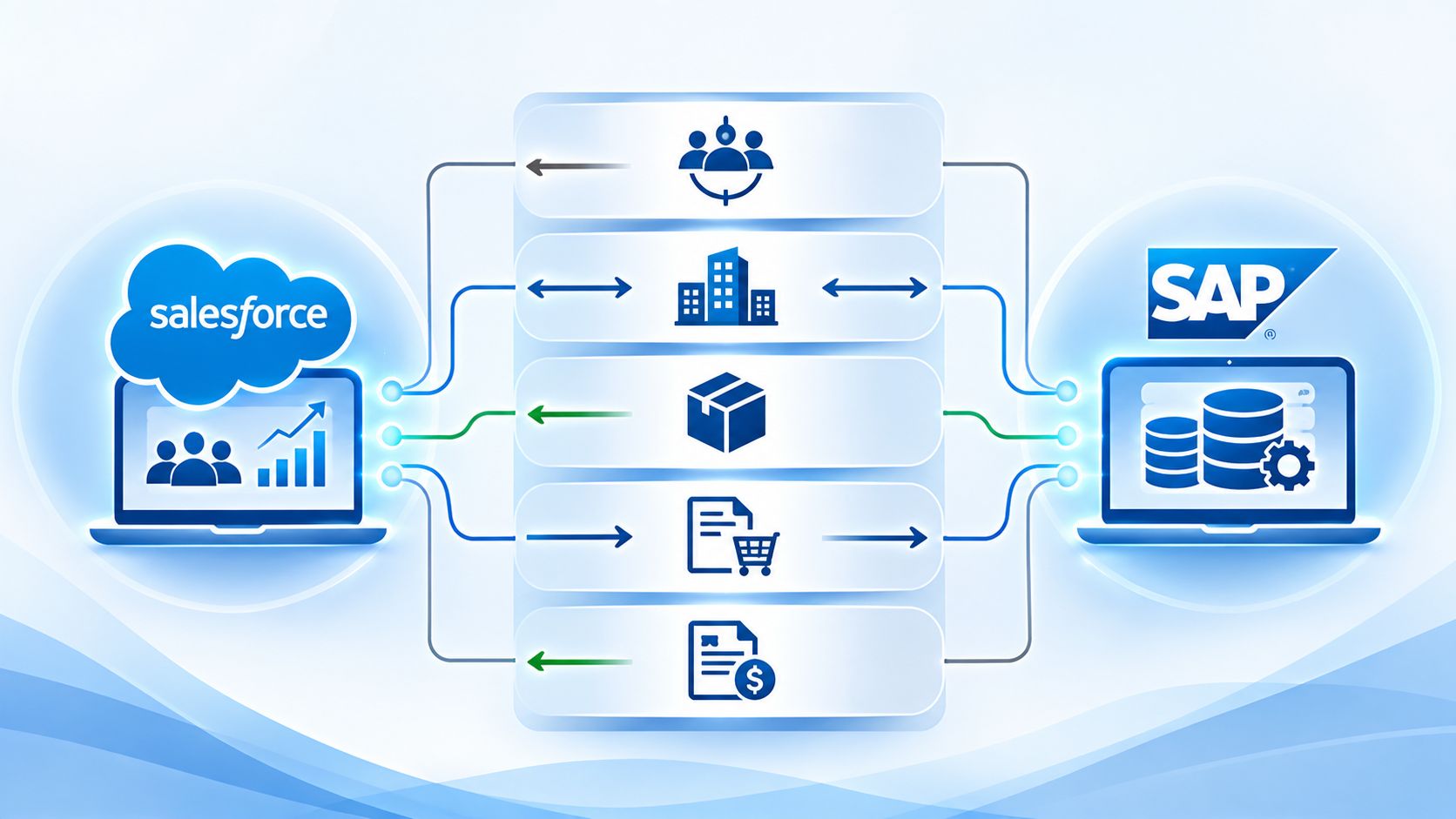
Decades of operation typically leave ECC environments tethered to dozens of point-to-point interfaces: RFC connections, flat-file FTP scripts, IDoc queues, and custom web services connecting to CRM platforms (such as Salesforce), third-party warehouse management systems, and regional banking portals.
- An exhaustive integration inventory must catalogue protocol types, payload volumes, frequency, and authentication mechanisms.
- Legacy RFC and IDoc interfaces should be evaluated for modernization to standardized OData REST APIs managed via SAP Integration Suite.
4. Financial & Asset Data Pre-Reconciliation
The core innovation of S/4HANA Finance is the Universal Journal (table ACDOCA), which unifies General Ledger (FI), Controlling (CO), Asset Accounting (FI-AA), and Material Ledger (ML) into a single line-item repository. Prior to migration:
- Organizations must execute financial consistency checks in ECC (transactions like `FINS_CUST_CONS_CHK`).
- Reconcile subledgers to the general ledger, complete open depreciation runs, resolve unposted asset transactions, and standardize depreciation areas to ensure a seamless data conversion.
5. Structured User Acceptance Testing (UAT)
User acceptance cannot be treated as a generic testing phase. Testing cycles must be structured across modular business process flows (Order-to-Cash, Procure-to-Pay, Record-to-Report) using realistic business transaction volumes. UAT must be governed by explicit sign-off criteria, error classification thresholds (Critical, High, Medium), and clear ownership from key department process owners.
6. Detailed Cutover Runbook & Rollback Thresholds
The transition from legacy ECC to S/4HANA must be orchestrated through a minute-by-minute cutover runbook. This plan must be tested and refined through at least two dress rehearsal mock cutovers on near-production data volumes. It must incorporate:
- Explicit Go/No-Go decision gates at critical technical junctions.
- Quantified rollback thresholds, establishing the exact point-of-no-return after which the system proceeds to production stabilization.
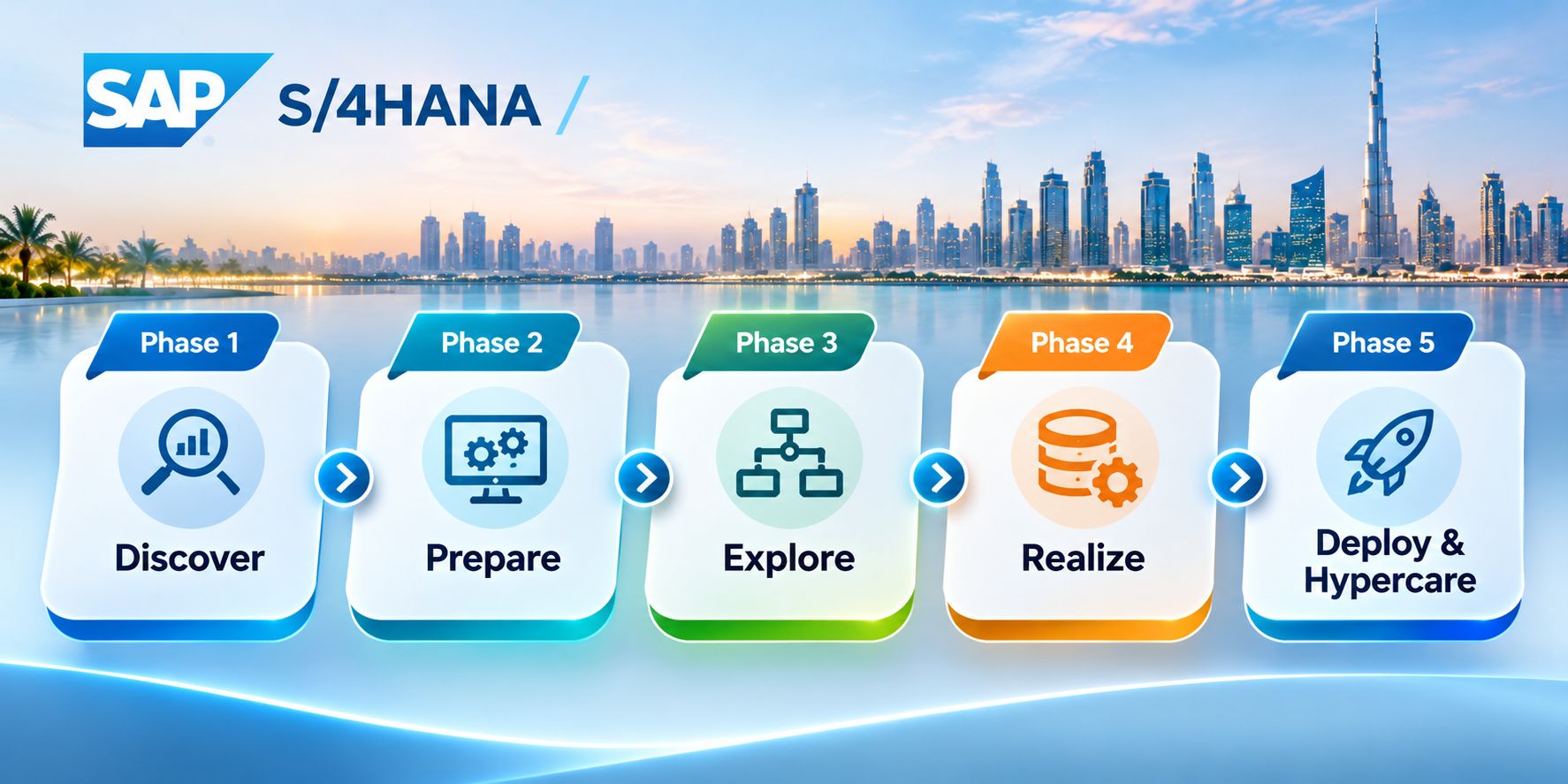
The 5-Phase Enterprise Migration Methodology
Discover & Readiness Assessment
Execute SAP Readiness Check 2.0 against the active ECC production system. Analyze SAP HANA database sizing, catalogue custom code using Usage Procedure Logging / ABAP Call Monitor, evaluate simplification items, and define the strategic business case.
Prepare & Clean Core Governance
Provision sandbox migration environments, activate target cloud landing zones, execute initial CVI conversion trials, and establish Clean Core architecture guidelines using SAP BTP.
Explore & Fit-to-Standard Harmonization
Conduct fit-to-standard workshops with departmental leaders to align workflows with SAP S/4HANA Best Practices. Define data mapping specifications, chart of accounts unification, and integration interface contracts.
Realize, Mock Conversions & Remediation
Remediate custom ABAP code, resolve syntax conflicts, and replace obsolete database accesses with CDS views. Conduct mock migrations, refine cutover timing, perform integration testing, and complete formal UAT sign-offs.
Deploy & Hypercare Transition
Execute production cutover according to the finalized runbook during a scheduled maintenance window. Transition into structured hypercare with dedicated functional and technical on-site and remote support teams to ensure business stabilization.
Regulatory Alignment: Phased UAE E-Invoicing Integration
A vital operational priority for any UAE enterprise modernizing its ERP core is maintaining uninterrupted statutory compliance. In the United Arab Emirates, digital tax compliance is entering an advanced phase under the oversight of the Federal Tax Authority (FTA).
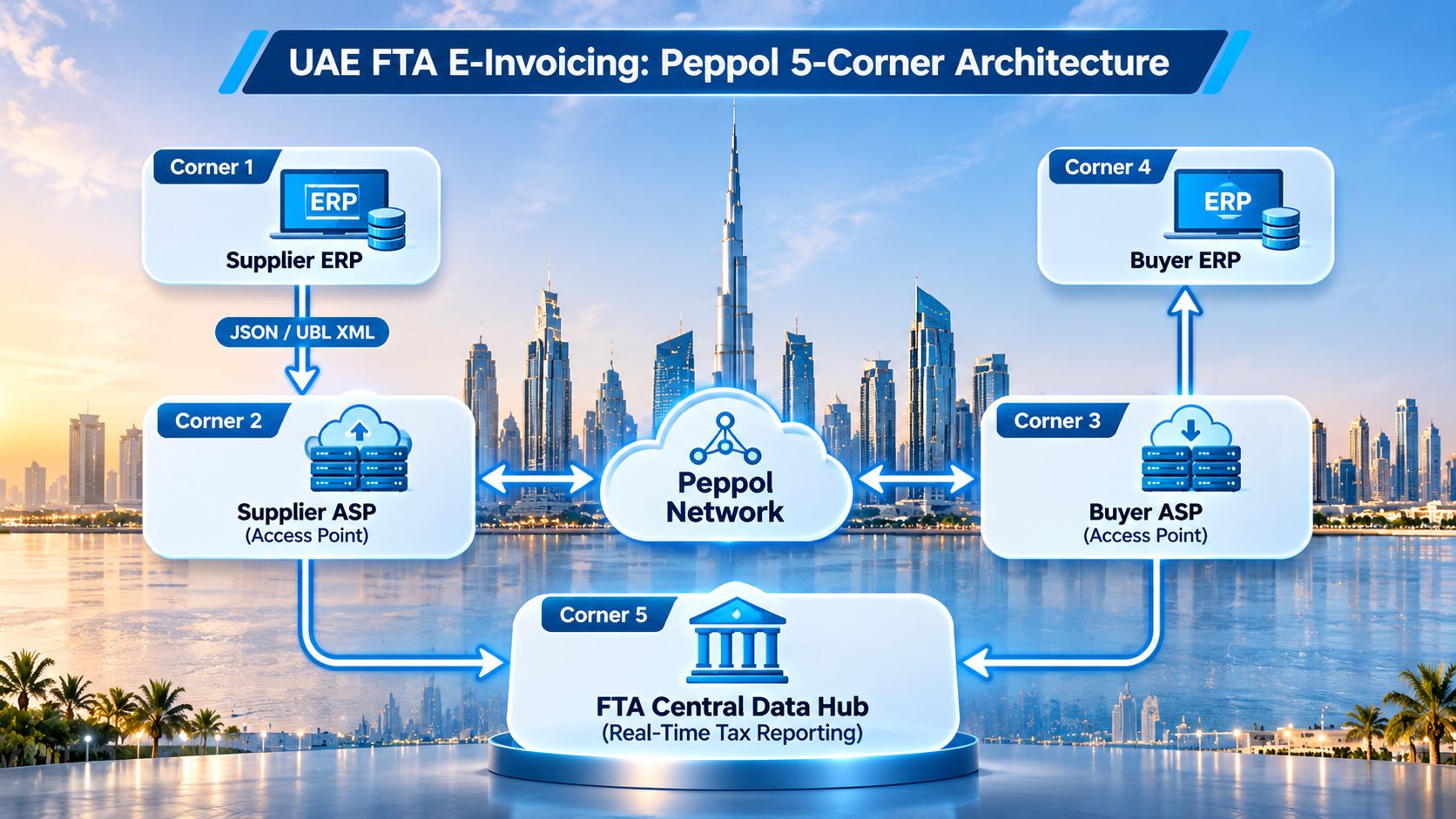
According to official FTA guidance on the national electronic invoicing framework (published via [tax.gov.ae](https://tax.gov.ae/en/media.centre/news/federal.tax.authority.calls.on.persons.subject.to.einvoicing.to.comply.wit.the.prescribed.legal.deadlines.and.avoid.administrative.penalties.aspx)), the UAE is implementing a phased e-invoicing model based on the internationally recognized Peppol (Pan-European Public Procurement On-Line) 5-Corner Framework.
Key Technical Considerations for Migration Planning:
- Phased Mandate Timelines: Rather than applying simultaneously to all businesses on a single date, UAE e-invoicing obligations roll out in structured phases determined by annual turnover and corporate classification. Migration roadmaps must align S/4HANA cutover schedules with the enterprise’s specific statutory deadline.
- Accredited Service Provider (ASP) Requirements: Businesses cannot transmit invoices directly to the FTA via uncertified point-to-point connections. All tax invoices and credit notes must route through an FTA-accredited service provider (Corner 2 / Corner 3 Access Point) capable of cryptographic validation, formatting into compliant PINT (Peppol International) XML syntax, and reporting invoice metadata to the FTA central tax repository (Corner 5).
- ERP Architecture Options: Enterprises transitioning to S/4HANA can integrate their billing engines using SAP Document and Reporting Compliance (DRC) connected to an accredited ASP, or deploy certified pre-built cloud connectors hosted on SAP BTP to orchestrate automated invoice transmission without disrupting daily billing operations.
Enterprise Delivery Governance: Beyond Blanket Guarantees
Enterprise ERP transformations are intricate architectural initiatives. Professional implementation requires transparent, disciplined governance rather than unverified commercial promises of “guaranteed on-budget delivery” or “risk-free weekend cutovers”:
- Quantified Cutover Windows: The duration of production downtime during cutover is determined by data volume, server throughput, and conversion complexity. Real cutover windows are established through rigorous mock rehearsals rather than assumed calendar slots.
- Proactive Risk Mitigation: Leading implementation partners establish structured risk management frameworks—identifying potential bottlenecks across master data cleansing, custom code remediation, and legacy interface testing well before cutover commences.
- Tailored Hypercare Support: Post-go-live stabilization requires dedicated support tiers tailored to the organization’s transaction volume, month-end closing cycles, and geographic operational spread.

As an accredited SAP delivery partner headquartered in Dubai, WMS Middle East LLC combines deep regional domain knowledge with certified technical capabilities across SAP S/4HANA Cloud, SAP BTP, and enterprise cloud architectures.
To evaluate your landscape’s technical readiness, custom code complexity, and migration roadmap, connect with our senior enterprise architecture team via our Contact Portal.

Frequently Asked Questions (FAQs)
What happens if our enterprise does not migrate from SAP ECC by December 31, 2027?
Organizations remaining on SAP ECC 6.0 after December 31, 2027, will either transition automatically to Customer-Specific Maintenance (which excludes new legal patches and active technology updates) or must purchase SAP Extended Maintenance. Extended maintenance is available through December 31, 2030, at a 2% surcharge on the base maintenance fee, but does not provide access to new innovations, cloud features, or SAP Business AI.
How does an organization determine whether to choose Brownfield or Greenfield?
The decision is primarily governed by the health and relevance of the current ECC landscape. If business processes align closely with corporate strategy, master data is clean, and custom developments are well-documented, Brownfield offers a direct path to preserving historical records. If the ECC system is heavily customized with obsolete Z-transactions, multi-layered interfaces, and legacy configurations, a Greenfield implementation provides a strategic opportunity to adopt modern SAP Best Practices and maintain a Clean Core.
How does the SAP Readiness Check 2.0 support migration planning?
The SAP Readiness Check is an automated diagnostic tool executed against the active ECC system. It analyzes custom code compatibility with SAP HANA, checks system sizing requirements, flags simplification items that impact active transactions, audits financial data consistency, and evaluates recommended SAP Fiori applications for end-user productivity.

Mahitab Maher
SAP professional specializing in SAP products, helping companies turn complex processes into smooth, scalable operations.


