


Last Updated 09/10/2026
Executive Summary
- Strategic Overview: Comprehensive guidance on sap implementation cost in dubai: what to expect in 2026 tailored for Middle East and GCC enterprises.
- Key Advantage: Eliminates departmental silos, standardizes reporting, and accelerates operational agility.
- Next Step: Consult with certified WMS Middle East SAP experts for tailored architecture sizing and cost estimation.
SAP implementation cost in Dubai is not a single number, and that is exactly why many businesses get budgeting wrong. A small trading company with straightforward processes will not spend the same way as a multi-entity manufacturer with complex approvals, integrations, and reporting needs. The real cost depends on the SAP product selected, the scope of business change, the quality of existing data, and the amount of local compliance work required in the UAE.
To evaluate technical partner qualifications and service levels, review our CFO checklist for choosing an SAP Gold Partner in Dubai.
For Dubai businesses, the question is usually not whether the selected SAP solution fits the company’s size, process complexity, and growth plan, but how to budget for it properly. If the project is underestimated, the business ends up paying later through delays, rework, user adoption issues, and extra consulting hours. If it is over-scoped, the company may choose a platform that is too heavy for what it actually needs. The smartest approach is to align SAP with the business model first, then build the budget around that decision.
Why SAP budgets vary so much
The biggest reason SAP budgets vary is that SAP implementations are transformation projects, not just software installs. A business is not only paying for licenses; it is paying for discovery, solution design, configuration, testing, training, data migration, and support after go-live. In many cases, the implementation service cost becomes more important than the license itself.
Several factors shape the final investment. The number of users matters because more users usually means more training, more roles, and more testing. The number of legal entities matters because multi-company setups require more reporting and controls. Integration requirements also matter because each connection to accounting systems, payroll tools, e-commerce platforms, or logistics systems adds complexity. Data quality is another major factor, since poor master data often needs cleansing before migration can begin.
UAE-specific requirements also affect the budget. Businesses in Dubai often need VAT-ready workflows, bilingual interfaces, local reporting logic, WPS-related payroll handling, and e-invoicing readiness. These are not minor add-ons. They influence both implementation effort and the time needed to go live successfully.
UAE Regulatory Compliance: Corporate Tax (9%) & FTA E-Invoicing
- Mandatory 9% Tax Provisioning: Automated general ledger tax accounting and transfer pricing compliance in SAP.
- FTA Peppol Connector: Real-time digital invoice generation and cryptographic verification.
- Action: Contact WMS Middle East for a comprehensive UAE tax and e-invoicing readiness assessment.
SAP Business One or SAP S/4HANA?

The choice between SAP Business One and SAP S/4HANA is usually the first major cost decision. SAP Business One is generally the better option for SMEs that need a practical ERP for finance, sales, inventory, purchasing, and basic manufacturing. It is simpler to deploy, easier to support, and usually faster to implement. That lower complexity often makes it the more economical choice for trading firms, distributors, and smaller manufacturers.
SAP S/4HANA, on the other hand, is designed for larger and more complex organisations. It supports advanced finance, supply chain management, multi-entity operations, and broader enterprise controls. That capability comes with a bigger budget requirement because the project usually involves more workshops, deeper process redesign, more testing, and a longer change-management effort. For businesses that genuinely need enterprise-level functionality, the cost is justified by the scale of the operation.
The wrong product choice is one of the most expensive mistakes a Dubai business can make. A company can spend too much by choosing S/4HANA before it is ready, or it can spend twice by starting with a smaller system and replacing it too early. The better approach is to assess operational complexity, growth plans, and compliance obligations before choosing the ERP path.
What should a budget include?
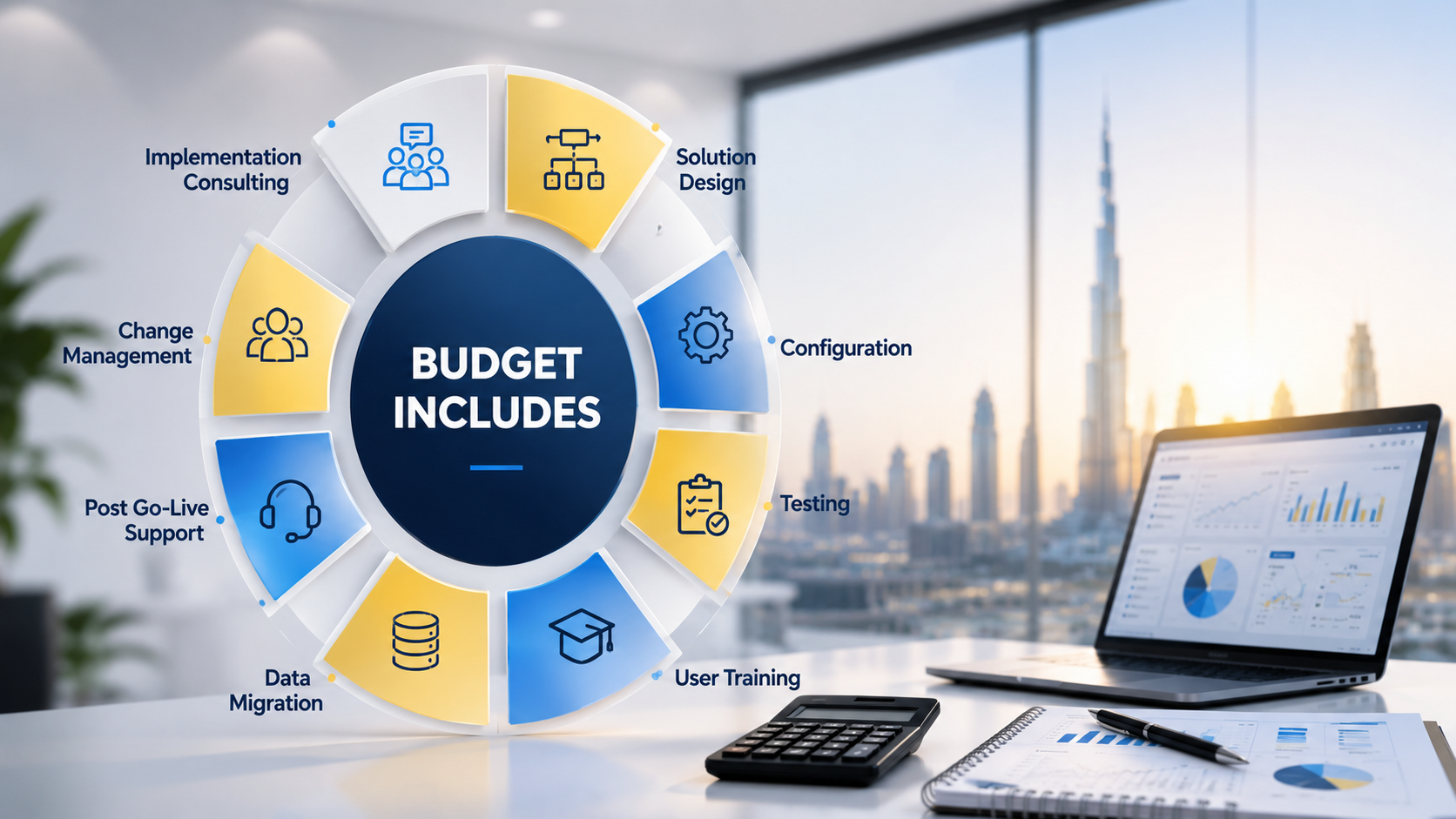
A realistic SAP project budget should include more than software licenses. It should include implementation consulting, solution design, configuration, testing, user training, data migration, and support after launch. It should also include the cost of change management, because even a well-built ERP can fail if staff are not prepared to adopt it.
Businesses often forget to budget for internal effort. Key team members must spend time in workshops, validate business requirements, review test scenarios, and support user acceptance testing. That internal time has a cost even if it does not appear on the vendor invoice. It also affects the project timeline, because decisions cannot be made quickly if the right stakeholders are unavailable.
Support after go-live is another item that should never be treated as optional. The first few weeks after launch usually reveal data issues, process gaps, and user questions that were not obvious during testing. A proper support arrangement helps the system stabilise and improves adoption. Without that support, businesses often see higher frustration and more operational interruptions.
Looking to implement or optimize this in Dubai or the UAE?
Speak with WMS Middle East certified SAP consultants for a customized architectural and cost assessment.
How Dubai businesses can avoid overspending
The easiest way to overspend is to start with features instead of business requirements. Companies sometimes ask for a long list of functions before they define what success actually looks like. That usually leads to unnecessary customisation. Customisation is not always bad, but every extra piece of bespoke work adds cost, testing effort, and future maintenance.
Another way to overspend is to migrate bad data into a new system without cleaning it first. Duplicate customers, incomplete product records, and outdated transaction history all create problems later. Data migration should be planned as a project activity, not treated as a technical detail at the end.
Businesses can also control spend by phasing the rollout. Instead of launching every module at once, some companies start with finance and core operations, then add additional functions after the team stabilises. This approach reduces risk and makes the budget easier to manage. It also helps users adapt gradually instead of being overwhelmed.

How WMS Dubai approaches SAP projects
WMS Dubai treats SAP implementation as a business decision first and a software decision second. The process starts with discovery, because a meaningful budget cannot be built without understanding the company structure, operating model, user count, and integration landscape. That is the only reliable way to recommend the right platform and scope.
For Dubai businesses, this approach matters because the city has a wide range of company profiles, from small trading operations to complex regional groups. A budget that works for one business may be completely wrong for another. WMS Dubai therefore focuses on fit, not on pushing the biggest system or the most expensive model.
The practical goal is to help the business choose an ERP that can be implemented successfully, supported properly, and grown over time. That means balancing cost, functionality, compliance, and future scalability.
To ensure seamless project governance, consult with an accredited SAP implementation partner in Dubai with proven regional experience.

Conclusion
SAP implementation cost in Dubai should be treated as a business planning exercise, not a fixed product price. The right budget depends on the size of the company, the complexity of operations, the SAP product selected, and the level of support needed to make the system successful. For many SMEs, SAP Business One will be the practical route. For larger or more complex organisations, SAP S/4HANA may be the better long-term investment.
The best outcome comes from choosing the right platform first, budgeting for the full project lifecycle, and planning for support after go-live. That is how Dubai businesses get SAP right the first time.

Frequently Asked Questions (FAQs)
How much does SAP implementation cost in Dubai?
It depends on the product, scope, customisation, integrations, and local compliance requirements. A detailed discovery phase is needed before any reliable estimate can be given.
Is SAP Business One cheaper than SAP S/4HANA?
Yes. SAP Business One is typically less expensive because it is designed for smaller organisations with simpler operational needs.
What drives SAP implementation fees in the UAE?
The main drivers are user count, business complexity, data quality, integrations, local compliance, and the amount of change management required.
Why do SAP projects go over budget?
The most common reasons are unclear scope, poor data quality, hidden integration work, and late changes to requirements.
Should UAE businesses budget for post-go-live support?
Yes. Support after launch is essential for stabilising the system, helping users, and fixing issues discovered in real usage.

Mahitab Maher
SAP professional specializing in SAP products, helping companies turn complex processes into smooth, scalable operations.


