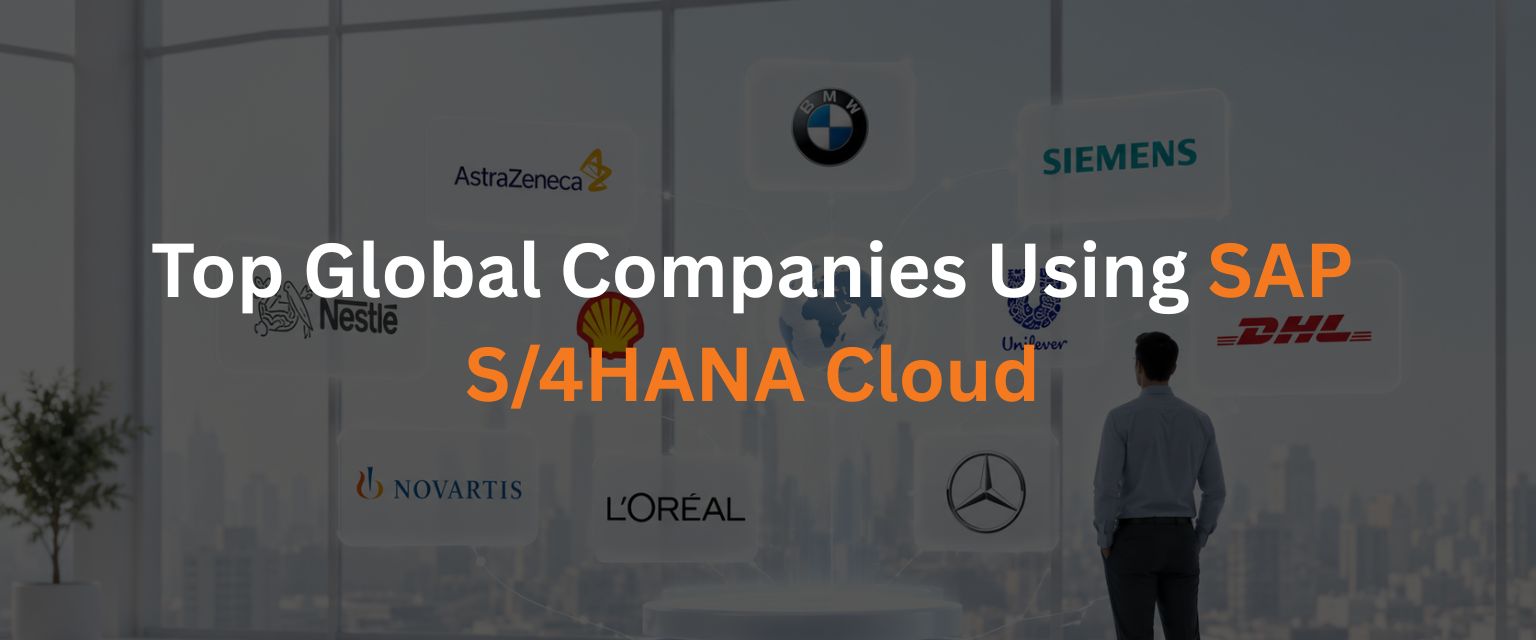
SAP now serves roughly 425,000 customers across more than 180 countries, and 84% of the Forbes Global 2000 run on SAP in some form (SAP FY2025 results). Within that base, S/4HANA Cloud has crossed 25,000+ customers (worldmetrics.org), split between two very different deployment models: Public Edition and Private Edition. For a broader, cross-industry view of who runs SAP overall, see our full list of top companies using SAP by industry.
The two editions are often confused, but the companies choosing between them make that choice for very different reasons. This list breaks down real-world adopters across seven industries and is explicit about what’s actually confirmed for each: whether a company is evaluating, has selected, is implementing, or is live on S/4HANA Cloud, and whether the specific edition (Public, Private, on-premise, or unspecified) has been publicly confirmed.
A note on sourcing: several company mentions below draw on AppsRunTheWorld, a proprietary technographics database of organizations identified as using or evaluating a given product. It is not SAP’s official customer registry, and it is not used here to calculate SAP’s global adoption numbers; it’s one data point among several, cited per company.
Public Edition vs Private Edition: The Core Differences
| Factor | SAP S/4HANA Cloud Public Edition | SAP S/4HANA Cloud Private Edition |
|---|---|---|
| Hosting | Multi-tenant, SAP-managed public cloud | Single-tenant, hosted on a hyperscaler or SAP data center |
| Customization | Limited, standardized best-practice processes | High, supports deep customization and add-ons |
| Update Cycle | Two SAP-managed upgrades per year | Customer-controlled release schedule |
| Typical Buyer | Mid-market, fast-growth, or subsidiaries needing standardization | Large enterprises with complex, industry-specific processes |
| Delivery Path | GROW with SAP | RISE with SAP |
| Best Fit | Companies that want speed and lower total cost | Companies migrating from a heavily customized ECC system |
If you’re comparing these two paths for your own organization, our dedicated pages on SAP Cloud ERP and SAP Cloud ERP Private break down each edition’s scope, pricing model, and implementation approach in more depth.

Why This Split Matters Right Now
SAP’s own FY2025 results show public cloud orders growing five times faster than private cloud orders, while Joule (SAP’s AI copilot) adoption rose ninefold (SAP News Center / Q4 2025 Quarterly Statement, via quantumrun.com). At the same time, more than 60% of legacy SAP ECC customers still haven’t migrated to S/4HANA at all, with the 2027 end-of-mainstream-maintenance deadline approaching (same source). That combination is pushing a wave of both new Public Edition sign-ups and large, complex Private Edition migrations at the same time, heading into the rest of 2026.
Companies Using SAP S/4HANA Cloud, Industry-Wise
Healthcare & Pharmaceuticals
| Company | Country | Industry Focus | Status | Edition & Source |
|---|---|---|---|---|
| CVS Health | United States | Healthcare & Pharmacy | Selected SAP S/4HANA | Unspecified AppsRunTheWorld ↗ |
| Chiesi | Italy | Pharmaceuticals | Implementing | Private Edition (RISE with SAP) SAP Customer Story ↗ |
| Uniphar | Ireland | Pharma & Healthcare Distribution | Selected | Unspecified SAP Customer Story ↗ |
| SNS Health | United States | Healthcare Services | Live | Public Edition TEC Reference ↗ |
Chiesi’s move to Private Edition through RISE with SAP was built around large-scale transformation needs that a standardized Public Edition rollout would not accommodate, which is a common pattern for global pharma manufacturers with regulated, country-specific processes. CVS Health’s S/4HANA relationship is confirmed via AppsRunTheWorld’s technographic tracking, not an SAP-published case study, so the cloud deployment and specific edition are not independently established.
Automotive & Manufacturing
| Company | Country | Industry Focus | Status | Edition & Source |
|---|---|---|---|---|
| BMW | Germany | Automotive | Selected / Using | Unspecified AppsRunTheWorld ↗ |
| PowerCo | Germany | EV Battery Manufacturing | Live | Unspecified SAP Customer Story ↗ |
| A Japanese Manufacturing Company | Japan | Manufacturing | Live (Go-Live in 2023) | Public Edition Cloud Wars ↗ |
The Japanese manufacturer case, reported by Cloud Wars, is a useful example of Public Edition’s core appeal for manufacturing groups: it was adopted specifically to standardize overseas subsidiaries onto one platform rather than to run the parent company’s core operations. RAUMEDIC, previously listed here, has been removed: the public source ties the company to SAP Digital Manufacturing, not to a confirmed S/4HANA Cloud deployment, so it doesn’t belong in this list without direct evidence.
Oil, Gas & Energy
| Company | Country | Industry Focus | Status | Edition & Source |
|---|---|---|---|---|
| Chevron Corporation | United States | Oil, Gas & Chemicals | Selected / Using | Unspecified AppsRunTheWorld ↗ |
| Phillips 66 | United States | Oil, Gas & Chemicals | Selected / Using | Unspecified AppsRunTheWorld ↗ |
| SA Power Networks | Australia | Utilities | Selected | SAP Business AI, Business Technology Platform & SuccessFactors SAP Customer Story ↗ |
Energy and utility companies tend to lean toward Private Edition or RISE with SAP given asset-heavy operations, safety compliance requirements, and long-lived legacy systems that need custom extensions rather than standardized processes, though the specific edition isn’t confirmed for the companies above. See the broader industry breakdown, including more energy and utilities companies running SAP, for additional context.
Retail & Consumer Goods
| Company | Country | Industry Focus | Status | Edition & Source |
|---|---|---|---|---|
| Apple | United States | Consumer Electronics & Retail | Selected / Using | S/4HANA Cloud Sourcing AppsRunTheWorld ↗ |
| Cult Beauty | United Kingdom | Beauty Retail | Selected / Using | S/4HANA Cloud Sourcing AppsRunTheWorld ↗ |
Retail’s Public Edition adoption picked up further after SAP released a dedicated retail and fashion industry platform on Public Edition, aimed at merchandising, store replenishment, and omnichannel fulfillment (TechTarget), closing a gap that previously pushed retailers toward Private Edition or on-premise SAP for industry-specific functionality.
Reportedly evaluating S/4HANA Cloud: MECCA Australia was reported to be evaluating S/4HANA Cloud as part of a migration away from Microsoft Dynamics NAV (AppsRunTheWorld). No selection or go-live has been confirmed, so it’s listed separately rather than alongside confirmed adopters.

Technology & Professional Services
| Company | Country | Industry Focus | Status | Edition & Source |
|---|---|---|---|---|
| Microsoft | United States | Technology & Professional Services | Selected / Using | Unspecified AppsRunTheWorld ↗ |
| PwC | United States | Professional Services | Live | Unspecified PwC Case Study ↗ |
| Boeing | United States | Aerospace & Defense | Selected / Using | S/4HANA Cloud Sourcing AppsRunTheWorld ↗ |
| An American Media Company | United States | Media | Live (Early Go-Live in 2019) | Public Edition Cloud Wars ↗ |
The media company example is one of SAP’s longest-running Public Edition deployments, expanding from core financials and indirect procurement into inventory, manufacturing, and warehouse management over several years, which shows Public Edition can scale in scope even though it’s standardized in configuration.
Banking & Financial Services
| Company | Country | Industry Focus | Status | Edition & Source |
|---|---|---|---|---|
| Cornèr Bank | Switzerland | Private Banking | Live (First Private Bank on the Platform) | SAP S/4HANA (Deployment Edition Not Publicly Confirmed) Deloitte Reference ↗ |
| Qonto | France | Digital Banking | Selected / Implementing SAP S/4HANA Cloud | Unspecified AppsRunTheWorld ↗ |
Banking is where the Public vs Private decision is sharpest. SAP’s own positioning for midmarket banks pitches Public Edition’s pre-built, standardized functionality as a fit for smaller institutions (SAP News), while larger banks with KYC, AML, and cross-border compliance needs generally require the deeper customization only Private Edition supports.
SAP ecosystem and integration partners: J.P. Morgan has publicized integrated treasury and payments capabilities built for SAP customers (J.P. Morgan Newsroom), but this reflects a banking-services integration offered to the broader SAP customer base, not a confirmed internal S/4HANA Cloud implementation at J.P. Morgan itself. It’s noted here as an ecosystem relationship rather than a customer listing.
Logistics & Transportation
| Company | Country | Industry Focus | Status | Edition & Source |
|---|---|---|---|---|
| Watco | United States | Rail & Logistics | Implementing / Live | SAP S/4HANA Cloud Private Edition (RISE with SAP) SAP Community ↗ |
| ÖBB Infra | Austria | Railway Infrastructure | Migrating | SAP S/4HANA Migration (Deployment Model Not Specified) SAP Community ↗ |
| A Major Technology, Logistics & Finance Company | United States | Parcel & Mail Logistics | Live | Public Edition LTM Case Study ↗ |
The parcel and logistics case above is a good illustration of why some large, complex operators still choose Public Edition: the goal was to move away from years of heavy customization on a legacy system, not add more of it, so a standardized platform was the better fit despite the company’s size.
How Company Size Shapes the Public vs Private Decision
Based on data from AppsRunTheWorld’s technographics database for S/4HANA Cloud (AppsRunTheWorld), which tracks organizations identified as using or evaluating the product rather than serving as SAP’s official customer registry:
- Companies with 0-100 employees: 4.6% of the tracked S/4HANA Cloud base
- Companies with 101-1,000 employees: 27.1%
- Companies with 1,001-10,000 employees: 38.1%
- Companies with 10,000+ employees: 30.2%
Mid-market companies (101-10,000 employees) make up the majority of the tracked S/4HANA Cloud base, and this segment is where Public Edition adoption is concentrated, since standardized processes usually cover their needs without heavy customization. The largest enterprises, meanwhile, are more likely to run Private Edition or RISE with SAP, where a complex ECC legacy footprint needs a more controlled migration path. For help deciding which path fits your own organization, see our breakdowns of SAP Cloud ERP and SAP Cloud ERP Private.
Frequently Asked Questions (FAQs)
What's the real difference between S/4HANA Cloud Public and Private Edition?
Public Edition is a multi-tenant, standardized SaaS product with two SAP-managed upgrades a year, best suited to companies willing to adapt to best-practice processes. Private Edition is single-tenant, allows deep customization, and gives the customer control over the update schedule, which suits large enterprises with complex or regulated operations.
Which companies typically choose Public Edition?
Which companies typically choose Private Edition?
Is SAP pushing companies toward one edition over the other?
What happens to companies still on SAP ECC?
Why do some companies in this list not have a confirmed edition?

Mahitab Maher
SAP professional specializing in SAP products, helping companies turn complex processes into smooth, scalable operations.
Sources referenced in this article:
- SAP FY2025 financial results, via SAP News Center / SAP Quarterly Statement Q4 2025 (quantumrun.com)
- SAP industry statistics (worldmetrics.org)
- AppsRunTheWorld, SAP S/4HANA Cloud customer database — a proprietary technographics database, not SAP’s official customer registry
- AppsRunTheWorld, SAP S/4HANA Cloud Sourcing customer database
- SAP Customer Stories
- Cloud Wars, “SAP’s Red-Hot S/4HANA Cloud: Six Customer Stories”
- TechTarget, “SAP S/4HANA Cloud Public Edition ready for retailers”
- Technology Evaluation Centers (TEC), S/4HANA Cloud Public Edition case listings
- PwC, “How PwC transformed finance with SAP S/4HANA Cloud ERP”
- J.P. Morgan Newsroom, integrated banking capabilities with SAP
- SAP News, midmarket banking industry
- Deloitte, SAP alliance case studies
- SAP Community, Travel and Transportation customer stories
- LTM, “Streamlined Operations with S/4HANA Public Cloud Implementation”
Related reading on wmsspl.com:


