


Listen to This Article
Perfect for busy professionals who prefer learning on the go.
Executive Overview: The UAE Digital Tax Transformation
The United Arab Emirates Ministry of Finance (MoF) and the Federal Tax Authority (FTA) have introduced the mandatory nationwide Electronic Invoicing System (E-Invoicing). Operating under the decentralized Continuous Transaction Controls (CTC) framework and the international Peppol 5-Corner Model, this initiative marks a historic shift in how B2B (Business-to-Business) and B2G (Business-to-Government) transactions are documented, validated, and reported.
It is important to emphasize that the current implementation decisions apply strictly to B2B and B2G transactions. B2C (Business-to-Consumer) transactions are currently excluded under the present implementation decisions.
Unlike traditional PDF or paper invoices, the UAE E-Invoicing mandate requires all invoices, credit notes, and debit notes to be structured in standardized machine-readable XML format (Peppol International – PINT UAE) and transmitted in real-time through certified Accredited Service Providers (ASPs) before reaching the buyer.

Official UAE E-Invoicing Phase Rollout Timeline & Revenue Thresholds
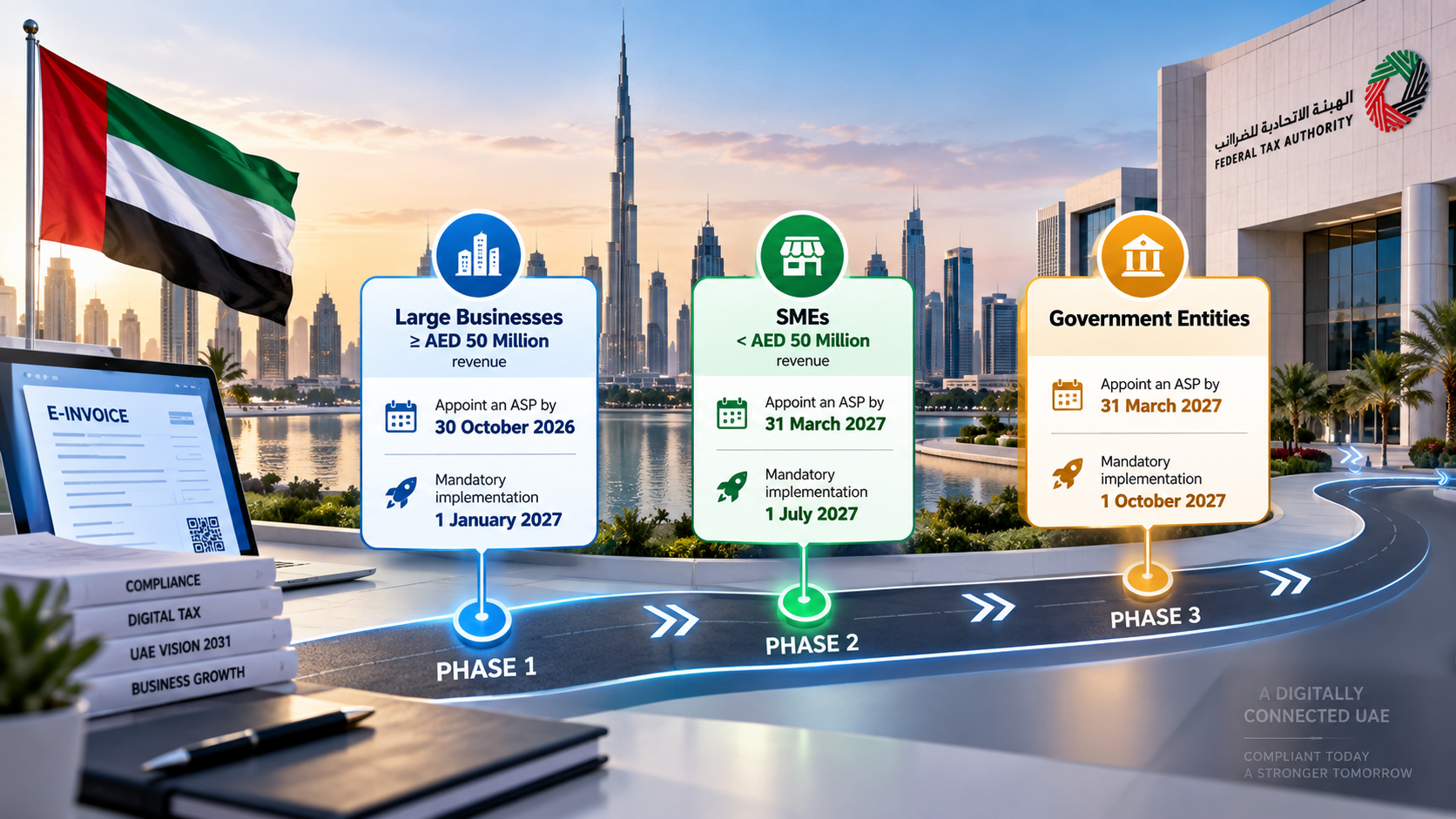
The phase-wise implementation schedule has been formally defined under Ministerial Decision 244/2025, as amended by Decision 66/2026. The rollout incorporates an initial voluntary / pilot phase commencing on 1 July 2026, followed by mandatory compliance milestones based on annual revenue thresholds. In accordance with updated regulatory directives, the ASP appointment deadline officially governs onboarding:
| Category | Appoint an ASP By | Mandatory Implementation |
|---|---|---|
| Persons in Scope with Revenue ≥ AED 50 Million | 30 October 2026 | 1 January 2027 |
| Persons in Scope with Revenue < AED 50 Million | 31 March 2027 | 1 July 2027 |
| Government Entities | 31 March 2027 | 1 October 2027 |
Key Phase Details & Revenue Thresholds:
- Phase 1 (Persons in scope with annual revenue equal to or exceeding AED 50 million): ASP appointment deadline is 30 October 2026 | Mandatory implementation: 1 January 2027
- Phase 2 (Persons in scope with annual revenue below AED 50 million): ASP appointment deadline is 31 March 2027 | Mandatory implementation: 1 July 2027
- Phase 3 (Government Entities & Federal Authorities): ASP appointment deadline is 31 March 2027 | Mandatory implementation: 1 October 2027
Key Scope Exclusions: B2C (Business-to-Consumer) transactions are currently excluded from the mandatory e-invoicing scope under the implementation decision. Non-compliance carries severe administrative penalties under the UAE Tax Procedures Law, including invoice invalidation, input VAT denial, and monetary fines per non-compliant document.
Technical Architecture: The Peppol 5-Corner Model Explained
The framework under which Electronic Invoices are issued and distributed in the UAE operates across a decentralized 5-corner exchange architecture, with each corner being as follows:
- Corner 1: Supplier
- Corner 2: Supplier’s ASP
- Corner 3: Recipient’s (Buyer’s) ASP
- Corner 4: Recipient (Buyer)
- Corner 5: Federal Tax Authority

Detailed End-to-End Transaction Flow:
1. Corner 1 (Supplier): The supplier generates the sales invoice or credit/debit note inside their ERP (SAP S/4HANA, SAP Business One, or billing software).
2. Corner 2 (Supplier’s ASP): The supplier’s certified Accredited Service Provider receives raw invoice data, converts it into standard PINT-XML syntax, signs it cryptographically (ECDSA), and transmits it.
3. Corner 5 (Federal Tax Authority): The central MoF/FTA tax platform receives the standardized invoice payload, validates business rules, registers clearance metadata in real time, and provides verification back to the network.
4. Corner 3 (Recipient’s ASP): The recipient’s (buyer’s) Accredited Service Provider receives the validated XML payload from the network and prepares it for ingestion.
5. Corner 4 (Recipient): The recipient (buyer) receives the electronic invoice directly into their Accounts Payable ERP for automated 3-way matching, reconciliation, and payment processing.
Key Technical Requirements for ERP Systems
- PINT-XML Data Schema: Standardized XML payload mapping with strict field validation (TRN, digital UUID, item classification codes, currency codes, and exact VAT split calculations).
- Cryptographic Hashing & Digital Signatures: ECDSA digital signature generation to guarantee document authenticity and tamper-proof transmission.
- Certified ASP RESTful API Connectors: Direct, automated API pipelines connecting SAP S/4HANA (via SAP BTP / SAP Document and Reporting Compliance) or SAP Business One (via WMS E-Invoicing Add-on) to registered ASP access points.
- Reconciliation with UAE 9% Corporate Tax: Seamless general ledger synchronization between e-invoiced revenue, VAT returns, and Corporate Tax provisioning.
How WMS Middle East Accelerates Your E-Invoicing Compliance
As an accredited SAP Gold Partner in Dubai with over 500+ successful enterprise implementations, WMS Middle East provides end-to-end e-invoicing deployment:
- Pre-Built E-Invoicing Integration for SAP Business One & S/4HANA
- Certified ASP Connector Integration (Peppol Access Point Onboarding)
- Automated PINT-XML Schema Mapping & Error Handling
- In-House Tax Health Check & General Ledger Re-conciliation
- 24/7 Dedicated Support & FTA Compliance Maintenance

Frequently Asked Questions (FAQs)
What is the UAE E-Invoicing mandate 2026?
The UAE E-Invoicing mandate is a digital invoicing framework requiring businesses in scope to issue and exchange structured electronic invoices through approved Accredited Service Providers (ASPs). The system uses the Peppol network and PINT-UAE XML standards for compliant invoice exchange.
When does UAE E-Invoicing become mandatory?
Mandatory implementation begins 1 January 2027 for businesses with annual revenue of AED 50 million or more. Businesses below AED 50 million must comply from 1 July 2027, while government entities have a 1 October 2027 implementation date.
Does UAE E-Invoicing apply to B2C transactions?
Under the current UAE implementation decisions, the mandatory e-invoicing requirements apply to B2B and B2G transactions. B2C transactions are currently excluded from the mandatory scope.
How does SAP integrate with UAE E-Invoicing?
SAP systems such as SAP S/4HANA and SAP Business One can integrate with UAE E-Invoicing through certified ASP connectors. The integration can automate invoice data extraction, PINT-XML conversion, validation, transmission, error handling, and receipt of compliant electronic invoices.
What is the Peppol 5-Corner Model in UAE E-Invoicing?
The Peppol 5-Corner Model connects the supplier, supplier’s ASP, buyer’s ASP, buyer, and the UAE tax authority. It enables structured invoice data to move securely between businesses and the tax authority while supporting automated validation and compliance.

Mahitab Maher
SAP professional specializing in SAP products, helping companies turn complex processes into smooth, scalable operations.


