Last Updated 07/09/2026
Executive Summary
In an increasingly competitive regional market, Middle East enterprises must continuously modernize their core business operations to drive sustainable growth. This strategic briefing examines critical technology adoption trends, enterprise architecture considerations, and proven SAP deployment best practices. Gain actionable executive insights into maximizing software ROI, maintaining governance compliance, and accelerating digital transformation.
Product Page: wmsspl.com/sap-cloud-erp
Why Most SME ERP Implementations Fail Before They Even Begin
SAP Cloud ERP is SAP’s cloud-delivered enterprise resource planning solution, formerly known as SAP S/4HANA Cloud Public Edition. For the official SAP overview, see https://www.sap.com/products/erp/s4hana.html. SAP also explains cloud ERP benefits here: https://www.sap.com/india/products/erp/what-is-erp/erp-benefits.html.
Growing businesses often reach a point where spreadsheets, disconnected tools, and manual approvals start slowing down finance, operations, and supply chain teams. SAP Cloud ERP is designed to solve that problem by bringing core business processes into one intelligent cloud platform that supports real-time decisions and continuous innovation.
Executive Summary
- Strategic Overview: Comprehensive guidance on what is sap cloud erp? a complete guide for growing businesses tailored for Middle East and GCC enterprises.
- Key Advantage: Eliminates departmental silos, standardizes reporting, and accelerates operational agility.
- Next Step: Consult with certified WMS Middle East SAP experts for tailored architecture sizing and cost estimation.
What Is SAP Cloud ERP?
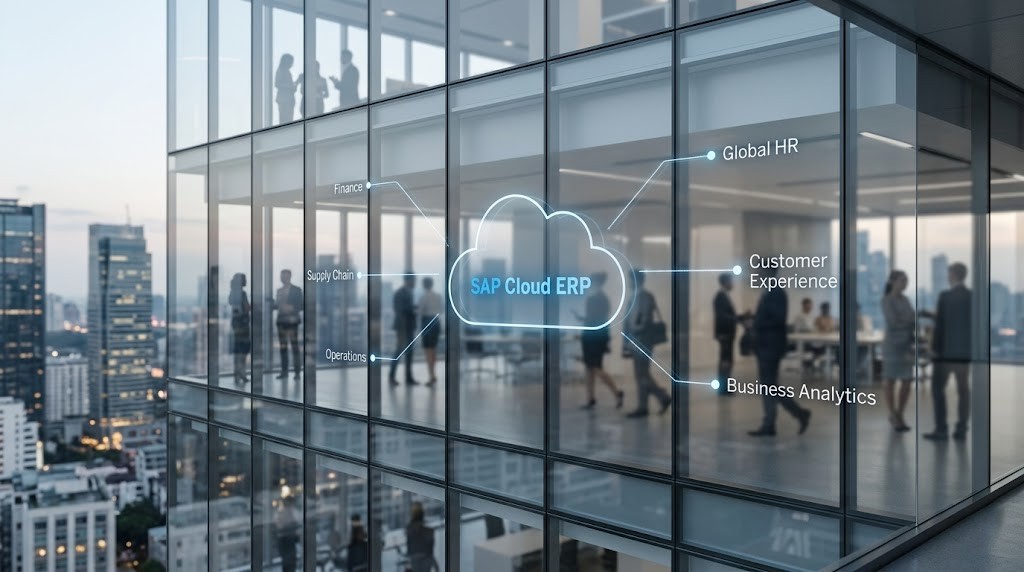
SAP Cloud ERP is SAP’s cloud-delivered enterprise resource planning solution, formerly known as SAP S/4HANA Cloud Public Edition. SAP positions it as a best-practice-driven system designed to help companies standardise operations and scale with less complexity.
In simple terms, it helps companies manage finance, supply chain, operations, sales, HR, and related processes on a single platform. Because it is cloud-based, updates and maintenance are handled by SAP, which reduces the burden on internal IT teams and keeps the system current.
Who Is It For?
SAP Cloud ERP is a strong fit for small, mid-sized, and growing businesses that want standardised processes, faster implementation, and a scalable system. SAP and partner content position it well for organisations that want a clean-core approach with fewer customisation needs.
It is especially relevant for companies that need better visibility across finance, procurement, inventory, manufacturing, and service without maintaining a heavy on-premise ERP environment.
How It Works
SAP Cloud ERP works as a software-as-a-service platform, which means the provider manages the infrastructure, security, patches, and upgrades. Businesses access the system through the cloud, while their data remains securely separated from other customers in the environment .
The value of this model is speed and simplicity: teams can standardise processes, automate routine work, and get real-time data without building a large internal ERP stack.
Key Benefits
- Faster access to best-practice business processes.
- Real-time visibility across core functions.
- Lower IT maintenance overhead than traditional ERP.
- Built-in scalability for growth.
- Continuous innovation through regular updates.
- Better alignment between finance, operations, and supply chain.
Core Capabilities
SAP Cloud ERP is built to connect the processes that growing businesses rely on every day. Common capability areas include finance, procurement, sales, service, supply chain, manufacturing, and reporting. SAP and partner sources also highlight AI, analytics, automation, and a simplified data model as central strengths of the platform.
At a Glance
| Area | What It Means | Why It Matters | Success Indicator |
|---|---|---|---|
| Deployment | Cloud-based ERP delivered as SaaS | Reduces infrastructure management and enables faster access | Faster implementation with minimal IT overhead |
| Process Model | Standardised best practices | Improves adoption and simplifies upgrades | Consistent workflows across teams |
| Data | Centralised real-time data model | Supports accurate decisions and reporting | Better visibility and reporting accuracy |
| Innovation | Continuous updates | Removes need for major upgrade cycles | Always up-to-date system functionality |
| Growth | Scales as business expands | Supports new users, markets, and processes | Smooth scaling without limitations |
Enterprises looking to fast-track their cloud adoption can leverage our 16-week SAP cloud migration roadmap for streamlined go-live execution.

Looking to implement or optimize this in Dubai or the UAE?
Speak with WMS Middle East certified SAP consultants for a customized architectural and cost assessment.
Why Businesses Choose It

Many companies choose SAP Cloud ERP when they want to modernise without rebuilding everything from scratch. It is particularly valuable when leadership wants a unified platform, stronger control over business data, and a system that can support long-term growth with less complexity.
For WMSSPL, this topic is useful because it speaks directly to businesses comparing cloud ERP options and looking for a partner who can explain the practical difference between ERP concepts and real-world implementation.
SAP Cloud ERP vs Traditional ERP
Traditional ERP often depends on on-premise servers, manual maintenance, and periodic upgrade projects. SAP Cloud ERP moves that burden to the cloud, giving organisations a more modern operating model with continuous updates and lower technical overhead.
That does not mean every business should choose it automatically. Companies with highly unique process requirements may need a deeper evaluation before deciding whether public cloud ERP is the best fit.
Before starting your migration, review our SAP implementation cost in Dubai analysis to plan your project budget accurately.
Should companies choose SAP Cloud ERP or SAP Cloud ERP Private?
That depends on process complexity, customisation needs, and how much existing SAP investment they need to protect.
If your team is evaluating cloud ERP options, WMSSPL can help you assess whether SAP Cloud ERP fits your business model, process needs, and growth plans. Talk to our team or visit the product page at https://wmsspl.com/sap-cloud-erp/ to explore the right SAP path for your organisation.
Frequently Asked Questions (FAQs)
Is SAP Cloud ERP the same as SAP S/4HANA Cloud Public Edition?
Yes. SAP Cloud ERP is the newer name for SAP S/4HANA Cloud Public Edition
What size businesses use SAP Cloud ERP?
It is commonly positioned for small, mid-sized, and growing businesses, as well as larger firms that want standardisation.
Does SAP Cloud ERP support real-time reporting?
Yes. SAP highlights real-time data and analytics as core advantages of the platform.
Is SAP Cloud ERP customisable?
It is more standardised than private cloud options, which is why it works best for fit-to-standard organisations.
Can SAP Cloud ERP help reduce IT workload?
Yes. SAP manages hosting, maintenance, and updates in the cloud model.
What business areas does SAP Cloud ERP cover?
Finance, supply chain, procurement, sales, service, manufacturing, and related enterprise processes.
Why is SAP Cloud ERP called a clean-core solution?
Because it encourages standard processes and avoids heavy customisation inside the core system.
Is SAP Cloud ERP good for growing companies?
Yes. It is designed to scale as users, products, and markets expand.
How does SAP Cloud ERP improve decision-making?
It centralises business data, so teams can work from one consistent source of truth.
Should companies choose SAP Cloud ERP or SAP Cloud ERP Private?
That depends on process complexity, customisation needs, and how much existing SAP investment they need to protect.

Mahitab Maher
SAP professional specializing in SAP products, helping companies turn complex processes into smooth, scalable operations.


Nice overview. Helpful for businesses trying to understand modern ERP options.
Thanks Laura. Glad it helped simplify things.
Interesting to see how widely SAP is used by large companies. It also shows why having the right ERP system becomes important as a business grows.
Thanks Daniel. That’s a great point. As businesses grow, managing data and processes across different departments becomes much harder without a connected system.