Last Updated 28/08/2026
Executive Summary
- Strategic Overview: Comprehensive guidance on what is sap cloud erp private? features, benefits, and use cases tailored for Middle East and GCC enterprises.
- Key Advantage: Eliminates departmental silos, standardizes reporting, and accelerates operational agility.
- Next Step: Consult with certified WMS Middle East SAP experts for tailored architecture sizing and cost estimation.
Product Page: wmsspl.com/sap-cloud-erp-private/
SAP Cloud ERP Private is SAP’s tailored cloud ERP for organisations that need more control, deeper flexibility, and protection for existing SAP investments. Official SAP references: https://www.sap.com/products/erp/s4hana-private-edition.html and https://learning.sap.com/products/s4hana-cloud-private.
Many growing businesses eventually outgrow standard software. They need more than a system that simply records transactions; they need a platform that can mirror complex workflows, preserve industry-specific processes, and support transformation without forcing a complete rebuild.
Enterprises looking to fast-track their cloud adoption can leverage our 16-week SAP cloud migration roadmap for streamlined go-live execution.
What Is SAP Cloud ERP Private?
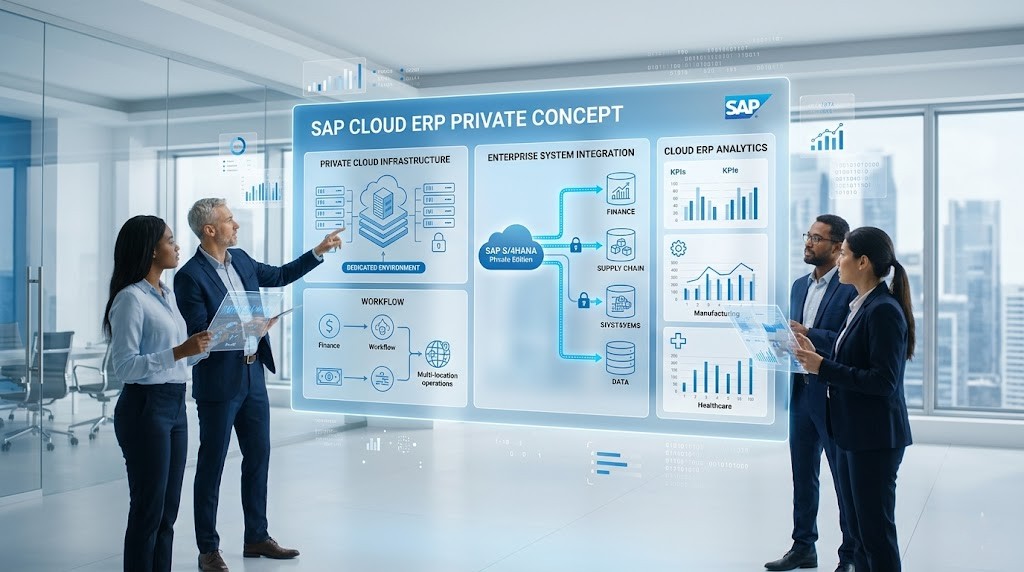
SAP Cloud ERP Private is SAP’s private-edition cloud ERP offering, built for organisations that want the benefits of cloud deployment while keeping more flexibility than a standard public-cloud model. SAP says it is designed to be customizable, hosted by SAP, a hyperscaler, or in the customer’s own data centre, depending on the deployment choice.
In simple terms, it is a cloud ERP for companies that cannot easily move to a fully standardised model because of process complexity, regulatory requirements, or existing SAP investments.
Who Should Use It?
SAP Cloud ERP Private is a strong fit for mid-market and enterprise organisations with complex operations, regulated environments, or substantial SAP ERP histories. It is also relevant for businesses that want to modernise at their own pace without giving up control over core processes.
Typical examples include manufacturers, healthcare and life sciences companies, regulated financial operations, and businesses running mission-critical ERP processes across multiple locations.
Key Benefits
- Higher configurability than public cloud ERP.
- Support for existing SAP ERP investments and brownfield migration scenarios.
- Real-time transaction and analytical data in one system.
- Embedded AI, automation, and advanced reporting.
- Predefined integrations and extensions for connected processes.
- Flexible hosting options with stronger control over deployment.
Benefits
The main benefit of SAP Cloud ERP Private is balance: it combines cloud agility with the flexibility many enterprises need. SAP states that it helps protect existing ERP investments while enabling innovation, and the private-edition model is designed to deliver streamlined operations, support, and mission-critical availability.
It is also attractive for companies that want a modern ERP roadmap without forcing every team into a one-size-fits-all process template.
At a Glance
| Area | Private Edition Meaning | Why It Matters |
|---|---|---|
| Deployment | Hosted by SAP, hyperscaler, or own data centre | More control over infrastructure |
| Flexibility | Highly customizable and extensible | Fits complex business processes |
| Migration | Supports existing SAP investments | Reduces disruption during transformation |
| Updates | Innovation at your pace | Less pressure than fully standard public cloud |
| Security | Advanced monitoring and compliance support | Useful for regulated industries |

Looking to implement or optimize this in Dubai or the UAE?
Speak with WMS Middle East certified SAP consultants for a customized architectural and cost assessment.
Use Cases
SAP Cloud ERP Private is especially useful in the following situations:
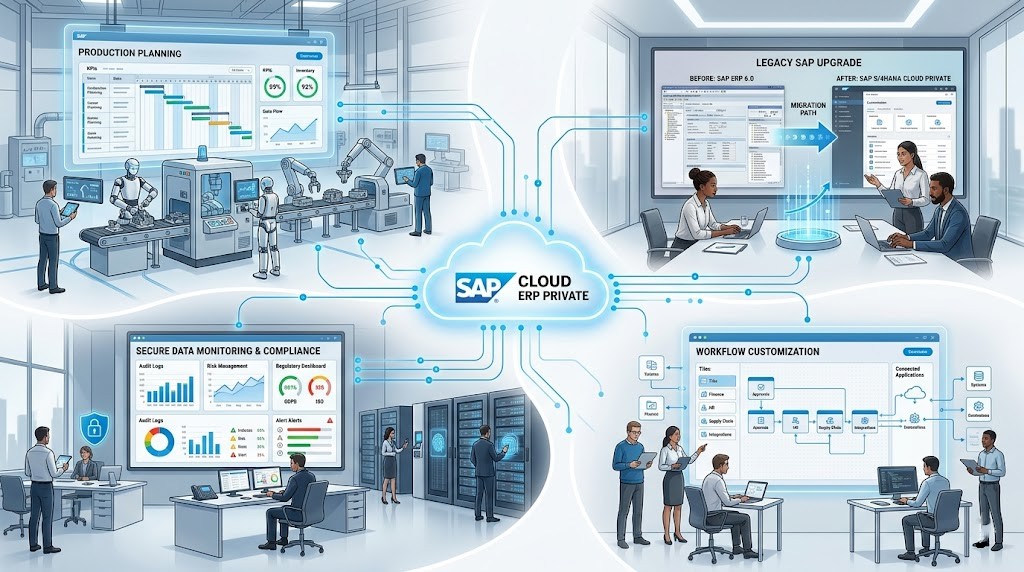
- A manufacturer needs deeper process tailoring for production planning and scheduling.
- A regulated enterprise needs stronger control over data, compliance, and infrastructure.
- A company already running SAP ERP wants to modernise without starting from zero.
- A business needs custom workflows, extensions, or integrations beyond standard public-cloud templates.
How It Differs From Public Cloud
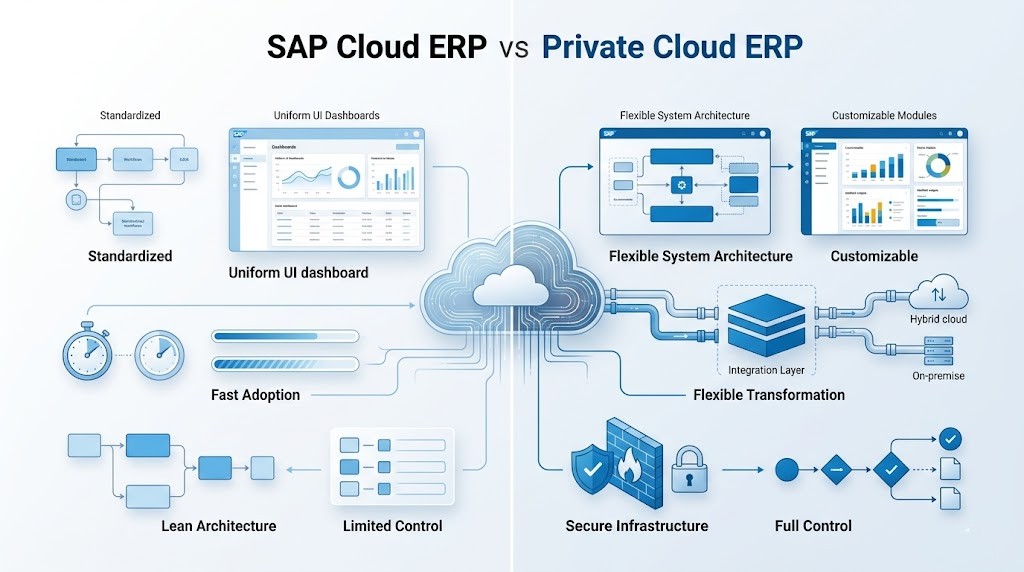
SAP Cloud ERP Private offers more configuration, control, and migration flexibility than SAP Cloud ERP Public. SAP and partner sources consistently position public cloud as best-practice and standardised, while private cloud is the tailored option for businesses with higher complexity or stricter requirements [web:807][web:808][web:810][web:811].
That difference is important for content strategy too: public cloud content should focus on standardisation and faster adoption, while private cloud content should focus on flexibility, control, and legacy transformation.
Before starting your migration, review our SAP implementation cost in Dubai analysis to plan your project budget accurately.
If your organisation is evaluating a tailored cloud ERP, WMSSPL can help you assess whether SAP Cloud ERP Private is the right fit for your current systems, compliance needs, and future roadmap. Visit the product page or talk to our team to explore your SAP options.
Frequently Asked Questions (FAQs)
Is SAP Cloud ERP Private the same as SAP S/4HANA Cloud Private Edition?
Yes. It is the current naming used by SAP for the private edition.
What kinds of companies choose SAP Cloud ERP Private?
Companies with complex operations, regulated environments, or existing SAP ERP systems often choose it.
Can SAP Cloud ERP Private be customised?
Yes. Customisation and extensions are a major reason businesses select this option.
Does it support real-time analytics?
Yes. SAP highlights integrated transactional and analytical data in one system.
Is SAP Cloud ERP Private cloud-based?
Yes, but it offers more deployment flexibility than public cloud ERP.
Why not choose public cloud instead?
Public cloud works best for fit-to-standard businesses; private cloud is better when processes are too unique or complex.
Does it help with compliance?
Yes. SAP and partner sources emphasise strong security and compliance support for private edition deployments.
Is it good for brownfield migrations?
Yes. Private edition is commonly positioned as the better option for existing SAP customers moving forward.
Can it scale as the business grows?
Yes. It is designed to scale while preserving control and flexibility.
What is the main advantage of SAP Cloud ERP Private?
It gives companies cloud benefits without forcing them to sacrifice the control they need.

Mahitab Maher
SAP professional specializing in SAP products, helping companies turn complex processes into smooth, scalable operations.


Good starting point for companies planning to move to ERP.
Thanks Kevin. Starting with the right understanding really helps.
Nice explanation. The private vs public cloud topic is still confusing for many.
Thanks Michael. Glad the article helped clear that up a bit.
Step-by-step format is really useful, especially for small businesses starting out.
Thanks Ahmed. We wanted to make it easy to follow for growing teams.
Clear and practical article. Good for companies planning ahead.
Thanks Rachel. Planning early always helps.
Helpful comparison topic. Many companies are still deciding which cloud model suits them best.
Thanks Laura. Choosing the right cloud model depends a lot on business goals and requirements.
Interesting topic. Many companies are trying to understand the difference between private and public cloud models.
Thanks Hannah. It’s a common question now, so we wanted to break it down clearly.
Helpful explanation. Many companies are still confused about private vs public cloud.
Thanks Ahmed. It’s a common question, so we tried to keep it simple.