


Last Updated 01/09/2026
Executive Summary
- Strategic Overview: Comprehensive guidance on sap business one in dubai – a complete guide for uae smes in 2026 tailored for Middle East and GCC enterprises.
- Key Advantage: Eliminates departmental silos, standardizes reporting, and accelerates operational agility.
- Next Step: Consult with certified WMS Middle East SAP experts for tailored architecture sizing and cost estimation.
The Problem Every Growing Dubai SME Eventually Hits
You started with spreadsheets. Then came a basic accounting tool. Then a separate inventory system. Then a CRM your sales team uses inconsistently. And now you have customer data in four places, no single reliable view of your finances, and an operations manager who spends three hours every Monday morning reconciling numbers that should update automatically.
This is the growth ceiling that catches most Dubai SMEs by surprise not because they grew too fast, but because the tools they used to get started were never designed for where they are going.
In 2026, this operational fragmentation carries an additional regulatory risk. UAE e-invoicing Phase 1 goes live in July 2026, requiring VAT-registered businesses to issue and receive invoices through an FTA-accredited digital network. PDF invoices, manual submissions, and systems that cannot generate XML-format invoices will not meet the mandate. The question for most Dubai SMEs is not whether to upgrade their business management platform it is which platform to upgrade to, and when.
For growing SMEs evaluating modern ERP options, explore our complete SAP Business One cost in the UAE guide to understand licensing and implementation requirements.
SAP Business One is the answer that the majority of UAE SMEs are arriving at. This guide explains exactly what it is, what it does, why it fits the Dubai market, and how to evaluate whether it is right for your business.
What Is SAP Business One?

What Is SAP Business One and Who Is It Designed For?
SAP Business One (commonly called SAP B1) is an integrated Enterprise Resource Planning (ERP) solution designed specifically for small and mid-sized businesses. Developed by SAP SE the world’s largest ERP software company with over 400,000 customers globally SAP Business One brings enterprise-grade business management capabilities to organisations that are too complex for basic accounting software but not yet at the scale that warrants SAP S/4HANA.
In the UAE context, SAP Business One is the most widely implemented ERP solution among Dubai and Abu Dhabi SMEs across trading, distribution, manufacturing, construction, and professional services sectors that form the backbone of the UAE’s non-oil private economy.
SAP Business One is a single, integrated platform that manages:
- Financial accounting general ledger, accounts payable, accounts receivable, cash flow, bank reconciliation, and financial reporting
- Sales and customer management (CRM) the complete sales cycle from lead to invoice to post-sales service
- Purchasing and procurement purchase orders, supplier management, goods receipt, and landed costs
- Inventory and warehouse management real-time stock levels, multi-warehouse tracking, serial and batch numbers, and inventory valuation
- Production and MRP bills of materials, production orders, and material requirements planning for manufacturing businesses
- Reporting and analytics interactive dashboards, drag-and-drop reports, Crystal Reports integration, and SAP HANA-powered analytics
The critical distinction from standalone accounting tools or disconnected systems: every module shares a single database. There is no manual data transfer between departments. When a sales order is confirmed, it updates inventory, triggers a purchase order if stock is low, and feeds directly into accounts receivable automatically, in real time.
UAE FTA E-Invoicing Phase Mandate Schedule
| Taxpayer Category | ASP Appointment Deadline | Mandatory Go-Live Date | Key ERP Requirement |
|---|---|---|---|
| Large Businesses (≥ AED 50M revenue) | October 30, 2026 | January 1, 2027 | Real-time transmission via SAP Integration Suite / ASP connector |
| SMEs (< AED 50M revenue) | March 31, 2027 | July 1, 2027 | Automated Peppol-compliant XML generation in SAP B1 / S/4HANA |
| Government Entities | March 31, 2027 | October 1, 2027 | Central government procurement & e-billing integration |
Why SAP Business One Is the Right Fit for Dubai SMEs in 2026

Dubai’s SME market has specific characteristics that make SAP Business One particularly well-suited as an ERP platform:
Multi-Currency and Multi-Entity Operations
Dubai businesses routinely trade in AED, USD, EUR, and GBP sometimes within the same day. Many UAE SMEs operate legal entities across the Mainland, free zones (DIFC, JAFZA, DMCC), and overseas markets simultaneously. SAP Business One handles multi-currency transactions natively, with real-time exchange rate updates and consolidated reporting across multiple legal entities and branches.
UAE VAT Compliance and FTA Integration
SAP Business One is pre-configured for UAE VAT compliance, including:
- Automated VAT calculation on every sales and purchase transaction, eliminating manual errors
- VAT return report generation in formats directly aligned with FTA submission requirements
- Real-time VAT liability tracking so finance teams see their tax position at any moment, not just at month-end
- Integration with the UAE Federal Tax Authority (FTA) EmaraTax portal for direct VAT return submission
- Audit trail a complete, immutable record of every financial transaction, essential for FTA audit readiness
UAE E-Invoicing Readiness July 2026 Is Now Critical
From July 2026, UAE businesses are required to issue and receive invoices through an FTA-accredited digital network in structured XML format not PDF, not email attachments, not paper.
This mandate covers B2B and B2G transactions for all VAT-registered businesses, and extends to businesses registered with a Tax Identification Number (TIN) even if not VAT-registered. It includes SMEs, exporters, and free-zone companies. Non-compliant invoices will be considered invalid, buyers may refuse payment, and mismatches will trigger FTA audits.
SAP Business One, implemented correctly through an accredited SAP partner, provides the infrastructure to generate PINT AE-compliant XML invoices and connect to an Accredited Service Provider (ASP) for e-invoicing transmission. For Dubai SMEs still on basic accounting software or disconnected systems, July 2026 is not a suggestion it is a deadline.
Scalability That Grows with the Business
One of the most common complaints from UAE SMEs is that they outgrow their accounting software and then face a painful, expensive re-implementation on a new platform. SAP Business One is designed for growth. It scales from 5 users to 200+ users, from a single Dubai warehouse to multi-country operations, from basic trading to complex manufacturing without requiring a platform change. The same system that runs your business at AED 10 million in revenue will still run it at AED 200 million.
Industry Localisation for UAE Market Conditions
SAP Business One in the UAE is not a generic global product it is deployed with localisation features specific to the UAE regulatory and commercial environment: WPS (Wage Protection System) integration for payroll compliance, UAE labour law leave calculation, Arabic-language reporting, Islamic calendar support, and UAE chart of accounts structures. A certified SAP Gold Partner like WMS Dubai deploys these localisations as standard, not as optional extras.

SAP Business One: Key Modules in Detail

What Are the Key Modules of SAP Business One?
| Module | What It Manages | UAE-Specific Benefit |
|---|---|---|
| Financial Management | GL, AR, AP, bank reconciliation, cash flow, budgeting | VAT-compliant chart of accounts, FTA integration, multi-currency |
| Sales & CRM | Leads, opportunities, quotations, sales orders, invoices, service | Arabic customer records, UAE customer credit management |
| Purchasing | RFQs, purchase orders, goods receipt, supplier invoices, landed costs | Supplier TRN tracking for input VAT recovery |
| Inventory | Real-time stock, multi-warehouse, serial/batch tracking, valuation | JAFZA and free zone inventory tracking, duty drawback support |
| Production & MRP | BoM, production orders, resource planning | Manufacturing SMEs in Dubai industrial zones |
| Project Management | Project costing, budgets, milestones, WIP | Construction and fit-out companies |
| HR & Payroll (Add-on) | Employee records, WPS payroll, leave, gratuity | UAE Labour Law compliance, MOHRE alignment |
| Analytics & Reporting | Interactive dashboards, Crystal Reports, SAP HANA analytics | Real-time KPI visibility for owner-operated businesses |
Deployment Options for UAE Businesses
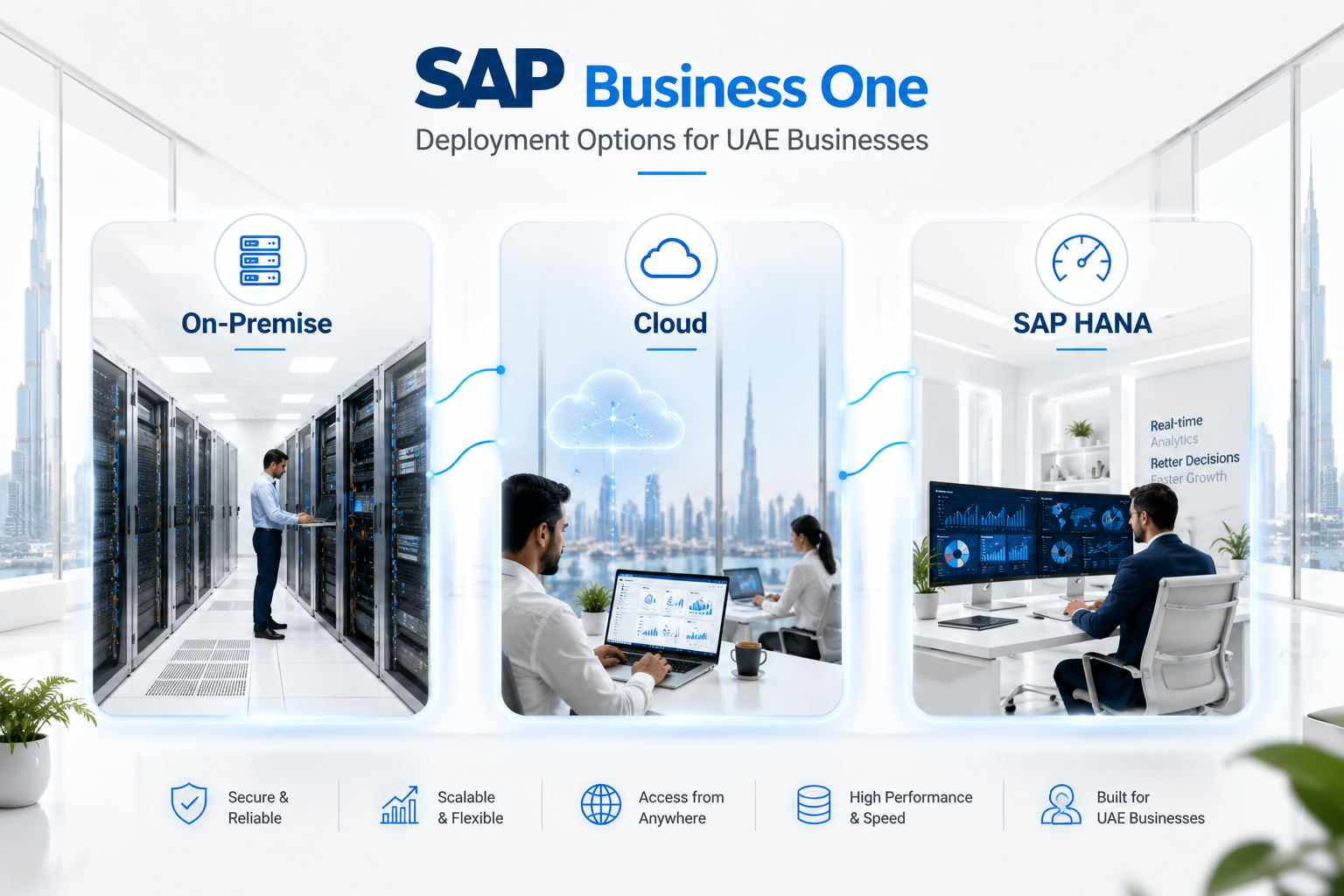
How Can UAE Businesses Deploy SAP Business One Cloud or On-Premise?
SAP Business One offers three deployment models and the right choice depends on your business size, IT infrastructure, data governance requirements, and growth plans:
SAP Business One On-Premise
The traditional deployment model SAP Business One is installed on servers within your facility or a UAE-based data centre. On-premise deployment gives maximum control over your data, is preferred by businesses with specific data residency requirements, and may be the right choice for manufacturing businesses with complex production integrations. The trade-off is higher upfront infrastructure cost and reliance on internal or managed IT for server maintenance.
Best for: Manufacturing businesses, companies with UAE data residency requirements, large multi-warehouse operations.
SAP Business One Cloud (Hosted)
SAP Business One is hosted on a cloud server either SAP’s own cloud infrastructure, a UAE-based cloud provider (such as AWS Middle East, Microsoft Azure UAE North, or a local provider), or a managed hosting environment run by your SAP partner. The business accesses SAP B1 via browser or desktop client. Monthly subscription pricing replaces large upfront licence costs.
Best for: Growing SMEs who want to avoid infrastructure investment, businesses with remote or hybrid teams across the UAE, companies prioritising fast deployment and predictable monthly costs.
Not sure whether Public Cloud (GROW with SAP) is better than a hosted Private Cloud? Read our SAP Public vs Private Cloud ERP comparison to understand the differences.
SAP Business One, Version for SAP HANA
SAP Business One can run on SAP HANA SAP’s in-memory database platform delivering significantly faster analytics, real-time reporting, and access to SAP’s AI and machine learning capabilities. For Dubai SMEs handling high transaction volumes or needing real-time business intelligence, the HANA version is the premium deployment choice. Including SAP Analytics Cloud for advanced planning and predictive analytics beyond standard reporting.
Best for: Fast-growing businesses, data-intensive industries (retail, wholesale distribution, logistics), businesses planning to integrate AI-driven forecasting or analytics.
UAE Regulatory Compliance: Corporate Tax (9%) & FTA E-Invoicing
- Mandatory 9% Tax Provisioning: Automated general ledger tax accounting and transfer pricing compliance in SAP.
- FTA Peppol Connector: Real-time digital invoice generation and cryptographic verification.
- Action: Contact WMS Middle East for a comprehensive UAE tax and e-invoicing readiness assessment.
SAP Business One for Key UAE Industries
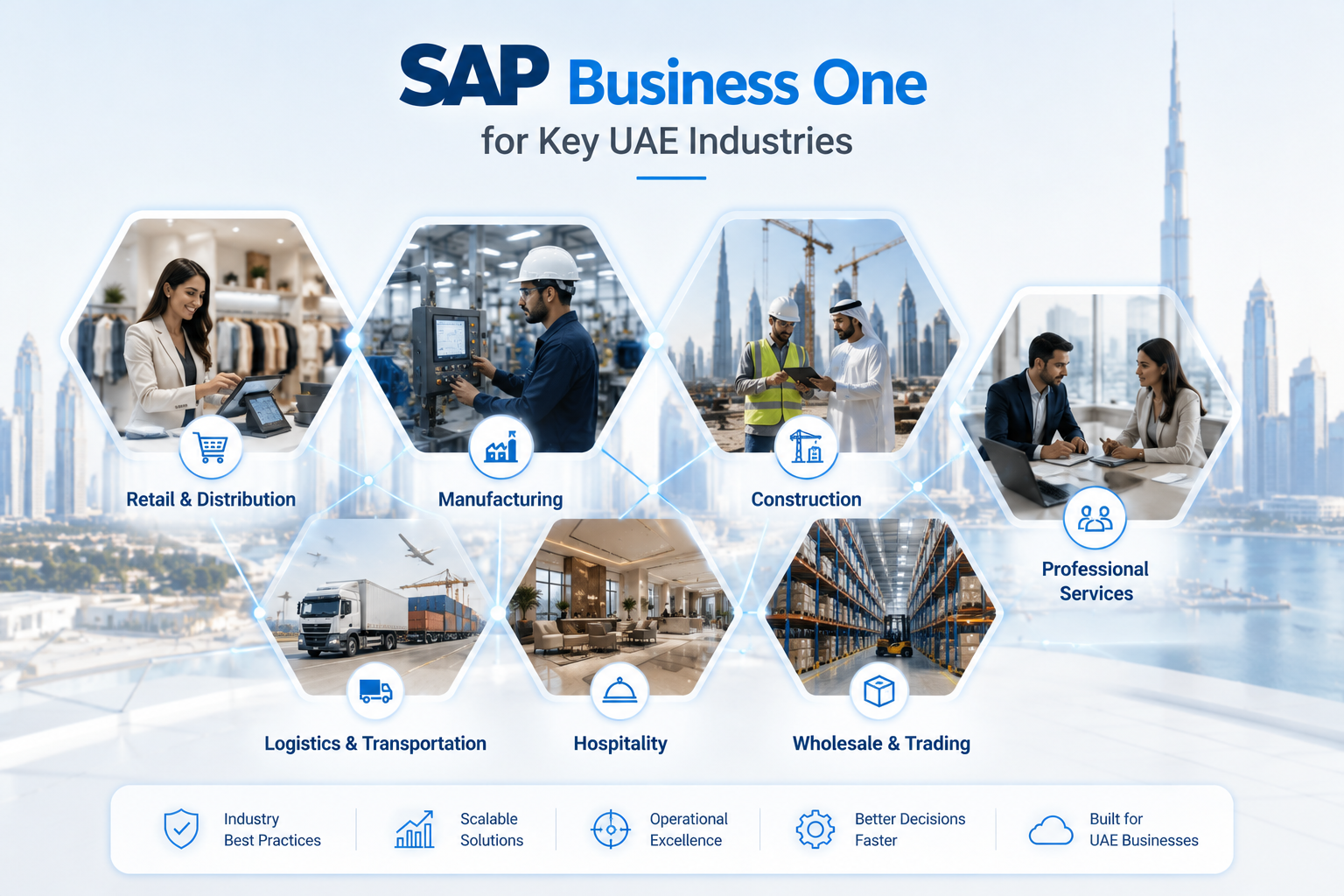
Which Industries in Dubai Use SAP Business One and How?
Trading and Distribution Companies
Dubai's position as a global trade hub means that wholesale and distribution businesses form the largest SAP Business One user group in the UAE. SAP B1 manages import procurement (including landed cost calculations with customs duties and freight), multi-warehouse inventory across JAFZA, DAFZA, and mainland facilities, customer credit management, and FTA-compliant invoicing.
Manufacturing and Light Industry
With the UAE's focus on expanding its manufacturing base through industrial zones in Sharjah, Abu Dhabi, and Ras Al Khaimah, manufacturing SMEs need production management that connects raw material procurement to shop floor operations to finished goods inventory. SAP Business One's production module handles Bills of Materials, Material Requirements Planning (MRP), production orders, and quality inspection giving factory managers real-time visibility from raw material to dispatch.
Construction and Real Estate Development
Dubai's construction sector from fit-out contractors to property developers faces specific financial management challenges: project-based costing, progress billing (milestone invoicing), subcontractor management, and retention tracking. SAP Business One's project management module handles all of these natively, with real-time project profitability reporting that gives finance directors the information they need without waiting for month-end. For larger EPC contractors and project-based businesses in the UAE, read our guide on how SAP supports project-based industries in energy and construction including SAP PS for project cost control.
Food and Beverage
Dubai's food industry from importers and distributors to restaurant chains and FMCG manufacturers relies on SAP Business One for batch tracking (traceability for expiry and recall management), cold chain inventory management, customer order management across multiple delivery locations, and VAT-compliant invoicing across B2B and B2C channels.
Professional Services
Consulting firms, engineering companies, IT service providers, and healthcare clinics in Dubai use SAP Business One to manage project-based billing, time and expense tracking, resource utilisation, and client profitability analysis with full integration into financial reporting and VAT compliance.
See how WMS has delivered SAP Business One implementations for UAE businesses across trading, retail, F&B and professional services read our client success stories.
Looking to implement or optimize this in Dubai or the UAE?
Speak with WMS Middle East certified SAP consultants for a customized architectural and cost assessment.
Choosing the Right SAP B1 Partner in Dubai

What Should You Look for in a SAP Business One Partner in Dubai?
These warning signals are based on patterns observed across failed implementations in the UAE market:
Choosing the wrong SAP B1 partner is the single most common reason implementations fail. The software itself is proven SAP Business One is used by over 80,000 companies in more than 170 countries. The variable is the implementation partner.
When evaluating SAP Business One partners in Dubai, assess these factors:
| Criteria | What to Ask |
|---|---|
| SAP Partner Certification Level | Are they a certified SAP Gold Partner? Gold status requires minimum certified consultants, verified customer references, and annual SAP audits — it is not self-declared. |
| UAE-Specific Experience | Have they implemented SAP Business One specifically in the UAE? Do they have references from UAE businesses in your industry? |
| Local Team vs. Offshore Delivery | Is the core delivery team based in the UAE with local timezone availability, Arabic-speaking capability, and on-site support when required? |
| E-Invoicing Capability | Can they configure SAP Business One for FTA e-invoicing Phase 1 compliance and provide accredited ASP integration support? |
| Post-Implementation Support | What support is available after go-live? Do they offer managed services, SLAs, and ongoing optimization support? |
| Industry Knowledge | Has the team implemented SAP Business One within your specific industry and business model, not just generic ERP projects? |
| References | Can they provide real customer references that you can speak with, ideally from similar UAE industries? |
WMS Dubai is a certified SAP Gold Partner with deep UAE market experience across trading, distribution, manufacturing, construction, and professional services — delivering SAP Business One implementations from Sharjah and Dubai to Abu Dhabi, Oman, and Saudi Arabia.
How Does WMS Dubai Support SAP Business One in the UAE?
WMS Dubai’s SAP Business One practice covers the complete lifecycle from initial discovery and scoping through implementation, go-live, and ongoing managed support:
- SAP Business One Implementation structured, methodology-driven deployments for UAE SMEs with full local regulatory configuration (VAT, e-invoicing, WPS, MOHRE compliance)
- SAP B1 Cloud Deployment hosted on UAE-based cloud infrastructure for businesses that want cloud agility without data sovereignty concerns
- SAP B1 Upgrade and Migration for businesses running older SAP B1 versions or migrating from other ERP systems
- SAP B1 Add-On and Integration connecting SAP Business One to e-commerce, 3PL logistics platforms, banking systems, and CRM tools
- SAP B1 Support and Managed Services ongoing administration, system optimisation, user support, and proactive monitoring after go-live
- UAE E-Invoicing Readiness configuration and testing for FTA Phase 1 e-invoicing compliance ahead of the July 2026 go-live deadline
To solve operational bottlenecks, discover how SAP Business One inventory management provides real-time warehouse control.

Frequently Asked Questions (FAQs)
What is SAP Business One and is it suitable for a small business in Dubai?
SAP Business One (SAP B1) is an integrated ERP (Enterprise Resource Planning) system designed specifically for small and mid-sized businesses. It manages financials, sales, purchasing, inventory, and reporting in a single platform. In Dubai, it is well-suited for SMEs with 5 to 200 users that have outgrown basic accounting software and need an integrated system that handles UAE VAT compliance, multi-currency transactions, and growing operational complexity. Businesses typically consider SAP B1 when they have between AED 5 million and AED 200 million in revenue, though there is no strict threshold the key trigger is operational complexity, not just revenue size.
Does SAP Business One handle UAE VAT compliance?
Yes. SAP Business One is pre-configured for UAE VAT compliance. It automates VAT calculations on every transaction, generates VAT return reports aligned to FTA requirements, tracks VAT liability in real time, and can integrate directly with the UAE Federal Tax Authority’s EmaraTax portal for VAT return filing. A certified SAP B1 partner in Dubai will configure the correct UAE VAT tax codes, exempt and zero-rated item groups, and supplier TRN tracking for input VAT recovery during implementation.
Is SAP Business One compliant with UAE e-invoicing requirements in 2026?
SAP Business One can be made compliant with UAE e-invoicing Phase 1 (July 2026), but compliance depends on correct implementation and integration with an FTA-Accredited Service Provider (ASP). The July 2026 mandate requires businesses to transmit invoices through an accredited digital network in PINT AE-compliant XML format. Your SAP B1 implementation partner must configure the system for XML invoice generation and connect it to an accredited ASP. WMS Dubai is implementing e-invoicing readiness configurations for all SAP B1 clients ahead of the July 2026 deadline. Businesses on non-compliant systems risk invoice rejection, input VAT recovery issues, and FTA audit triggers.
What is the difference between SAP Business One and SAP S/4HANA?
SAP Business One and SAP S/4HANA are both SAP ERP products but designed for very different business profiles. SAP Business One is designed for SMEs it is simpler, faster to implement, and more affordable. SAP S/4HANA is SAP’s flagship enterprise ERP designed for large and complex organisations with advanced finance, supply chain, manufacturing, and compliance requirements. The decision depends on your organisation’s size, complexity, transaction volumes, and industry-specific requirements. A certified SAP partner can assess which product is the right fit for your current and projected business needs. WMS Dubai offers both — and conducts a structured scoping assessment to recommend the right product rather than the highest-value one.
How long does a SAP Business One implementation take in Dubai?
A typical SAP Business One implementation for a UAE SME takes between 8 and 16 weeks from project kickoff to go-live. The timeline depends on the number of modules in scope, the volume and quality of data being migrated, the number of integrations required, and the organisation’s internal readiness (availability of key stakeholders, data cleanliness, decision-making speed). Heavily customised implementations or those involving complex manufacturing or multi-entity structures may take 4 to 6 months. A phased go-live deploying core modules first and adding functionality in subsequent phases is often the recommended approach for businesses that cannot afford a long pre-go-live period.
What industries use SAP Business One in Dubai?
SAP Business One is used across a wide range of industries in Dubai and the UAE, including: wholesale and general trading, food and beverage distribution, light manufacturing and assembly, construction and contracting, real estate development, automotive spare parts, healthcare and pharmaceuticals, professional services, logistics and 3PL, and retail. WMS Dubai has implemented SAP B1 across all of these sectors within the UAE market with industry-specific configuration for each.
What should I look for in a SAP Business One partner in Dubai?
The most important factors when selecting a SAP B1 partner in Dubai are: SAP certification level (Gold Partner status is the highest tier and requires audited standards), UAE market experience with verifiable local customer references, a local team available in UAE timezone, e-invoicing capability for FTA Phase 1, and a formal post-go-live support offering. Avoid partners who offshore delivery to non-UAE resources for a UAE implementation local regulatory knowledge, Arabic-language capability, and physical availability for go-live support are material to implementation success.
Can SAP Business One integrate with other software we already use?
Yes. SAP Business One has a well-developed integration framework (the SAP Business One Integration Framework, formerly known as B1if) that allows connection to third-party systems including e-commerce platforms (Shopify, WooCommerce, Magento), logistics and 3PL systems, banking platforms for automated bank feeds, CRM systems, payroll and HR tools, and industry-specific add-ons available through SAP’s partner ecosystem. The SAP Business One AppStore (similar to AppExchange for Salesforce) lists hundreds of certified add-ons developed specifically for SAP B1 including UAE payroll, WPS, and advanced warehouse management extensions. WMS Dubai assesses integration requirements during the discovery phase and builds integration architecture into the project plan, not as an afterthought.

Mahitab Maher
SAP professional specializing in SAP products, helping companies turn complex processes into smooth, scalable operations.


