

Last Updated 01/09/2026
Executive Summary
- Strategic Overview: Comprehensive guidance on how to choose a salesforce consulting partner in dubai – 2026 buyer’s guide tailored for Middle East and GCC enterprises.
- Key Advantage: Eliminates departmental silos, standardizes reporting, and accelerates operational agility.
- Next Step: Consult with certified WMS Middle East SAP experts for tailored architecture sizing and cost estimation.
Ninety percent of Salesforce projects fail to deliver their expected results.
Not because Salesforce is the wrong platform. It is the world’s #1 CRM for a reason. The failure almost always comes back to the same root cause: the wrong consulting partner.
In Dubai’s fast-moving business environment where real estate firms, trading companies, financial institutions, and retail businesses are all racing to digitise their customer operations the choice of Salesforce consulting partner is one of the most consequential technology decisions your business will make. Get it right, and Salesforce becomes the engine of your growth. Get it wrong, and you are left with an expensive system that nobody uses, data you cannot trust, and a project that costs far more than it should have.
This guide is written for business owners, IT directors, and operations managers in the UAE who are evaluating Salesforce consulting partners in 2026. It covers everything you need to make a confident, informed decision from understanding partner tiers and certifications, to the seven questions you must ask before signing any engagement, to the red flags that reveal a bad partner before the contract is signed.
What Does a Salesforce Consulting Partner Actually Do?
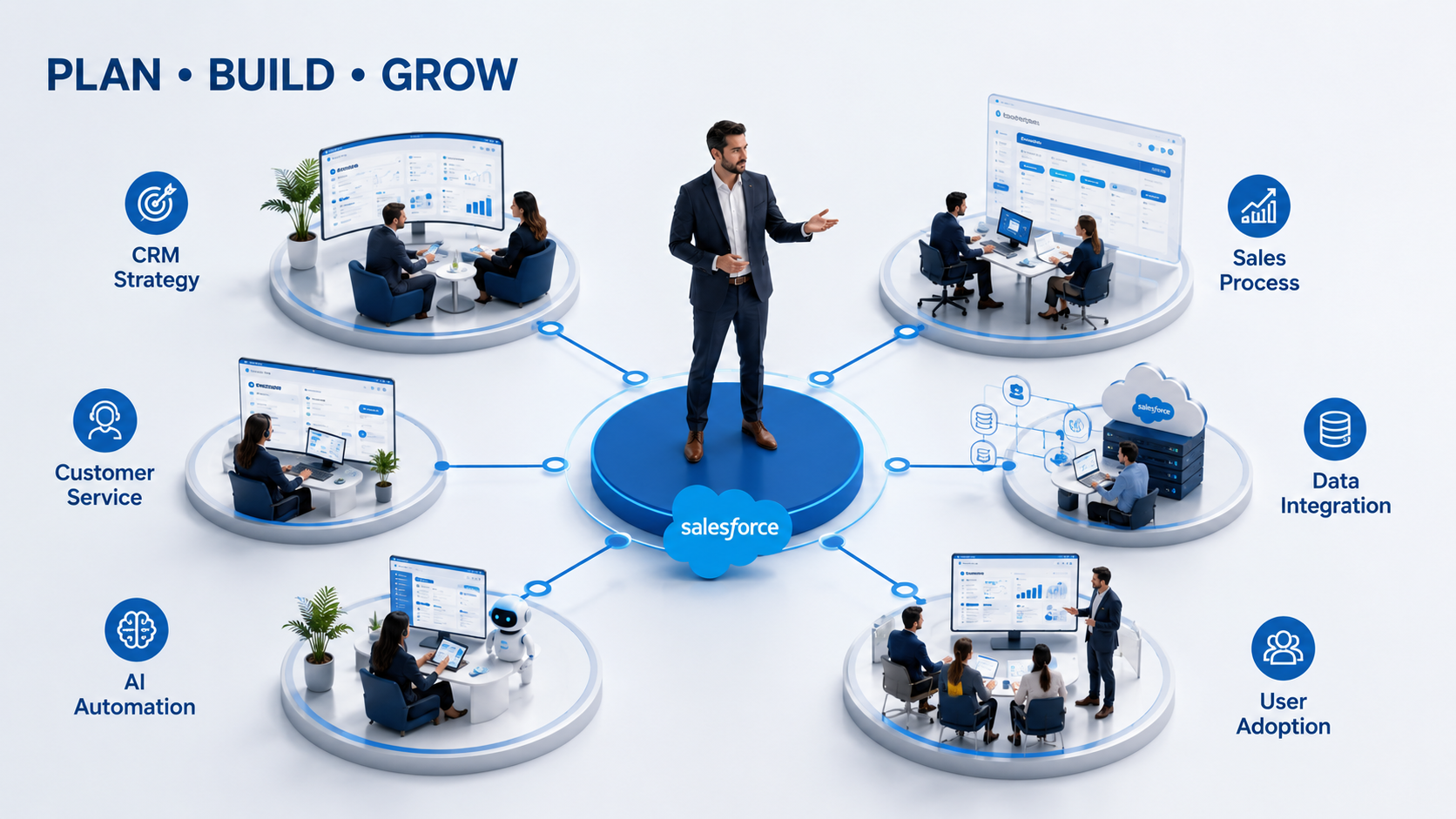
What Does a Salesforce Consulting Partner Do and Why Does the UAE Need One?
A Salesforce consulting partner is a company that Salesforce has officially certified to advise, implement, customise, and support Salesforce products on behalf of clients. They are not resellers. Their role is to translate your specific business processes into a working Salesforce configuration and to ensure your team actually uses the platform effectively.
In the UAE context, a consulting partner does considerably more than a standard implementation. They need to understand:
- VAT and UAE financial compliance how your billing, invoicing, and revenue tracking in Salesforce aligns with FTA requirements
- UAE Labour Law particularly if Salesforce is being used for HR, service, or workforce management workflows
- Arabic language requirements whether your Salesforce instance needs to support Arabic interface, right-to-left text, or bilingual data entry
- UAE Personal Data Protection Law (PDPL) how customer data is stored, processed, and governed within Salesforce in compliance with UAE privacy regulation
- Regional integrations connecting Salesforce with local ERP systems, payment gateways, banking APIs, or government portals
A consulting partner that has only done implementations in Europe or North America will not automatically understand these requirements. UAE-specific experience is not a bonus it is a baseline requirement.
Understanding Salesforce Partner Tiers
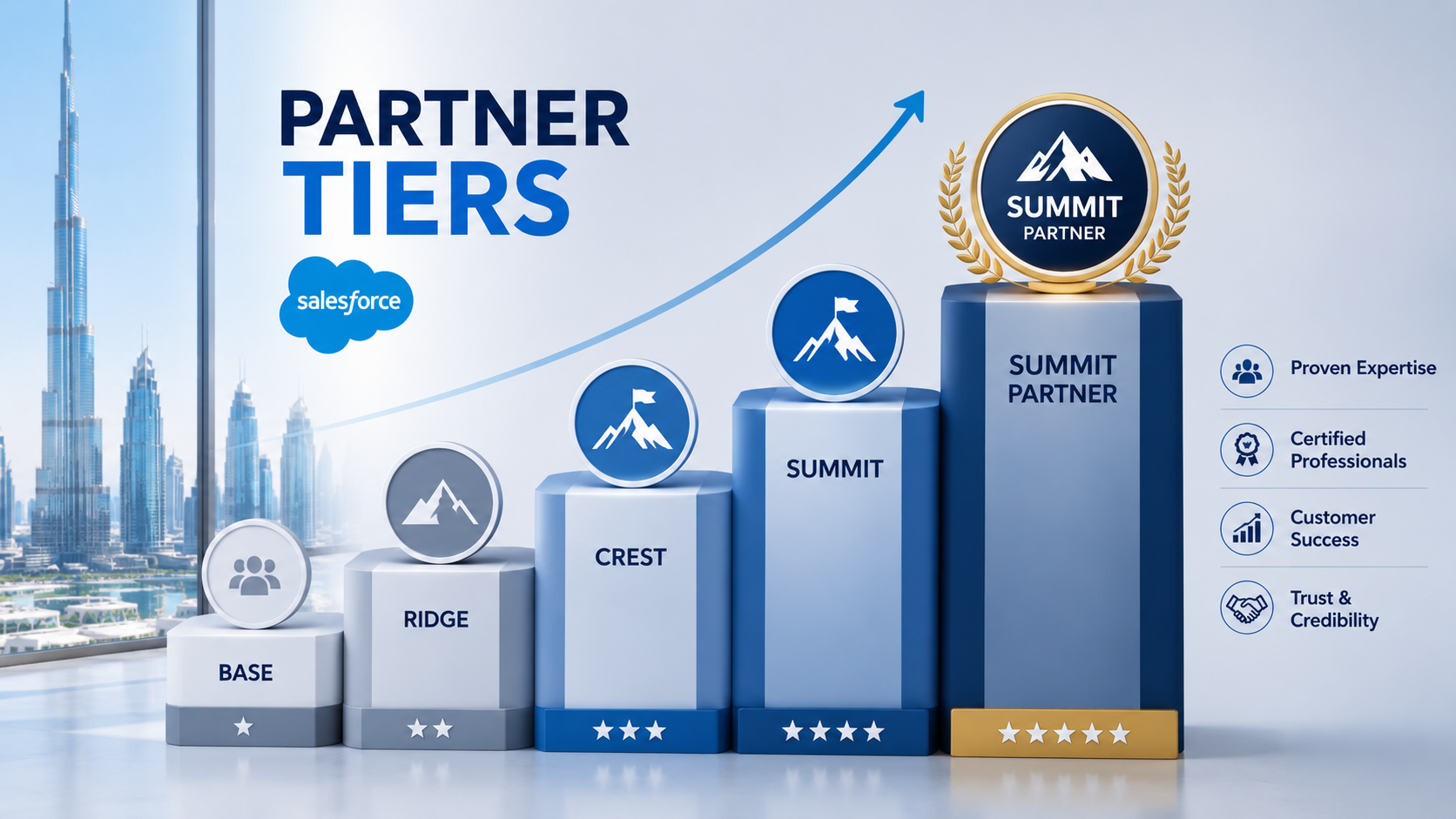
Salesforce operates a four-tier partner programme. Each tier reflects the partner’s level of expertise, client success track record, and certified headcount.
| Tier | Trailblazer Score | Certified Experts | What It Signals |
|---|---|---|---|
| Base | Up to 249 points | Basic certifications | New or small partner; limited track record |
| Ridge | 500+ points | 5+ certified | Growing practice; moderate experience |
| Crest | 750+ points | 10+ certified | Established partner; strong regional delivery capability |
| Summit | 1,000+ points | 15+ certified experts | Elite tier; exceptional customer success, innovation, and market impact |
The Trailblazer Score is calculated across four weighted dimensions: Customer Success (30%), Innovation (25%), Growth (25%), and Impact (20%). Summit partners the highest tier maintain scores above 1,000 points, sustained quarterly.
Does Partner Tier Guarantee Quality?
Tier is a signal, not a guarantee. A Summit-tier partner is statistically more likely to have the experience, processes, and certified staff to deliver complex projects successfully. However, a mid-sized Dubai business may be better served by a Crest-tier partner who specialises in their industry than a Summit-tier global firm that assigns a junior team to a regional project.
The right question is not “what is their tier?” it is “who will actually be on my project, and what have they delivered in the UAE?”

Looking to implement or optimize this in Dubai or the UAE?
Speak with WMS Middle East certified SAP consultants for a customized architectural and cost assessment.
Salesforce Certifications - What to Look For
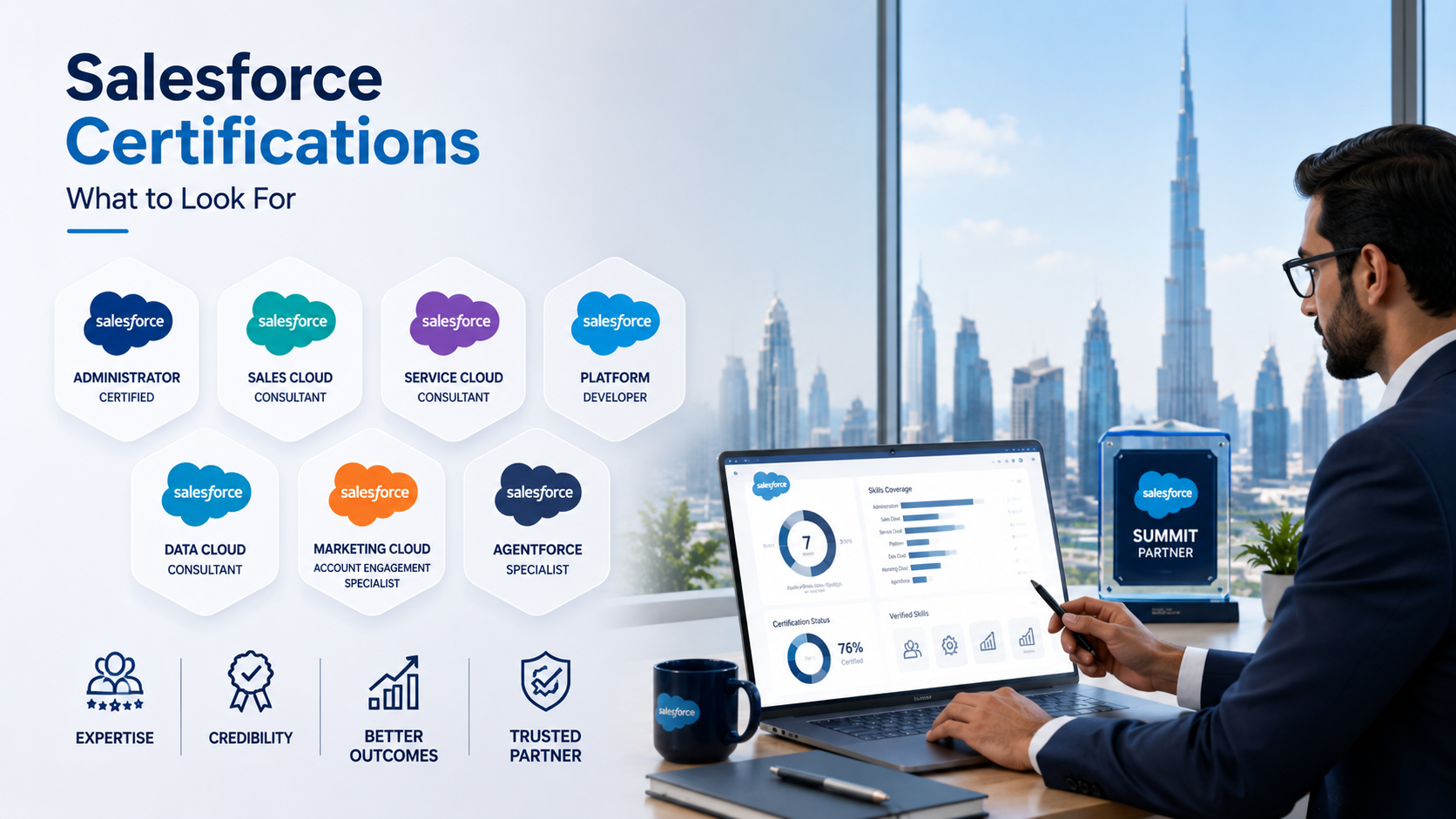
Which Salesforce Certifications Should Your Dubai Consulting Partner Hold?
Salesforce offers over 40 certifications across its product portfolio. The ones most relevant to a typical Dubai business engagement are:
| Certification | What It Covers | Why It Matters for UAE |
|---|---|---|
| Salesforce Administrator | Core platform configuration, workflows, user management | Foundation for any implementation |
| Salesforce Sales Cloud Consultant | Sales pipeline, lead management, forecasting | Core for B2B and trading businesses |
| Salesforce Service Cloud Consultant | Customer support, case management, contact centre | Critical for retail, hospitality, financial services |
| Salesforce Platform Developer I & II | Custom development, Apex, Lightning components | Required for complex customisations |
| Salesforce Data Cloud Consultant | Unified data, real-time profiles, AI data foundation | Increasingly important for UAE enterprises using Agentforce |
| Marketing Cloud Consultant | Email, journeys, audience segmentation | Relevant for B2C brands, real estate, e-commerce |
| Agentforce Specialist | AI agent configuration, autonomous task automation | The newest and fastest-growing certification in 2026 |
Ask any consulting partner: how many of your staff hold each relevant certification? Are those certifications current? Salesforce certifications expire and require maintenance a partner with outdated certifications is not keeping pace with the platform.
To evaluate technical partner qualifications and service levels, review our CFO checklist for choosing an SAP Gold Partner in Dubai.
Industry-Specific Salesforce Consulting in Dubai
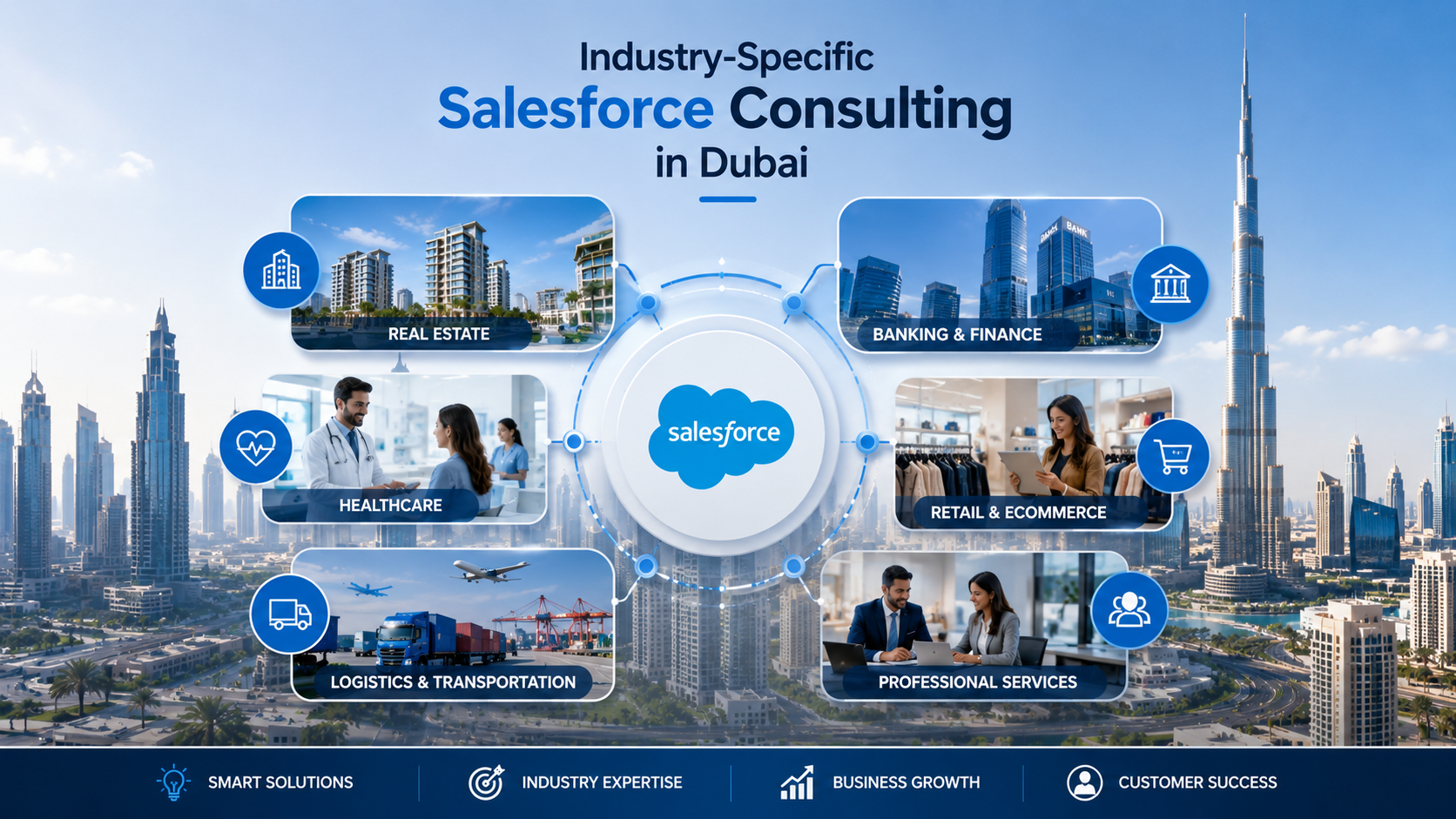
Does Your Salesforce Consulting Partner Have Experience in Your Industry?
Dubai’s economy is concentrated in specific sectors. Salesforce configurations differ significantly between them. A partner that has delivered ten retail implementations will bring a fundamentally different set of pre-built frameworks, integration knowledge, and process expertise to the table than a partner who has only done financial services projects.
| Industry | Key Salesforce Requirements in Dubai |
|---|---|
| Real Estate | Lead-to-listing workflows, broker management, developer project portals, Arabic language support, Emirates ID integration |
| Banking & Financial Services | Strict data residency (UAE cloud region), compliance workflows, KYC automation, regulatory reporting |
| Retail & E-commerce | Commerce Cloud or B2C Commerce, loyalty management, omnichannel service, POS integration |
| Logistics & Trade | Order management, partner portals, shipment tracking, ERP integration with Oracle or SAP |
| Healthcare | Health Cloud, HIPAA/DHA compliance, patient journey management, appointment workflows |
| Professional Services | Project billing, resource management, client onboarding, Salesforce Revenue Cloud |
In the Logistics industry row.ADD a sentence after the table:”For UAE businesses running SAP alongside Salesforce, read our SAP Business One Dubai guide WMS implements both SAP and Salesforce and can design integrations between the two platforms.
7 Questions to Ask Before Hiring a Salesforce Consulting Partner in Dubai
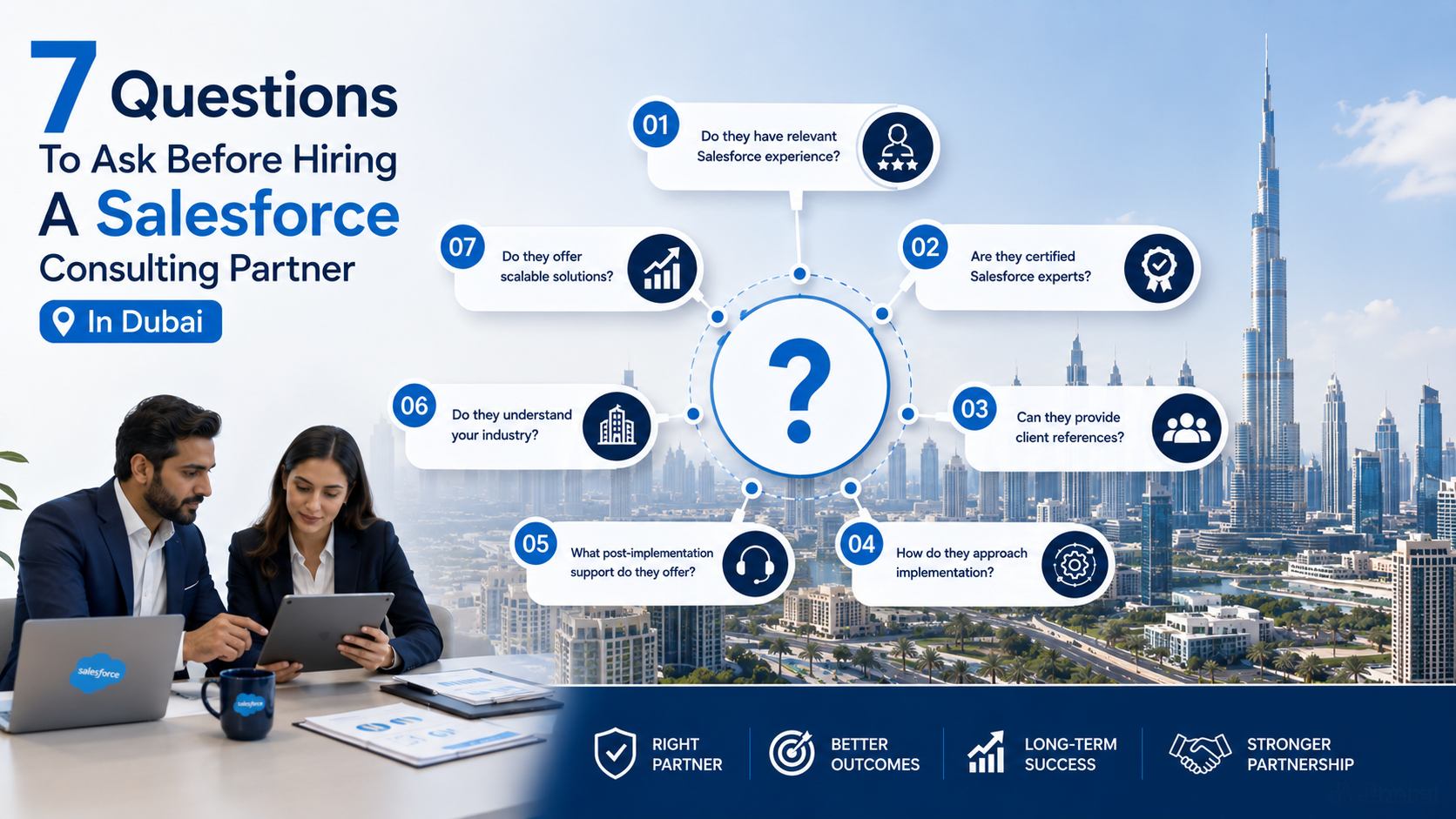
What Questions Should You Ask a Salesforce Consulting Partner in Dubai Before Signing?
These seven questions separate partners who are right for your business from those who are not regardless of their tier, marketing materials, or sales pitch.
1. Who will actually be on my project and what are their certifications?
Partners frequently sell the engagement with senior consultants in the room and then deploy junior staff or offshore teams to the actual project. Ask for CVs and certification records for the specific individuals who will be assigned to your account.
2. Can you show me three UAE implementations similar to my business?
References and case studies from comparable businesses in the UAE are the strongest proof of relevant capability. Global case studies are context-free what matters is demonstrated delivery in your market and sector.
3. How do you handle UAE-specific requirements VAT, PDPL, Arabic language?
A partner who gives a vague answer to this question has not done enough UAE implementations to have developed a systematic approach. The right answer is detailed and specific including their approach to FTA-aligned revenue workflows, data residency configuration, and Arabic localisation.
4. What does your post-go-live support model look like?
Many implementations go wrong not during the build phase, but in the first 90 days after go-live when users encounter real-world scenarios the project did not anticipate. Ask specifically: what is included in post-go-live support? What is the response time SLA? Is there a dedicated support contact in the UAE timezone?
5. How do you manage scope creep and what is your change management process?
Scope creep is the single most common cause of Salesforce project overruns. A professional partner has a formal change control process: how new requirements are logged, assessed for impact, approved, and priced. Partners who handle scope changes "informally" are setting up for disputes.
6. What is your data migration methodology?
Data migration from legacy CRMs, spreadsheets, or ERPs is the highest-risk phase of any Salesforce implementation. Ask for their step-by-step approach: data audit, mapping, cleansing, test migration, validation, and cutover. The answer reveals their technical maturity and project management discipline.
7. How are you integrating Agentforce and AI into implementations in 2026?
The Salesforce platform has fundamentally shifted with the introduction of Agentforce. A consulting partner who is not actively building capability in AI agent configuration, Data Cloud, and autonomous workflow automation is already behind the curve. Their answer reveals whether they are building forward-looking solutions or repeating 2022-era implementations.
Red Flags How to Spot the Wrong Partner Before You Sign
What Are the Red Flags That Reveal a Poor Salesforce Consulting Partner in Dubai?
These warning signals are based on patterns observed across failed implementations in the UAE market:
- 🚩 They quote a fixed timeline and price without conducting a discovery session first. Legitimate Salesforce projects require a discovery phase before any realistic scope, timeline, or budget can be defined.
- 🚩 Their UAE experience consists only of international head office projects, not regionally-led work. International project experience does not automatically transfer to UAE-specific compliance and localisation.
- 🚩 They cannot name the certified consultants who will deliver your project. If the team is undefined at proposal stage, it is likely being filled with whoever is available not whoever is qualified.
- 🚩 They propose going live within 4 weeks for anything beyond a basic Sales Cloud setup. Complex implementations cannot be responsibly delivered in weeks. Compressed timelines produce technical debt, poor user adoption, and post-go-live failure.
- 🚩 They have no formal approach to user training and change management. Technology without adoption is worthless. A partner who does not have a structured training and change management methodology will leave your team with a system nobody uses.
- 🚩 They are not current on Agentforce, Data Cloud, or AI capabilities. In 2026, a Salesforce partner who cannot speak to AI-powered automation is not keeping their practice current.
- 🚩 No post-implementation references are available. Before-and-after case studies with measurable outcomes (not just logos on a slide) are the only reliable proof of delivery quality.
What the Right Salesforce Consulting Partnership Looks Like
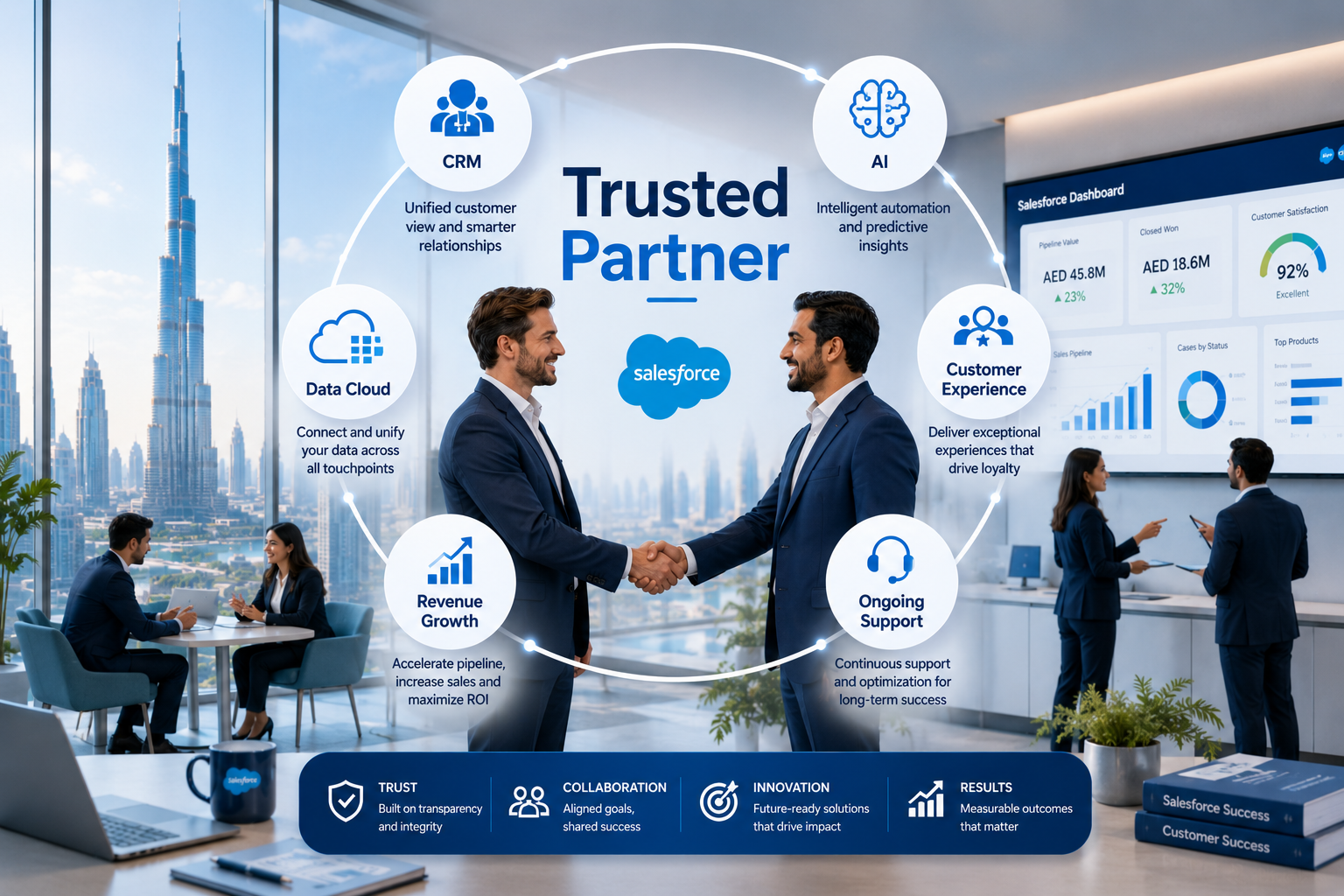
What Should a Good Salesforce Consulting Engagement in Dubai Look Like?
A high-quality Salesforce consulting engagement in the UAE follows a structured, transparent process:
| Phase | What Happens | What You Should See |
|---|---|---|
| Discovery | Business process mapping, requirements gathering, current system audit | Detailed discovery document; clear scope definition |
| Solution Design | Architecture decisions, integration mapping, data model design | Solution design document; approved before build begins |
| Build & Configuration | Salesforce configuration, custom development, integration setup | Sprint-based delivery with regular demos; not a single “big reveal” |
| Data Migration | Data audit, mapping, cleansing, test migration, validation | Signed-off data migration plan; test run completed before cutover |
| Testing | User acceptance testing (UAT), regression testing, performance testing | Formal UAT sign-off by your team before go-live |
| Training | Role-based training, admin training, adoption planning | Training materials and sandbox environment for practice |
| Go-Live & Hypercare | Staged or full cutover; intensive support in first 2–4 weeks | Dedicated support resource available during hypercare period |
| Ongoing Support | Managed service or retainer; continued optimisation | Defined SLA and named support contact in UAE timezone |
How Does WMS Dubai's Salesforce Consulting Service Work?
Understanding your business before recommending Salesforce configuration. Every WMS engagement begins with a structured discovery session because no two Dubai businesses have the same processes, compliance requirements, or growth trajectory.
Regional expertise embedded in every project. Our team delivers Salesforce solutions with UAE VAT compliance, PDPL data governance, Arabic language requirements, and GCC market integration built in from day one not retrofitted after go-live.
Long-term partnership, not a one-time project. Salesforce is a platform that evolves continuously. The businesses that get the most value from it have a consulting partner who stays engaged, optimises continuously, and brings new capabilities including Agentforce AI agents as the platform advances.
Explore all WMS Salesforce services from initial consulting and implementation through audit, managed services and Agentforce implementation on our Salesforce services overview page.
WMS Dubai brings UAE-specific Salesforce expertise across the full Salesforce platform from initial consulting and implementation through to ongoing managed support and audit services. Our consulting practice is built around three principles: wmsspl.com/salesforce-consulting-services/
To ensure seamless project governance, consult with an accredited SAP implementation partner in Dubai with proven regional experience.

Frequently Asked Questions (FAQs)
What does a Salesforce consulting partner do?
A Salesforce consulting partner helps businesses plan, implement, customize, integrate, and optimize Salesforce solutions. Their services typically include business process analysis, CRM strategy, system configuration, data migration, user training, third-party integrations, testing, and ongoing support. A good consulting partner ensures Salesforce aligns with your business goals and delivers measurable ROI.
How do I verify a Salesforce partner's tier and certifications?
You can verify a Salesforce partner by checking the official Salesforce Partner Finder or requesting the partner’s certification details directly. Review their partner tier, certified consultants, customer success stories, industry experience, and implementation portfolio. Certified professionals demonstrate expertise across Salesforce products and best practices.
What is the difference between a Ridge, Crest and Summit Salesforce partner?
Salesforce partner tiers reflect a partner’s expertise, customer success, and certified talent.
- Ridge Partner An emerging partner with growing Salesforce experience and certified professionals.
- Crest Partner A highly experienced partner with a proven delivery record, multiple certifications, and successful enterprise implementations.
- Summit Partner The highest Salesforce partner tier, awarded to firms with exceptional expertise, extensive certifications, large-scale project experience, and outstanding customer satisfaction.
The best choice depends on your project complexity, industry, and budget not just the partner tier.
How long does a Salesforce implementation take in Dubai?
Implementation timelines depend on project size and complexity.
- Small CRM deployment: 4–8 weeks
- Mid-sized implementation: 2–4 months
- Enterprise transformation with multiple integrations: 4–9 months or longer
Factors such as data migration, integrations, customization, testing, and user training significantly affect the timeline.
What is Agentforce and should my Dubai business use it?
Agentforce is Salesforce’s AI-powered platform for building autonomous AI agents that can assist customers and employees. These agents can answer questions, automate routine tasks, generate insights, and support sales and customer service operations.
Does my Salesforce implementation need to comply with UAE PDPL?
Yes. Businesses operating in the UAE should ensure their Salesforce implementation complies with the UAE Personal Data Protection Law (PDPL) and any applicable industry-specific regulations.
Compliance typically includes:
- Secure handling of personal data
- Appropriate user access controls
- Data retention policies
- Consent management where required
- Security monitoring and audit capabilities
Consulting with legal and compliance experts is recommended for regulated industries.
How much does a Salesforce implementation cost in Dubai?
The total cost varies based on licensing, customization, integrations, data migration, and ongoing support.
Typical implementation ranges include:
- Basic implementation: AED 20,000–60,000
- Mid-sized business implementation: AED 60,000–200,000
- Enterprise implementation: AED 200,000+
Request a detailed discovery session to receive an accurate project estimate based on your business requirements.
What post-go-live support should a Salesforce partner provide?
A reliable Salesforce partner should continue supporting your business after deployment with services such as:
- System monitoring and issue resolution
- User training and onboarding
- Performance optimization
- Feature enhancements
- Security updates
- Release management
- New Salesforce feature adoption
- Integration maintenance
- Data quality management
- Ongoing technical support through SLAs
Continuous support helps maximize user adoption and ensures your Salesforce platform evolves with your business needs.

Mahitab Maher
SAP professional specializing in SAP products, helping companies turn complex processes into smooth, scalable operations.


