
Last Updated 01/09/2026
Executive Summary
- Strategic Overview: Comprehensive guidance on sap business one in dubai – a complete guide for uae smes in 2026 tailored for Middle East and GCC enterprises.
- Key Advantage: Eliminates departmental silos, standardizes reporting, and accelerates operational agility.
- Next Step: Consult with certified WMS Middle East SAP experts for tailored architecture sizing and cost estimation.
The Document Problem No Enterprise Has Fully Solved
A document controller in a large enterprise receives a revised drawing at 11 PM. It is emailed to three departments. One person opens it, one forwards an older version to the site, and another sees the update only the next morning. By then, work has already started from the wrong file.
This is not just a document issue. It is a business process issue. Across oil and gas, construction, manufacturing, government, and financial services, large enterprises lose time, money, and control when documents live in email inboxes, shared drives, and paper files instead of inside governed business processes. SAP Document Management solves this by connecting documents directly to the transactions, assets, projects, and workflows they support — a capability that WMS helps enterprises deploy as part of a broader SAP ERP implementation.
Enterprises looking to fast-track their cloud adoption can leverage our 16-week SAP cloud migration roadmap for streamlined go-live execution.
What Is EDMS?

An Enterprise Document Management System (EDMS) is a central platform for storing, versioning, approving, distributing, and retaining business documents. In a large enterprise, an EDMS must do more than store files; it must link content to business objects, enforce version control, automate approvals, maintain audit trails, and support compliance across geographies and business units. According to Generis Corporation’s enterprise DMS research, the gap between document storage and document control is where most enterprise compliance risks live.
For large organizations in the GCC, this matters because document control is rarely centralized by default. Business units often use a mix of email, network drives, Microsoft tools, and paper-based approvals, which creates duplicate work and weak governance. A modern EDMS brings order to that chaos by giving teams a controlled, searchable, and auditable process — and when it is connected to SAP, it becomes a true operational tool rather than just a repository. To understand how this connects to broader enterprise transformation, see how WMS approaches SAP BTP digital services for integrated business automation.
Why Enterprises Still Struggle

The biggest problem is not lack of storage. It is lack of structure.
| Challenge | Root Cause | Business Impact |
|---|---|---|
| Multiple disconnected systems | Documents stored across email, shared drives, and paper | No single source of truth |
| Poor ERP integration | Files not linked to SAP transactions | Missing business context |
| Informal approvals | Decisions handled through email chains | No audit trail |
| Inconsistent metadata | Different departments use different naming rules | Search and retrieval failures |
| Decentralized access control | Weak governance of permissions | Security and compliance risk |
| Manual retention | No formal records lifecycle | Audit exposure |
These issues become more expensive as document volume grows. In large enterprises, the cost of finding, validating, and approving the right document often exceeds the cost of creating it in the first place. Aricoma’s practical guide to SAP DMS implementation highlights that most organizations underestimate process complexity when attempting to implement EDMS without proper change management.
How SAP EDMS Works
SAP treats document management as part of the business process, not as a separate file repository. SAP Document Management connects documents to SAP objects such as equipment, assets, purchase orders, work breakdown structures, production orders, and customer records. This is why organizations running SAP S/4HANA have a significant structural advantage — documents live inside the same system where work actually happens. For industries like oil and gas and EPC, this connection is especially critical; see how this plays out in our blog on SAP EPC project execution and progress monitoring.

UAE FTA E-Invoicing Phase Mandate Schedule
| Taxpayer Category | ASP Appointment Deadline | Mandatory Go-Live Date | Key ERP Requirement |
|---|---|---|---|
| Large Businesses (≥ AED 50M revenue) | October 30, 2026 | January 1, 2027 | Real-time transmission via SAP Integration Suite / ASP connector |
| SMEs (< AED 50M revenue) | March 31, 2027 | July 1, 2027 | Automated Peppol-compliant XML generation in SAP B1 / S/4HANA |
| Government Entities | March 31, 2027 | October 1, 2027 | Central government procurement & e-billing integration |
What Does SAP DMS Do?
SAP DMS is the native document management capability inside SAP S/4HANA. It supports version control, status management, check-in/check-out, and document linkage to SAP business objects. That makes it useful for organizations that need controlled document handling tightly embedded in SAP transactions. For enterprises already running SAP S/4HANA, enabling DMS is often a lower-effort path to structured document control than deploying a standalone EDMS. The SAP product page for Document Management outlines the full capability set and integration points.


When Is SAP xECM by OpenText Needed?
SAP Extended ECM by OpenText is the enterprise content management layer for larger, more complex environments. It adds process-centric collaboration, records management, business workspaces, enterprise archiving, and stronger handling of unstructured content like emails, scanned files, and correspondence. The SAP Extended ECM product page explains how xECM integrates natively with SAP Fiori, meaning users work with documents directly from the SAP interface without switching applications. For document-intensive sectors like oil and gas, WMS frequently recommends xECM as the foundation — the same capability that underpins our SAP document management solutions.

Where Does SAP BTP Fit?
SAP Document Management Service on SAP BTP is a cloud-based option for organizations that need API-driven document management, external collaboration, or hybrid integration across SAP and non-SAP environments. It offers repository services, integration APIs, and a reusable document layer for custom business applications. This is particularly relevant for GCC enterprises operating across joint ventures or multi-entity structures where documents must flow between organizations. To explore how SAP BTP enables broader enterprise automation, visit our page on SAP BTP and intelligent automation for GCC businesses.
UAE Regulatory Compliance: Corporate Tax (9%) & FTA E-Invoicing
- Mandatory 9% Tax Provisioning: Automated general ledger tax accounting and transfer pricing compliance in SAP.
- FTA Peppol Connector: Real-time digital invoice generation and cryptographic verification.
- Action: Contact WMS Middle East for a comprehensive UAE tax and e-invoicing readiness assessment.
Where EDMS Delivers the Most Value
Oil & Gas and EPC
EPC projects generate massive document volumes: drawings, transmittals, technical submittals, inspection reports, and handover records. SAP xECM and SAP DMS help keep that content attached to the right project, asset, or work package, which reduces errors and supports handover. According to EisenVault’s oil and gas document management research, the inability to trace document versions is one of the most common root causes of rework on construction and EPC sites. WMS’s experience in this space is reflected in our detailed blog on SAP EPC project execution.
Manufacturing
Manufacturing teams depend on quality records, inspection files, and production documentation. EDMS helps link quality documents to batches, equipment, and corrective actions, making compliance and traceability easier. When connected to SAP EAM, document management becomes part of the asset lifecycle — from commissioning records to ongoing maintenance history.
Government
Public sector organizations manage policies, approvals, contracts, and regulated records that must be retained properly. SAP EDMS gives them structure, permissions, and retention discipline. As Gulf governments accelerate digital transformation programs, integrated document control is increasingly a prerequisite for regulatory readiness. Read more on how WMS supports smart government digital services in the GCC.
Finance and Corporate Groups
Holding companies and financial institutions need secure control over contracts, board files, regulatory submissions, and legal documents. Business workspaces and records management from OpenText Content Management help bring those documents into one governed environment connected to SAP financial processes.
What a Phased Implementation Looks Like
| Phase | Focus | Outcome |
|---|---|---|
| Phase 1 | SAP DMS setup, taxonomy, metadata | Controlled document storage |
| Phase 2 | Approval workflows, notifications | Fewer manual follow-ups |
| Phase 3 | xECM or BTP expansion | Enterprise collaboration and records control |
| Phase 4 | Analytics and automation | Better governance and visibility |
A phased approach works best because it avoids disrupting every department at once. It also allows the organization to standardize document rules before opening the system to larger groups. SAP’s own BTP Document Management Service guide recommends aligning implementation phases with specific business process priorities rather than attempting a full rollout simultaneously.
Looking to implement or optimize this in Dubai or the UAE?
Speak with WMS Middle East certified SAP consultants for a customized architectural and cost assessment.
SAP Capabilities Mapped to EPC Project Phases
| EPC Phase | Primary SAP Capability | Key Business Outcome |
|---|---|---|
| FEED & Concept | SAP PS — WBS Setup, Baseline | Approved project structure and cost baseline |
| Detailed Engineering | SAP DMS / xECM by OpenText | Controlled document issue and revision management |
| Procurement | SAP PS + SAP MM integration | PO tracking against WBS, delivery milestone monitoring |
| Construction | SAP PS + SAP EAM + BTP Fiori | Real-time physical progress, asset master data build |
| Pre-commissioning | SAP EAM + SAP QM | Inspection lots, punch lists, and completion certificates |
| Commissioning | SAP EAM + SAP DMS | Work order execution, as-built documentation control |
| Handover to Operations | SAP EAM + SAP DMS | Clean asset handover with complete maintenance strategy |
Why This Matters for CIOs and Document Controllers
For CIOs, EDMS reduces risk, improves process control, and creates a stronger digital foundation for ERP and automation programs. For document controllers, it eliminates version confusion, speeds up retrieval, and replaces manual chasing with structured workflows. Together, these improvements directly support the kind of digital transformation outcomes that enterprise leadership teams are being held accountable for across the GCC.
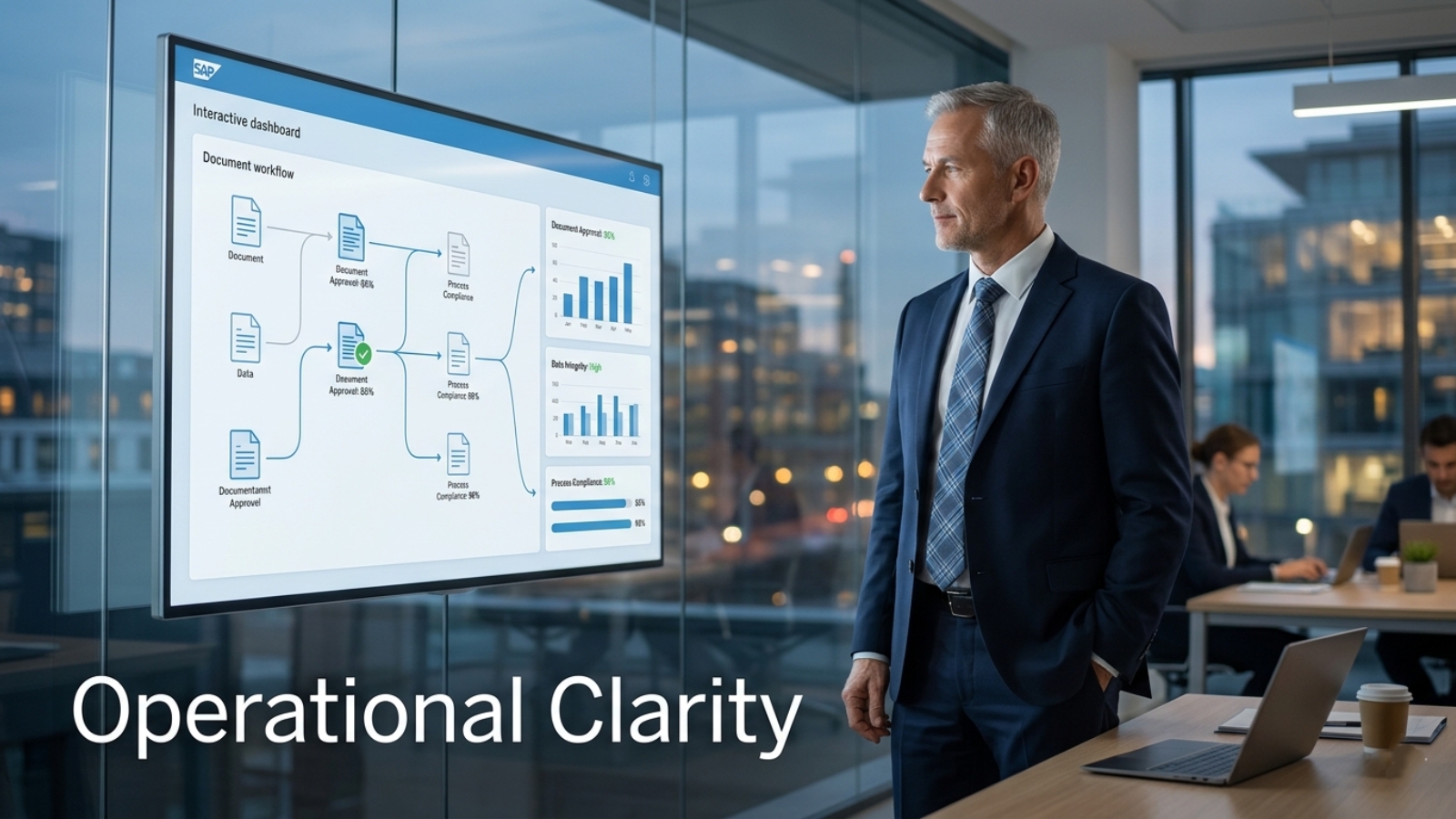
The real gain is not just digital storage. It is operational clarity. Once documents are tied to the right SAP process, people spend less time searching and more time executing.

Why WMS for SAP Document Management
WMS brings SAP implementation experience across document-intensive industries in the Middle East. The focus is not only on software configuration, but also on how document workflows actually operate inside enterprises: who creates, who reviews, who approves, and who must retain the record.
That matters because a good EDMS is shaped by process design as much as technology. A system that reflects real business control points becomes easier to adopt and far more valuable long term. Whether your organization is beginning with SAP DMS or expanding to full enterprise content management, WMS can help design the right architecture for your specific environment.
Ready to Digitize Your Document Processes?
If your enterprise still depends on email approvals, shared drives, and manual follow-ups, it may be time to move document control into the core of your SAP environment. A structured EDMS conversation can show where the fastest gains are possible and how to reduce risk without creating unnecessary complexity.
To ensure seamless project governance, consult with an accredited SAP implementation partner in Dubai with proven regional experience.
Frequently Asked Questions (FAQs)
What is the difference between SAP DMS and SAP xECM?
SAP DMS is the native document management layer inside SAP S/4HANA, handling structured documents linked to SAP business objects. SAP xECM by OpenText is the enterprise content management extension that adds business workspaces, records management, enterprise archiving, and deeper handling of unstructured content like emails and scanned files. The SAP Extended ECM product page details the full capability comparison.
Can SAP EDMS work in a hybrid environment?
Yes. SAP BTP Document Management Service is designed for cloud and hybrid environments and supports API-based integration with SAP and non-SAP applications. This makes it suitable for multi-entity GCC organizations. See how WMS implements SAP BTP solutions for these hybrid scenarios.
Why do large enterprises need EDMS if they already use SharePoint or shared drives?
General-purpose tools are good for collaboration, but they do not natively connect documents to SAP business objects, approval workflows, or audit trails. OpenText’s enterprise content management platform illustrates how deep SAP integration produces a fundamentally different level of document governance.
How does SAP help with version control?
SAP DMS and SAP xECM manage versioning, status control, and access permissions so teams always see the current approved document. This is explained in detail on the SAP Document Management product page.
Is SAP EDMS useful outside oil and gas?
Yes. It is widely relevant in manufacturing, government, finance, construction, healthcare, and any document-heavy enterprise with compliance needs. WMS has deployed EDMS solutions across multiple sectors — see our SAP EAM solutions page for asset management document integration examples.
Can external vendors or contractors access the system?
Yes, through controlled BTP-based portals or workspace access. SAP BTP’s document management APIs enable external parties to interact with the document repository without requiring full SAP licenses.
What makes SAP EDMS different from a generic DMS?
The key difference is process linkage. SAP EDMS attaches content to assets, projects, and transactions, giving documents business context. This is the same principle WMS applies across SAP project-based industry implementations.
Does SAP EDMS support compliance and records retention?
Yes. SAP xECM by OpenText includes records management and archiving capabilities that support retention policies and audit readiness. OpenText’s content management documentation covers the full records lifecycle management capability.
How should an enterprise begin an EDMS rollout?
Start with document taxonomy, metadata standards, and one critical business process such as contracts, project documents, or quality records, then expand in phases. Aricoma’s SAP DMS implementation guide provides a useful framework for planning the first phase.
Why should a CIO care about EDMS?
Because document control affects compliance, productivity, auditability, and the quality of digital transformation across the enterprise. CIOs leading SAP S/4HANA transformations increasingly recognize that ungoverned content is one of the largest hidden risks in any ERP-led programme.

Mahitab Maher
SAP professional specializing in SAP products, helping companies turn complex processes into smooth, scalable operations.
WMS is an SAP Gold Partner with deep implementation experience in SAP Document Management, SAP Extended ECM by OpenText, and SAP BTP across large enterprises in oil and gas, construction, manufacturing, and government sectors in the Middle East.


