


Last Updated 02/09/2026
Executive Summary
- Strategic Overview: Comprehensive guidance on how can data and sap transform enterprise risk management? tailored for Middle East and GCC enterprises.
- Key Advantage: Eliminates departmental silos, standardizes reporting, and accelerates operational agility.
- Next Step: Consult with certified WMS Middle East SAP experts for tailored architecture sizing and cost estimation.
Regulatory pressure is not easing. Across industries and geographies — from ZATCA compliance in Saudi Arabia to GST reconciliation mandates in India — enterprises face a growing list of obligations that require more than spreadsheets and manual audits to manage effectively.
At the same time, operational risk is more complex than ever. A single access control gap, an unmonitored segregation of duties conflict, or an undetected process deviation can result in financial penalties, audit findings, or reputational damage that takes years to recover from.
Enterprises looking to fast-track their cloud adoption can leverage our 16-week SAP cloud migration roadmap for streamlined go-live execution.
This is the business problem that SAP GRC — Governance, Risk, and Compliance — is purpose-built to solve. For enterprises already running SAP ERP or SAP S/4HANA, GRC is not an add-on; it is the control framework that makes your existing SAP investment genuinely resilient.
Who Is This Guide For?
This guide is written for:
- CFOs and Finance Heads dealing with audit findings or regulatory reporting pressures.
- CIOs and IT Managers looking to strengthen access governance across SAP landscapes.
- Compliance Officers responsible for internal controls and risk documentation.
- Risk Managers in manufacturing, distribution, banking, or public sector enterprises.
- SAP project leaders evaluating GRC implementation as part of an S/4HANA rollout.
Whether your organization is implementing SAP GRC for the first time or looking to upgrade an existing deployment, understanding the framework is the foundation for making it work.

What Is SAP GRC?

SAP GRC is an integrated suite of solutions within the SAP ecosystem designed to help organizations manage governance obligations, control enterprise risk, and ensure continuous regulatory compliance — all from within the same platform used to run their core business processes.
According to SAP, a GRC framework “integrates organisation-wide systems and processes to oversee all aspects of governance, enterprise risk management, and compliance.” When implemented well, it enables organizations to anticipate and respond to evolving risks rather than react to them after the fact.
The key distinction between SAP GRC and generic compliance tools is integration. Because GRC operates within the SAP environment, it has direct access to transaction data, user access logs, and process controls — which means risk detection is real-time, not retrospective.
The Core Modules of SAP GRC
SAP GRC is not a single product — it is a suite of modules, each addressing a specific dimension of the governance and compliance challenge.
| Module | Primary Function | Key Business Benefit |
|---|---|---|
| SAP Access Control | Manages user access rights and detects Segregation of Duties (SoD) conflicts | Eliminates unauthorized access risks before they become audit issues |
| SAP Process Control | Documents, tests, and monitors internal controls across business processes | Ensures consistent control execution and continuous compliance |
| SAP Risk Management | Identifies, assesses, and tracks enterprise-wide risks | Provides a structured risk register with real-time monitoring |
| SAP Audit Management | Automates audit planning, fieldwork, and reporting | Reduces audit cycle time and surfaces issues faster |
| SAP Fraud Management | Detects anomalies and irregular patterns using predictive analytics | Prevents financial fraud before it causes significant damage |
| SAP Global Trade Services | Manages export/import compliance and trade regulations | Reduces customs risk for multi-country operations |
For most mid-to-large enterprises, the three most critical modules for initial implementation are Access Control, Process Control, and Risk Management — which together address the majority of audit and compliance risk.
Looking to implement or optimize this in Dubai or the UAE?
Speak with WMS Middle East certified SAP consultants for a customized architectural and cost assessment.
How the Three GRC Pillars Work Together
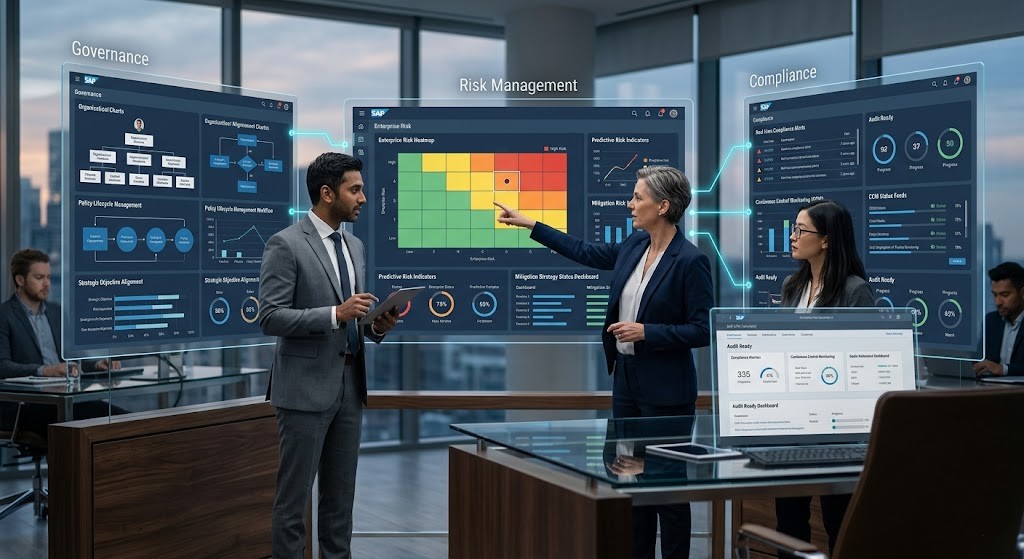
Governance: Defining Who Controls What
Governance within SAP GRC begins with access. SAP Access Control ensures that the right people have access to the right transactions — and only those transactions. It enforces Segregation of Duties rules automatically, preventing the same user from, for example, both creating and approving a purchase order. Role design, user provisioning, and access request workflows are all managed within this module, creating a documented, auditable governance trail.
Risk Management: Seeing Risk Before It Becomes Damage
SAP Risk Management provides the organizational layer for identifying and tracking risks across business units, processes, and geographies. Risk owners can document risk scenarios, assign likelihood and impact ratings, link risks to specific controls, and monitor status over time. The result is a live risk register — not a static document — that reflects the current state of the enterprise and informs decision-making at the leadership level. For a deep dive into how SAP Risk Management works — including KRI frameworks, Monte Carlo simulation and AI-driven risk detection — read our companion guide on how data and SAP transform enterprise risk management.
Compliance: Continuous, Not Periodic
The traditional approach to compliance — periodic audits, manual testing, spreadsheet-based documentation — is simply too slow for the regulatory environment enterprises face today. SAP Process Control changes this by enabling Continuous Control Monitoring (CCM), which automatically tests controls against live SAP data and generates real-time alerts when exceptions occur. Instead of discovering a control failure during an annual audit, organizations detect and remediate it within hours or days.

Why SAP GRC Has Become a Priority in 2026
- Regulatory complexity is increasing across every major market. India’s GST reconciliation requirements, Saudi Arabia’s ZATCA Phase 2 e-invoicing mandates, UAE VAT compliance, and Egypt’s e-invoicing regulations all require documented, auditable compliance processes that manual methods cannot sustain.
- SAP GRC 2026 has introduced a unified platform built on SAP HANA that merges risk management, process control, audit management, and access governance into a single harmonized environment — with embedded AI-driven insights for automated access reviews and smarter risk detection.
- Digital transformation is expanding the attack surface. As enterprises migrate to SAP S/4HANA and cloud environments, the number of users, integrations, and access points grows — increasing the need for automated governance controls. For a detailed breakdown of the specific cybersecurity threats this creates, read what are the real cybersecurity risks to SAP systems in 2026.
- Board-level accountability for risk and compliance is increasing. Regulators and investors expect organizations to demonstrate systematic, documented risk management — not just pass annual audits.

SAP GRC Implementation: A Phased Approach
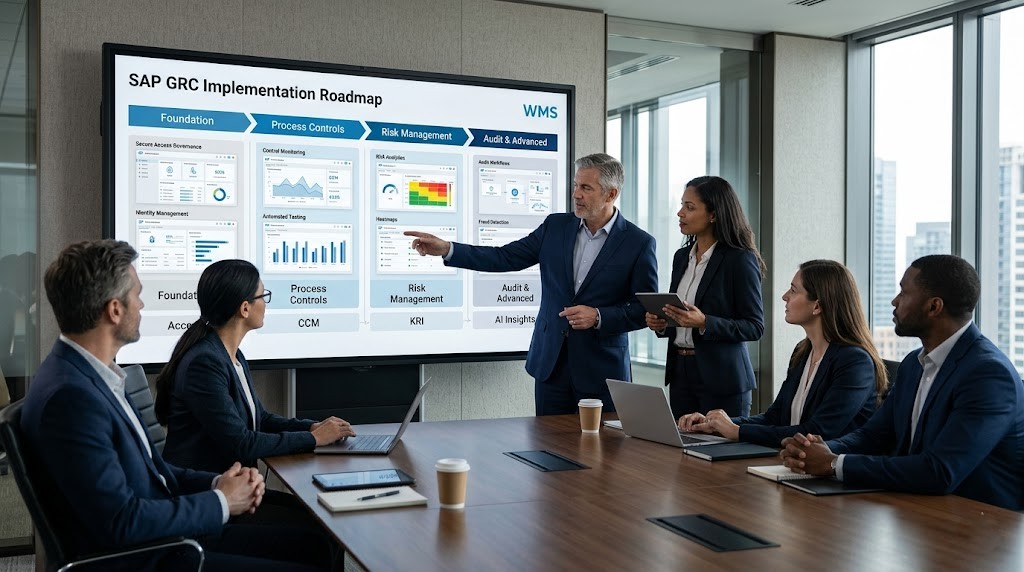
Successful SAP GRC implementations follow a structured phasing that matches organizational complexity and risk priorities.
| Phase | Focus | Deliverable |
|---|---|---|
| Phase 1: Foundation | Access Control — role design, SoD ruleset, user provisioning | Clean access landscape with documented role matrix |
| Phase 2: Process Controls | Process Control — control documentation, testing automation, CCM setup | Live control monitoring with exception reporting |
| Phase 3: Risk Management | Risk Management — risk register, risk owners, key risk indicators | Enterprise risk register with board-ready reporting |
| Phase 4: Audit & Advanced | Audit Management, Fraud Management, Global Trade Services | Fully integrated GRC suite with predictive risk capabilities |
Most enterprises see meaningful compliance improvement within the first two phases. Phasing also allows organizations to manage implementation cost and resource requirements without attempting to deploy the full suite simultaneously.
GRC Implementation in India and the Middle East

For enterprises operating across India, UAE, Saudi Arabia, and Egypt, SAP GRC implementation has a regional dimension that generic compliance tools cannot address.
- India: Multi-entity SAP environments must manage GST reconciliation, TDS compliance, and internal audit requirements across multiple legal entities and business units simultaneously.
- Saudi Arabia (KSA): ZATCA Phase 2 e-invoicing compliance requires real-time invoice validation and integration with SAP — making SAP GRC’s process control capabilities essential for companies that cannot afford compliance gaps.
- UAE: VAT compliance, free zone regulations, and multi-currency operations create a complex governance environment where SAP GRC provides the centralized control and reporting layer.
- Egypt: Multi-currency ERP environments with e-invoicing mandates benefit from SAP GRC’s integrated compliance management to handle the complexity of import/export documentation and tax reporting.
Enterprises with multi-country SAP footprints benefit most from SAP GRC precisely because it provides a single, integrated control environment across all jurisdictions — rather than requiring country-specific compliance tools that create information silos.
For the broader digital transformation context driving these compliance requirements across the region, read how Middle East enterprises are competing globally.
Common Mistakes Enterprises Make with SAP GRC
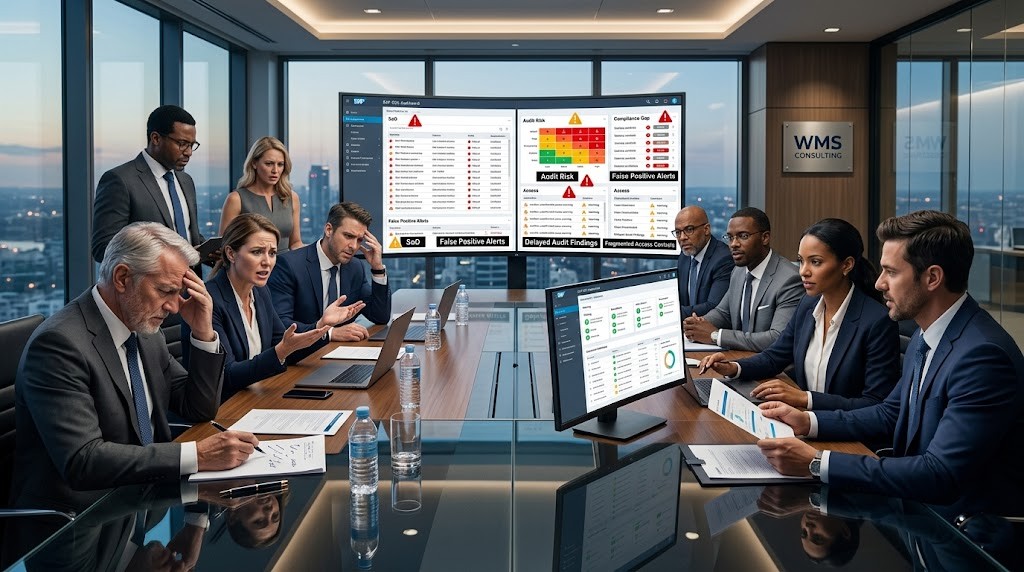
- Treating GRC as an IT project rather than a business risk initiative — leading to poor adoption by business users and compliance owners.
- Starting with an overly complex SoD ruleset that generates too many false positives and overwhelms the remediation team.
- Skipping the role redesign phase and trying to implement Access Control on top of poorly structured SAP roles.
- Underinvesting in training for risk and control owners, resulting in the system being maintained only by the IT team.
- Delaying implementation until after an audit finding — by which point the cost of remediation is significantly higher than preventive implementation would have been.
A qualified SAP GRC implementation partner helps enterprises avoid these mistakes by combining technical configuration expertise with an understanding of how GRC processes need to work at the business level.
How WMS Supports SAP GRC Implementation
WMS brings implementation experience across SAP GRC modules — including Access Control, Process Control, and Risk Management — with a track record across enterprise environments in India and the Middle East. Our approach is practical: we do not simply configure software; we align the GRC framework to how your organization actually manages risk and compliance, ensuring adoption, sustainability, and audit readiness.
If your organization is evaluating SAP GRC as part of an S/4HANA implementation, an audit response, or a proactive governance improvement programme, WMS can provide an honest assessment of where to start and how to build a roadmap that delivers results.
To ensure seamless project governance, consult with an accredited SAP implementation partner in Dubai with proven regional experience.

Frequently Asked Questions (FAQs)
What is SAP GRC?
SAP GRC (Governance, Risk, and Compliance) is an integrated suite of SAP solutions that helps enterprises manage access governance, internal controls, enterprise risk management, and regulatory compliance — all from within their existing SAP environment.
What are the core modules of SAP GRC?
The primary modules are SAP Access Control, SAP Process Control, SAP Risk Management, SAP Audit Management, SAP Fraud Management, and SAP Global Trade Services. Most enterprises begin with Access Control, Process Control, and Risk Management.
What is Segregation of Duties (SoD) in SAP GRC?
Segregation of Duties (SoD) is a control principle that prevents a single user from performing conflicting activities — such as creating and approving a payment. SAP Access Control automates SoD detection and enforces role-based access rules.
What is Continuous Control Monitoring in SAP GRC?
Continuous Control Monitoring (CCM) is a feature of SAP Process Control that automatically tests internal controls against live SAP data in real time. When a control exception occurs, it generates an alert — enabling immediate remediation rather than waiting for an audit.
How is SAP GRC different from generic compliance tools?
SAP GRC operates directly within the SAP ecosystem, giving it real-time access to transaction data, user logs, and process flows. This integration allows risk detection and compliance monitoring to happen continuously, unlike standalone compliance tools that require data exports.
Is SAP GRC relevant for mid-size enterprises?
Yes. While SAP GRC scales to large enterprises, mid-size companies on SAP Business One or SAP S/4HANA benefit significantly from Access Control and Process Control implementations — particularly in regulated industries or multi-entity environments.
How does SAP GRC support ZATCA compliance in Saudi Arabia?
SAP GRC’s Process Control and Audit Management modules help Saudi enterprises document and monitor their e-invoicing compliance controls, ensuring ZATCA Phase 2 requirements are met with auditable evidence and real-time exception alerts.
What is the SAP GRC 2026 update?
SAP GRC 2026 introduces a unified platform built on SAP HANA that merges risk management, process control, audit management, and access governance into a single environment — with embedded AI for automated access reviews and predictive risk detection.
How long does SAP GRC implementation take?
Implementation timelines vary by scope. Access Control typically takes 8–16 weeks for initial deployment. Full GRC suite implementations, including Process Control and Risk Management, typically run 6–12 months depending on organizational complexity.
How can WMS help with SAP GRC implementation?
WMS provides end-to-end SAP GRC implementation services — from access control and role design to process control setup and risk management configuration — with experience across enterprise environments in India and the Middle East. Contact WMS to discuss your requirements.

Mahitab Maher
SAP professional specializing in SAP products, helping companies turn complex processes into smooth, scalable operations.


